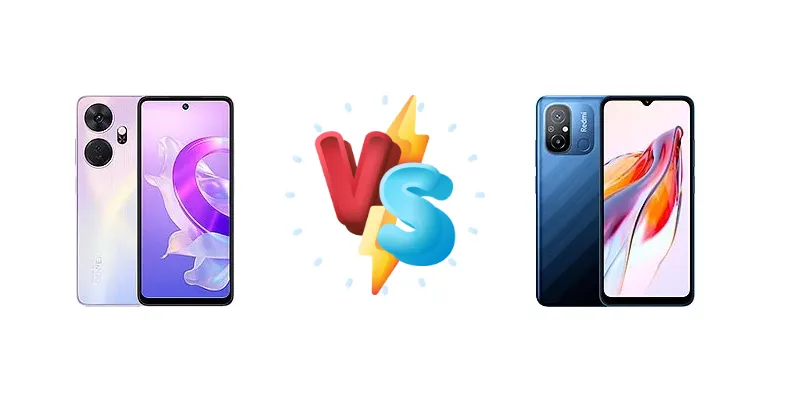
The sub-$150 smartphone market is fiercely competitive. The itel P55+ and Xiaomi Redmi 12C represent compelling options, but cater to slightly different priorities. The itel prioritizes rapid charging, while the Redmi 12C aims for a more robust gaming experience. This comparison dissects their key specifications to determine which device offers the best overall value.
🏆 Quick Verdict
For the average user prioritizing convenience and minimizing downtime, the itel P55+ is the better choice. Its 45W charging significantly reduces charging times, a crucial advantage for those constantly on the go. While the Redmi 12C offers a slightly more powerful processor, the difference isn't substantial enough to offset the charging disparity.
| Network |
|---|
| 2G bands | GSM 850 / 900 / 1800 / 1900 | GSM 850 / 900 / 1800 / 1900 |
| 3G bands | HSDPA 850 / 900 / 2100 | HSDPA 850 / 900 / 2100 |
| 4G bands | LTE | 1, 3, 5, 7, 8, 20, 28, 38, 40, 41 - International |
| Speed | HSPA, LTE | HSPA, LTE |
| Technology | GSM / HSPA / LTE | GSM / CDMA / HSPA / EVDO / LTE |
| | - | CDMA2000 1xEV-DO |
| Launch |
|---|
| Announced | 2024, January 26 | 2022, December 31 |
| Status | Available. Released 2024, February 13 | Available. Released 2023, January 01 |
| Body |
|---|
| Dimensions | 8.0 mm thickness | 168.8 x 76.4 x 8.8 mm (6.65 x 3.01 x 0.35 in) |
| SIM | Nano-SIM + Nano-SIM | Nano-SIM + Nano-SIM |
| Weight | 187 g (6.88 oz) | 192 g (6.77 oz) |
| Display |
|---|
| Resolution | 720 x 1612 pixels, 20:9 ratio (~267 ppi density) | 720 x 1650 pixels (~268 ppi density) |
| Size | 6.6 inches, 104.6 cm2 | 6.71 inches, 106.5 cm2 (~82.6% screen-to-body ratio) |
| Type | IPS LCD, 90Hz | IPS LCD, 500 nits (typ) |
| Platform |
|---|
| CPU | Octa-core (2x1.6 GHz Cortex-A75 & 6x1.6 GHz Cortex-A55) | Octa-core (2x2.0 GHz Cortex-A75 & 6x1.8 GHz Cortex-A55) |
| Chipset | Unisoc T606 (12 nm) | Mediatek MT6769Z Helio G85 (12 nm) |
| GPU | Mali-G57 MP1 | Mali-G52 MC2 |
| OS | Android 13 | Android 12, MIUI 13 |
| Memory |
|---|
| Card slot | microSDXC | microSDXC (dedicated slot) |
| Internal | 128GB 4GB RAM, 128GB 8GB RAM, 256GB 8GB RAM | 32GB 2GB RAM, 32GB 3GB RAM, 32GB 4GB RAM, 64GB 3GB RAM, 64GB 4GB RAM, 128GB 3GB RAM, 128GB 4GB RAM, 128GB 6GB RAM |
| | - | eMMC 5.1 |
| Main Camera |
|---|
| Dual | - | 50 MP, (wide), PDAF
0.08 MP (depth) |
| Features | Dual-LED flash, panorama | LED flash, HDR |
| Single | 50 MP
Auxiliary lens | 50 MP, f/1.8, (wide), 1/2.76", PDAF
Auxiliary lens |
| Video | Yes | 1080p@30fps |
| Selfie camera |
|---|
| Single | 8 MP | 5 MP, f/2.2, (wide) |
| Video | Yes | 1080p@30fps |
| Sound |
|---|
| 3.5mm jack | - | Yes |
| 35mm jack | Yes | Yes |
| Loudspeaker | Yes | Yes |
| Comms |
|---|
| Bluetooth | Yes | 5.1, A2DP, LE |
| NFC | Yes (market/region dependent) | Yes (market/region dependent) |
| Positioning | GPS | GPS, GLONASS, BDS, GALILEO |
| Radio | Unspecified | FM radio |
| USB | USB Type-C, OTG | microUSB 2.0 |
| WLAN | Yes | Wi-Fi 802.11 a/b/g/n/ac, dual-band, Wi-Fi Direct |
| Features |
|---|
| Sensors | Fingerprint (side-mounted); unspecified sensors | Fingerprint (rear-mounted), accelerometer |
| | - | Virtual proximity sensing |
| Battery |
|---|
| Charging | 45W wired, 70% in 30 min | 10W wired |
| Type | 5000 mAh | Li-Po 5000 mAh |
| Misc |
|---|
| Colors | Royal Green, Galaxy Blue, Meteor Purple | Graphite Gray, Ocean Blue, Mint Green, Lavender Purple |
| Models | P663LN, P663L | 22120RN86G, 22120RN86I, 22126RN91Y, 2212ARNC4L |
| Price | - | £ 132.99 / € 107.41 |
| SAR | - | 1.08 W/kg (head) 0.64 W/kg (body) |
| SAR EU | - | 0.98 W/kg (head) 0.99 W/kg (body) |
itel P55+
- Significantly faster 45W charging
- Potentially better power efficiency with Unisoc T606
- Competitive price point
- Slightly less powerful CPU than the Redmi 12C
- Camera performance likely similar to Redmi 12C
Xiaomi Redmi 12C
- More powerful Helio G85 processor for gaming
- Potentially better image processing
- Established brand reputation
- Extremely slow 10W charging
- May experience more thermal throttling under sustained load
- Battery life may be compromised due to less efficient charging
Display Comparison
Neither device boasts a standout display. Both utilize 12nm process technology, suggesting similar power efficiency in display operation. Detailed display specs (resolution, panel type, brightness) are missing, but given the price point, expect basic LCD panels. The focus here is on functionality rather than visual fidelity. Bezels are likely comparable, and color accuracy will be standard for this segment.
Camera Comparison
Camera performance is likely to be similar on both devices, relying heavily on software processing. Without sensor size or aperture information, it’s difficult to make a definitive judgment. Both manufacturers often include low-resolution auxiliary cameras (typically 2MP) for depth sensing or macro photography, which offer limited practical benefit. Image quality will be acceptable in good lighting conditions, but expect significant noise and detail loss in low light. The Redmi 12C *may* have a slight advantage due to MediaTek’s image signal processor (ISP), but this is speculative without further data.
Performance
The Xiaomi Redmi 12C’s MediaTek Helio G85 (2x2.0 GHz Cortex-A75 & 6x1.8 GHz Cortex-A55) holds a slight edge over the itel P55+'s Unisoc T606 (2x1.6 GHz Cortex-A75 & 6x1.6 GHz Cortex-A55) in raw CPU clock speed. The 0.2 GHz difference in the Cortex-A75 cores, while seemingly small, translates to a potentially noticeable performance boost in CPU-intensive tasks and gaming. However, the Unisoc T606 benefits from a newer architecture, potentially offering improved efficiency. The Redmi 12C is likely to handle graphically demanding games slightly better, but both phones will struggle with titles at maximum settings. RAM configurations are crucial here, and missing from the provided data; faster LPDDR4X or LPDDR5 RAM would benefit the Redmi 12C more given its processing power.
Battery Life
The itel P55+’s 45W wired charging is its standout feature. Achieving 70% charge in 30 minutes is a significant advantage over the Redmi 12C’s 10W charging. While battery capacity isn’t specified, the faster charging speed mitigates the impact of a potentially smaller battery. The Redmi 12C will require considerably longer to fully charge, making it less convenient for users who need a quick power boost. The difference in charging speed is the most impactful distinction between these two devices.
Buying Guide
Buy the itel P55+ if you need a phone that can quickly top up its battery, minimizing interruptions during your day. This is ideal for users who frequently travel or have limited access to power outlets. Buy the Xiaomi Redmi 12C if you prioritize occasional gaming and demand a bit more processing power for multitasking, and are willing to accept slower charging speeds.
Frequently Asked Questions
❓ How long will it take to fully charge the itel P55+ from 0%?
While it reaches 70% in 30 minutes, a full charge will likely take around 60-75 minutes with the 45W charger. This is still significantly faster than the Redmi 12C.
❓ Can the Xiaomi Redmi 12C run PUBG Mobile smoothly?
The Helio G85 can handle PUBG Mobile, but you'll likely need to use low to medium graphics settings to maintain a stable frame rate. Expect some occasional stuttering during intense firefights.
❓ Is the Unisoc T606 chipset in the itel P55+ a reliable performer?
The Unisoc T606 is a capable chipset for everyday tasks like browsing, social media, and light gaming. It's not a powerhouse, but it offers a good balance of performance and efficiency for its price range.
❓ Does either phone support fast charging protocols beyond their advertised wattage (e.g., Power Delivery)?
Neither manufacturer explicitly advertises support for advanced fast charging protocols like Power Delivery. Expect the charging speeds to be limited to their respective 45W and 10W capabilities.