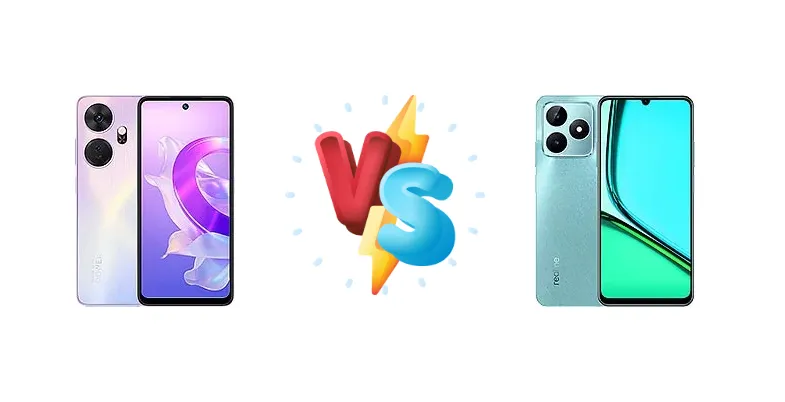
The itel P55+ and Realme C51s represent the fiercely competitive sub-$150 smartphone market. Both devices leverage Unisoc chipsets to deliver essential functionality, but subtle differences in processing power and charging capabilities could make one a better fit for your needs. This comparison dissects those differences, focusing on real-world performance implications.
🏆 Quick Verdict
For the average user prioritizing slightly faster performance and a marginally quicker charge, the Realme C51s is the better choice. Its Unisoc Tiger T612 offers a small but noticeable CPU clock speed advantage. However, the itel P55+’s 45W charging is a strong contender, making it a viable option for those who value rapid power-ups.
| Network |
|---|
| 2G bands | GSM 850 / 900 / 1800 / 1900 | GSM 850 / 900 / 1800 / 1900 |
| 3G bands | HSDPA 850 / 900 / 2100 | HSDPA 900 / 2100 |
| 4G bands | LTE | 1, 3, 5, 8, 38, 40 |
| Speed | HSPA, LTE | HSPA, LTE |
| Technology | GSM / HSPA / LTE | GSM / HSPA / LTE |
| Launch |
|---|
| Announced | 2024, January 26 | 2024, March 15 |
| Status | Available. Released 2024, February 13 | Available. Released 2024, March 15 |
| Body |
|---|
| Build | - | Glass front, plastic frame, plastic back |
| Dimensions | 8.0 mm thickness | 167.2 x 76.7 x 7.5 mm (6.58 x 3.02 x 0.30 in) |
| SIM | Nano-SIM + Nano-SIM | Nano-SIM + Nano-SIM |
| Weight | 187 g (6.88 oz) | 182 g (6.42 oz) |
| Display |
|---|
| Resolution | 720 x 1612 pixels, 20:9 ratio (~267 ppi density) | 720 x 1600 pixels, 20:9 ratio (~260 ppi density) |
| Size | 6.6 inches, 104.6 cm2 | 6.74 inches, 109.7 cm2 (~85.5% screen-to-body ratio) |
| Type | IPS LCD, 90Hz | IPS LCD, 90Hz, 560 nits (peak) |
| Platform |
|---|
| CPU | Octa-core (2x1.6 GHz Cortex-A75 & 6x1.6 GHz Cortex-A55) | Octa-core (2x1.8 GHz Cortex-A75 & 6x1.8 GHz Cortex-A55) |
| Chipset | Unisoc T606 (12 nm) | Unisoc Tiger T612 (12 nm) |
| GPU | Mali-G57 MP1 | Mali-G57 |
| OS | Android 13 | Android 13, Realme UI |
| Memory |
|---|
| Card slot | microSDXC | microSDXC (dedicated slot) |
| Internal | 128GB 4GB RAM, 128GB 8GB RAM, 256GB 8GB RAM | 128GB 6GB RAM |
| Main Camera |
|---|
| Features | Dual-LED flash, panorama | LED flash, HDR, panorama |
| Single | 50 MP
Auxiliary lens | 50 MP, f/1.8, 27mm (wide), 1/2.76", 0.64µm, PDAF
Auxiliary lens |
| Video | Yes | 1080p@30fps |
| Selfie camera |
|---|
| Features | - | HDR |
| Single | 8 MP | 5 MP, f/2.2, 28mm (wide), 1/5.0", 1.12µm |
| Video | Yes | 720p@30fps |
| Sound |
|---|
| 35mm jack | Yes | Yes |
| Loudspeaker | Yes | Yes |
| Comms |
|---|
| Bluetooth | Yes | 5.0, A2DP, LE |
| NFC | Yes (market/region dependent) | Yes, 360˚ (market/region dependent) |
| Positioning | GPS | GPS, GLONASS, GALILEO |
| Radio | Unspecified | Unspecified |
| USB | USB Type-C, OTG | USB Type-C |
| WLAN | Yes | Wi-Fi 802.11 a/b/g/n/ac, dual-band |
| Features |
|---|
| Sensors | Fingerprint (side-mounted); unspecified sensors | Fingerprint (side-mounted), accelerometer, gyro, proximity, compass |
| Battery |
|---|
| Charging | 45W wired, 70% in 30 min | 33W wired, 0-50% in 28 min |
| Type | 5000 mAh | 5000 mAh |
| Misc |
|---|
| Colors | Royal Green, Galaxy Blue, Meteor Purple | Shiny Green, Mighty Black |
| Models | P663LN, P663L | RMX3765 |
| Price | - | About 100 EUR |
itel P55+
- Faster 45W wired charging
- Potentially better battery turnaround time
- Competitive price point
- Slightly slower processor than the Realme C51s
- Limited information on display quality
Realme C51s
- Slightly faster CPU clock speeds
- More responsive app loading and multitasking
- Competitive price point
- Slower 33W wired charging
- Limited information on display quality
Display Comparison
Neither itel nor Realme provide display specifications beyond the basic resolution. Given the price point, both likely utilize LCD panels. The absence of details like peak brightness or color gamut suggests a focus on cost reduction. Bezels are expected to be substantial on both devices, and color accuracy will likely be standard for this segment. Without further data, a clear winner is impossible to determine.
Camera Comparison
Both phones are expected to feature basic camera setups geared towards casual photography. Without sensor size or aperture information, it’s difficult to make a meaningful comparison. The inclusion of a 2MP macro camera on both devices is largely a marketing tactic, offering limited practical benefit due to the small sensor size and lack of optical image stabilization (OIS). Image processing will likely be heavily reliant on software algorithms to enhance detail and dynamic range, but don't expect flagship-level results. The primary camera's megapixel count is less important than sensor size and lens quality, both of which are currently unknown.
Performance
The Realme C51s edges out the itel P55+ in processing power thanks to its Unisoc Tiger T612. While both chipsets are 12nm, the T612 boasts a 1.8 GHz clock speed on its Cortex-A75 cores, compared to the itel’s 1.6 GHz. This 200 MHz difference, coupled with a similar clock speed on the Cortex-A55 cores, translates to snappier app launches and smoother multitasking. However, the real-world difference will be subtle for basic tasks. Both phones will likely be paired with LPDDR4X RAM, limiting overall memory bandwidth. Thermal management is also a question mark; neither manufacturer details cooling solutions, suggesting passive cooling will be the norm, potentially leading to throttling under sustained load.
Battery Life
The itel P55+’s 45W wired charging is a significant advantage over the Realme C51s’s 33W. While the Realme claims 0-50% in 28 minutes, the itel boasts 70% in 30 minutes. This suggests a faster overall charge time for the itel, even considering the difference in percentage points. Battery capacity is not specified for either device, but given the segment, it's likely around 5000mAh. The faster charging of the itel P55+ mitigates the impact of a potentially smaller battery, allowing for quicker top-ups throughout the day.
Buying Guide
Buy the itel P55+ if you prioritize maximizing charging speed and are comfortable with a slightly less powerful processor for everyday tasks. This phone suits users who frequently find themselves needing to top up their battery quickly. Buy the Realme C51s if you prefer a small performance boost in app loading and multitasking, and are willing to trade a bit of charging speed for that extra responsiveness. This is ideal for users who engage in light gaming or frequently switch between applications.
Frequently Asked Questions
❓ Will the Unisoc T612 in the Realme C51s handle popular games like PUBG Mobile?
The Unisoc T612 can run PUBG Mobile, but expect to play at lower graphics settings (Balanced or Low) to maintain a stable frame rate. The chipset isn't designed for demanding gaming, and prolonged sessions may result in some thermal throttling. The itel P55+ will offer a similar gaming experience.
❓ How long does it *really* take to fully charge the itel P55+ with the 45W charger?
While itel claims 70% charge in 30 minutes, a full 0-100% charge will likely take around 60-75 minutes. The charging rate typically slows down as the battery approaches full capacity to protect battery health. This is still significantly faster than the Realme C51s.
❓ Is the difference in CPU clock speed between the T606 and T612 noticeable in everyday use?
The 200 MHz difference in CPU clock speed is subtle but present. You'll likely notice it in app loading times and when multitasking between several applications. The Realme C51s will feel slightly more responsive in these scenarios, but for basic tasks like browsing and social media, the difference will be minimal.