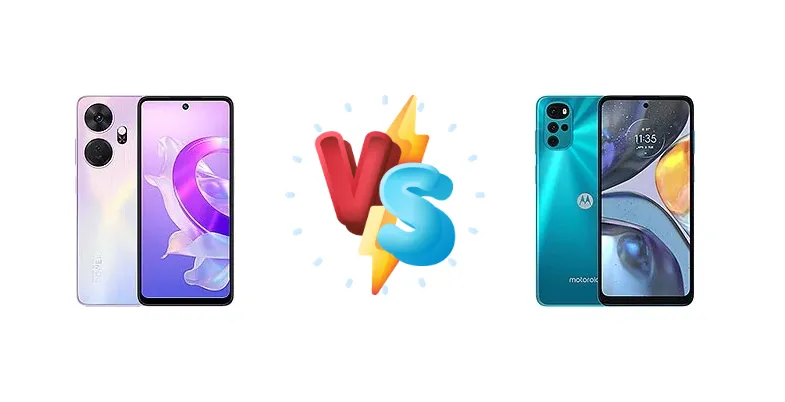
The sub-$150 smartphone market is fiercely competitive. The itel P55+ and Motorola Moto G22 both aim to deliver essential features at an accessible price point, but they take different approaches. The itel prioritizes rapid charging, while the Motorola focuses on a slightly more powerful, though less efficient, processor. This comparison dissects their key differences to help you choose the best fit for your needs.
🏆 Quick Verdict
For the average user prioritizing quick top-ups and decent all-day battery life, the itel P55+ is the stronger choice. Its 45W charging significantly outperforms the Moto G22’s 15/20W, and the Unisoc T606 provides adequate performance for everyday tasks. The Moto G22 is a viable option for those who prioritize slightly higher CPU clock speeds, but at the cost of slower charging.
| Network |
|---|
| 2G bands | GSM 850 / 900 / 1800 / 1900 | GSM 850 / 900 / 1800 / 1900 |
| 3G bands | HSDPA 850 / 900 / 2100 | HSDPA 850 / 900 / 1900 / 2100 |
| 4G bands | LTE | 1, 3, 5, 7, 8, 20, 38, 40, 41 |
| Speed | HSPA, LTE | HSPA 42.2/5.76 Mbps, LTE Cat4 150/50 Mbps |
| Technology | GSM / HSPA / LTE | GSM / HSPA / LTE |
| Launch |
|---|
| Announced | 2024, January 26 | 2022, March 04 |
| Status | Available. Released 2024, February 13 | Available. Released 2022, March 04 |
| Body |
|---|
| Build | - | Glass front, plastic frame, plastic back |
| Dimensions | 8.0 mm thickness | 164 x 75 x 8.5 mm (6.46 x 2.95 x 0.33 in) |
| SIM | Nano-SIM + Nano-SIM | · Nano-SIM· Nano-SIM + Nano-SIM |
| Weight | 187 g (6.88 oz) | 185 g (6.53 oz) |
| | - | Water-repellent design |
| Display |
|---|
| Resolution | 720 x 1612 pixels, 20:9 ratio (~267 ppi density) | 720 x 1600 pixels, 20:9 ratio (~268 ppi density) |
| Size | 6.6 inches, 104.6 cm2 | 6.5 inches, 103.5 cm2 (~84.2% screen-to-body ratio) |
| Type | IPS LCD, 90Hz | IPS LCD, 90Hz |
| Platform |
|---|
| CPU | Octa-core (2x1.6 GHz Cortex-A75 & 6x1.6 GHz Cortex-A55) | Octa-core (4x2.3 GHz Cortex-A53 & 4x1.8 GHz Cortex-A53) |
| Chipset | Unisoc T606 (12 nm) | Mediatek MT6765V/CB Helio G37 (12 nm) |
| GPU | Mali-G57 MP1 | PowerVR GE8320 |
| OS | Android 13 | Android 12 |
| Memory |
|---|
| Card slot | microSDXC | microSDXC (dedicated slot) |
| Internal | 128GB 4GB RAM, 128GB 8GB RAM, 256GB 8GB RAM | 64GB 4GB RAM, 128GB 4GB RAM |
| Main Camera |
|---|
| Features | Dual-LED flash, panorama | LED flash, HDR, panorama |
| Quad | - | 50 MP, f/1.8, (wide), 0.64µm, PDAF
8 MP, f/2.2, 118˚ (ultrawide), 1/4.0", 1.12µm
2 MP (macro)
Auxiliary lens |
| Single | 50 MP
Auxiliary lens | - |
| Video | Yes | 1080p@30fps |
| Selfie camera |
|---|
| Features | - | HDR |
| Single | 8 MP | 16 MP, f/2.5, (wide), 1.0µm |
| Video | Yes | 1080p@30fps |
| Sound |
|---|
| 3.5mm jack | - | Yes |
| 35mm jack | Yes | Yes |
| Loudspeaker | Yes | Yes |
| Comms |
|---|
| Bluetooth | Yes | 5.0, A2DP, LE |
| NFC | Yes (market/region dependent) | Yes (market/region dependent) |
| Positioning | GPS | GPS, GLONASS, GALILEO |
| Radio | Unspecified | Unspecified |
| USB | USB Type-C, OTG | USB Type-C 2.0 |
| WLAN | Yes | Wi-Fi 802.11 a/b/g/n/ac, dual-band, Wi-Fi Direct |
| Features |
|---|
| Sensors | Fingerprint (side-mounted); unspecified sensors | Fingerprint (side-mounted), accelerometer, gyro, proximity, compass |
| Battery |
|---|
| Charging | 45W wired, 70% in 30 min | 20W wired (India)
15W wired (Global) |
| Type | 5000 mAh | Li-Po 5000 mAh |
| Misc |
|---|
| Colors | Royal Green, Galaxy Blue, Meteor Purple | Pearl White, Iceberg Blue, Cosmic Black, Mint Green |
| Models | P663LN, P663L | XT2231-1, XT2231-2, XT2231-5 |
| Price | - | About 120 EUR |
itel P55+
- Significantly faster 45W charging
- More efficient processor (Unisoc T606)
- Potentially better sustained performance due to A75 cores
- Potentially lower peak CPU performance compared to Helio G37
- Camera specs are unknown
Motorola Moto G22
- Higher CPU clock speeds (Helio G37)
- Potentially more responsive for basic tasks
- Established brand recognition (Motorola)
- Significantly slower charging (15W/20W)
- Less efficient processor (Helio G37)
- Potentially more thermal throttling under load
Display Comparison
Neither device boasts a standout display. Both utilize 12nm chipsets, suggesting similar power constraints impacting display capabilities. While specific display specs (resolution, panel type) are missing, the focus here is on performance. The absence of high refresh rates on either device indicates a cost-saving measure, prioritizing battery life over visual fluidity. Bezels are likely comparable, given the price bracket, and color accuracy will likely be standard for this segment.
Camera Comparison
Detailed camera specs are unavailable, but it's safe to assume both phones feature a multi-camera setup with a primary sensor and supporting lenses (likely including a depth or macro sensor). Given the price point, image processing will be heavily reliant on software algorithms. The absence of OIS (Optical Image Stabilization) on either device suggests low-light performance will be a weakness. The quality will likely hinge on the primary sensor's resolution and aperture, but without that data, it's difficult to declare a clear winner. We can assume both will struggle in challenging lighting conditions.
Performance
The core difference lies in the chipsets. The itel P55+ features the Unisoc T606, an octa-core processor with a heterogeneous architecture – 2x 1.6 GHz Cortex-A75 cores for performance and 6x 1.6 GHz Cortex-A55 cores for efficiency. The Motorola Moto G22 uses the MediaTek Helio G37, also octa-core, but with a less efficient configuration: 4x 2.3 GHz Cortex-A53 and 4x 1.8 GHz Cortex-A53. While the Helio G37’s higher clock speeds *suggest* better single-core performance, the older Cortex-A53 architecture is less efficient than the A75 cores in the Unisoc chip. This means the itel P55+ will likely offer better sustained performance under load and potentially better thermal management. The Unisoc T606’s architecture is more modern, offering a better balance between power and efficiency, making it better suited for longer gaming sessions or multitasking.
Battery Life
The itel P55+’s 45W wired charging is a significant advantage. It claims 70% charge in 30 minutes, a substantial improvement over the Motorola Moto G22’s 20W (India) or 15W (Global) charging. While battery capacity isn’t specified, the faster charging allows for quicker top-ups, mitigating the impact of a potentially smaller battery. The Motorola’s slower charging means longer periods tethered to a power outlet, a significant inconvenience for users on the go. The Unisoc T606’s efficiency also contributes to potentially better battery life, even with a similar capacity to the Moto G22.
Buying Guide
Buy the itel P55+ if you need a phone that can quickly recover from heavy usage thanks to its 45W charging, and you value long-term battery health. Buy the Motorola Moto G22 if you prefer a slightly more responsive experience in CPU-intensive tasks, and are willing to accept significantly slower charging speeds and potentially more frequent charging cycles.
Frequently Asked Questions
❓ How much faster is the 45W charging on the itel P55+ compared to the Motorola Moto G22?
The itel P55+ charges at 45W, claiming 70% in 30 minutes. The Moto G22 charges at 15W (Global) or 20W (India). This means the itel P55+ will likely fully charge in under an hour, while the Moto G22 could take over 2 hours, depending on battery capacity. This difference is substantial for users who frequently need to top up their phone quickly.
❓ Will the Unisoc T606 in the itel P55+ struggle with demanding games?
While not a gaming powerhouse, the Unisoc T606’s Cortex-A75 cores provide a performance boost over the Moto G22’s Cortex-A53 cores. It will handle most casual games adequately. However, for graphically intensive titles, you’ll likely need to lower settings to maintain a playable frame rate. The more efficient architecture also means less thermal throttling during extended gaming sessions.
❓ Is the Motorola Moto G22 a better choice for someone who primarily uses their phone for calls, texts, and social media?
The Motorola Moto G22 is *sufficient* for those basic tasks, and its slightly higher CPU clock speeds might offer a marginally snappier experience when switching between apps. However, the itel P55+’s faster charging and potentially better battery life make it a more practical choice even for light users, as it reduces the need for frequent charging.