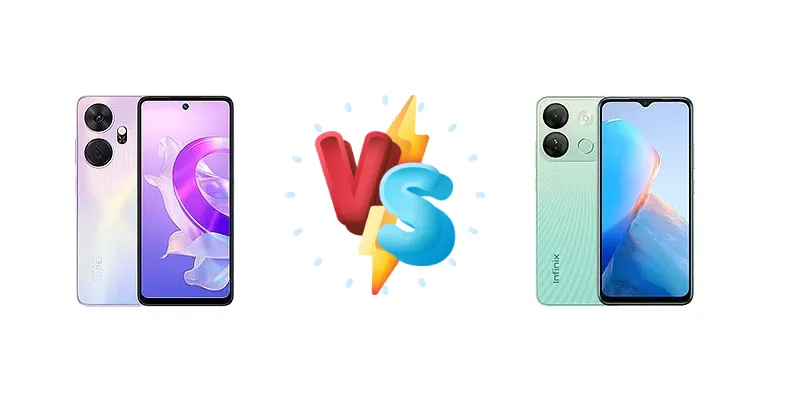
The sub-$150 smartphone market is fiercely competitive. Both the itel P55+ and the Infinix Smart 7 HD aim to deliver essential smartphone functionality at an accessible price point. However, they take different approaches: the itel P55+ prioritizes faster charging and a more recent chipset, while the Infinix Smart 7 HD focuses on affordability. This comparison will dissect their key specifications to determine which device offers the best value.
🏆 Quick Verdict
For most users, the itel P55+ is the better choice. Its Unisoc T606 chipset provides a noticeable performance edge over the Infinix Smart 7 HD’s unspecified CPU, and the 45W charging is a game-changer for convenience. While the Infinix Smart 7 HD is cheaper, the itel P55+'s benefits justify the price difference.
| Network |
|---|
| 2G bands | GSM 850 / 900 / 1800 / 1900 | GSM 850 / 900 / 1800 / 1900 |
| 3G bands | HSDPA 850 / 900 / 2100 | HSDPA 850 / 900 / 2100 |
| 4G bands | LTE | 1, 3, 5, 8, 38, 40, 41 |
| Speed | HSPA, LTE | HSPA, LTE |
| Technology | GSM / HSPA / LTE | GSM / HSPA / LTE |
| | - | 1, 2, 3, 4, 5, 7, 8, 20, 28, 38, 40, 41 |
| Launch |
|---|
| Announced | 2024, January 26 | 2023, April 14 |
| Status | Available. Released 2024, February 13 | Available. Released 2023, April 14 |
| Body |
|---|
| Build | - | Glass front, plastic back, plastic frame |
| Dimensions | 8.0 mm thickness | 163.9 x 75.5 x 8.7 mm (6.45 x 2.97 x 0.34 in) |
| SIM | Nano-SIM + Nano-SIM | Nano-SIM + Nano-SIM |
| Weight | 187 g (6.88 oz) | 196.5 g (6.95 oz) |
| Display |
|---|
| Resolution | 720 x 1612 pixels, 20:9 ratio (~267 ppi density) | 720 x 1612 pixels, 20:9 ratio (~267 ppi density) |
| Size | 6.6 inches, 104.6 cm2 | 6.6 inches, 104.6 cm2 (~84.6% screen-to-body ratio) |
| Type | IPS LCD, 90Hz | IPS LCD, 500 nits |
| Platform |
|---|
| CPU | Octa-core (2x1.6 GHz Cortex-A75 & 6x1.6 GHz Cortex-A55) | Octa-core 1.6 GHz |
| Chipset | Unisoc T606 (12 nm) | - |
| GPU | Mali-G57 MP1 | - |
| OS | Android 13 | Android 12 (Go edition) |
| Memory |
|---|
| Card slot | microSDXC | microSDXC (dedicated slot) |
| Internal | 128GB 4GB RAM, 128GB 8GB RAM, 256GB 8GB RAM | 64GB 2GB RAM |
| | - | UFS 2.1 |
| Main Camera |
|---|
| Dual | - | 8 MP, f/2.0
0.08 MP, (depth) |
| Features | Dual-LED flash, panorama | Dual-LED flash, HDR, panorama |
| Single | 50 MP
Auxiliary lens | 8 MP, f/2.0
Auxiliary lens |
| Video | Yes | 1080p@30fps |
| Selfie camera |
|---|
| Features | - | LED flash |
| Single | 8 MP | 5 MP, f/2.0 |
| Video | Yes | 720p@30fps |
| Sound |
|---|
| 3.5mm jack | - | Yes |
| 35mm jack | Yes | Yes |
| Loudspeaker | Yes | Yes |
| Comms |
|---|
| Bluetooth | Yes | 5.0, A2DP, LE |
| NFC | Yes (market/region dependent) | No |
| Positioning | GPS | GPS |
| Radio | Unspecified | FM radio |
| USB | USB Type-C, OTG | microUSB 2.0, OTG |
| WLAN | Yes | Wi-Fi 802.11 b/g/n |
| Features |
|---|
| Sensors | Fingerprint (side-mounted); unspecified sensors | Fingerprint (rear-mounted), accelerometer, proximity |
| Battery |
|---|
| Charging | 45W wired, 70% in 30 min | 10W wired |
| Type | 5000 mAh | 5000 mAh |
| Misc |
|---|
| Colors | Royal Green, Galaxy Blue, Meteor Purple | Ink Black, Silk Blue, Jade White, Green Apple |
| Models | P663LN, P663L | X6516 |
| Price | - | About 110 EUR |
itel P55+
- Significantly faster 45W charging
- More powerful Unisoc T606 chipset
- Potentially smoother multitasking experience
- Likely a slightly higher price point
- Limited information on display quality
Infinix Smart 7 HD
- More affordable price
- Acceptable for basic smartphone tasks
- Simple and easy to use
- Slow 10W charging
- Less powerful processor
- Potentially sluggish performance
Display Comparison
Neither itel nor Infinix provide detailed display specifications beyond the basic resolution. However, the focus here isn't on display quality; it's on the overall user experience. Given the price bracket, both likely utilize IPS LCD panels. The absence of information regarding peak brightness or color gamut suggests neither phone will excel in outdoor visibility or color accuracy. The real difference lies elsewhere.
Camera Comparison
Both phones likely feature basic camera setups geared towards casual photography. Without detailed sensor information, it’s difficult to make a definitive judgment. However, the market segment suggests both will rely on lower-resolution sensors. Focusing on megapixel counts alone is misleading; sensor size and image processing are far more critical. It's safe to assume image quality will be adequate for social media sharing but won't compete with higher-end smartphones. The absence of OIS on either device means low-light performance will be limited.
Performance
The itel P55+ features the Unisoc T606, a 12nm octa-core processor with a heterogeneous core configuration (2x1.6 GHz Cortex-A75 & 6x1.6 GHz Cortex-A55). This architecture provides a significant advantage over the Infinix Smart 7 HD’s unspecified octa-core CPU clocked at 1.6 GHz. The Cortex-A75 cores in the Unisoc T606 offer substantially higher single-core performance, translating to snappier app launches and smoother multitasking. While both are entry-level chips, the T606’s design allows for a more responsive user experience. The lack of RAM specifications for both devices makes it difficult to assess multitasking capabilities fully, but the chipset difference is a clear win for the itel P55+.
Battery Life
The itel P55+’s 45W wired charging is its standout feature. The claim of reaching 70% charge in 30 minutes is a significant advantage over the Infinix Smart 7 HD’s slow 10W charging. While battery capacity isn’t specified for either device, the faster charging speed of the itel P55+ mitigates the impact of a potentially smaller battery. Users who frequently find themselves needing a quick power boost will greatly appreciate this feature. The 10W charging on the Infinix Smart 7 HD will require significantly longer to reach a full charge, making it less convenient for on-the-go users.
Buying Guide
Buy the itel P55+ if you need a phone that charges quickly and can handle moderate multitasking without significant slowdowns. It’s ideal for users who frequently find themselves with low battery and need a fast top-up. Buy the Infinix Smart 7 HD if your primary concern is absolute affordability and you only need a phone for basic tasks like calls, texts, and light social media browsing. It’s a good option for first-time smartphone users or as a reliable backup device.
Frequently Asked Questions
❓ How much faster is the 45W charging on the itel P55+ compared to the 10W charging on the Infinix Smart 7 HD in real-world use?
The 45W charging on the itel P55+ can realistically add several hours of usage in just 30 minutes, while the 10W charging on the Infinix Smart 7 HD will likely only provide a minimal charge increase in the same timeframe. This difference is particularly noticeable for users who frequently forget to charge their phones overnight.
❓ Will the Unisoc T606 in the itel P55+ handle popular apps like WhatsApp, Facebook, and YouTube smoothly?
Yes, the Unisoc T606 is capable of running these apps smoothly for most users. The Cortex-A75 cores provide a performance boost that ensures a responsive experience even with multiple apps open. However, demanding games or heavy multitasking may still result in some slowdown.
❓ Is the Infinix Smart 7 HD a good option for someone who primarily uses their phone for calls and texts?
Absolutely. The Infinix Smart 7 HD is perfectly adequate for basic communication tasks like calls and texts. Its affordability makes it a suitable choice for users who don't require advanced features or high performance.
❓ Does either phone support fast charging protocols beyond the advertised wattage (e.g., Power Delivery)?
Neither itel nor Infinix typically implements advanced fast charging protocols like Power Delivery in this price segment. The advertised wattage is the maximum supported charging speed.