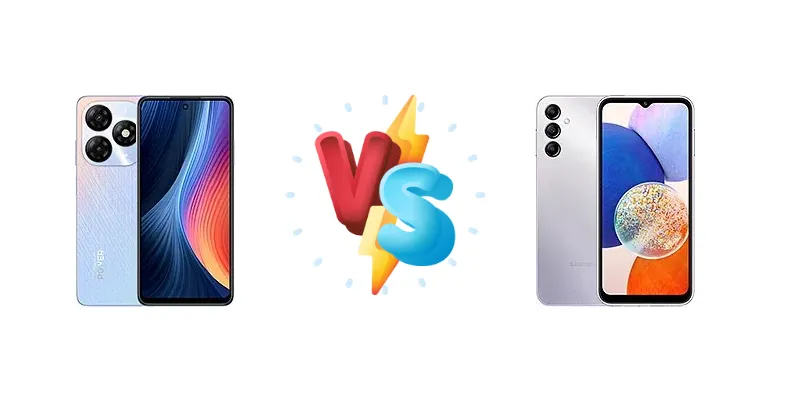
The sub-$200 5G smartphone market is heating up, and the itel P55 and Samsung Galaxy A14 5G are two key players. While both aim to deliver 5G connectivity at an accessible price, they take different approaches to achieving this. The itel P55 focuses on efficiency with a Unisoc chipset, while the Samsung A14 5G boasts a more powerful, though potentially power-hungry, Exynos processor (and a Mediatek variant depending on region). This comparison will dissect their strengths and weaknesses to help you choose the right device.
🏆 Quick Verdict
For the average user prioritizing overall performance and a slightly brighter display, the Samsung Galaxy A14 5G is the better choice. Its Exynos 1330 (or Dimensity 700) offers a significant performance uplift over the itel P55’s Unisoc T606. However, the itel P55 presents a compelling option for those seeking a potentially more efficient device.
| Network |
|---|
| 2G bands | GSM 850 / 900 / 1800 / 1900 | GSM 850 / 900 / 1800 / 1900 |
| 3G bands | HSDPA 850 / 900 / 2100 | HSDPA 850 / 900 / 1700(AWS) / 1900 / 2100 |
| 4G bands | LTE | 1, 2, 3, 4, 5, 7, 8, 12, 17, 20, 26, 28, 38, 40, 41, 66 - International |
| 5G bands | - | 2, 5, 66, 77 Sub6/mmWave - USA |
| Speed | HSPA, LTE | HSPA, LTE, 5G |
| Technology | GSM / HSPA / LTE | GSM / HSPA / LTE / 5G |
| | - | 1, 3, 5, 7, 8, 20, 28, 40, 41, 78 SA/NSA/Sub6 - India |
| Launch |
|---|
| Announced | 2024, January 26 | 2023, January 04 |
| Status | Available. Released 2024, January 31 | Available. Released 2023, January 12 |
| Body |
|---|
| Build | - | Glass front, plastic back, plastic frame |
| Dimensions | 8.0 mm thickness | 167.7 x 78 x 9.1 mm (6.60 x 3.07 x 0.36 in) |
| SIM | Nano-SIM + Nano-SIM | · Nano-SIM· Nano-SIM + Nano-SIM |
| Weight | 190 g (6.70 oz) | 202 g (7.13 oz) |
| Display |
|---|
| Resolution | 720 x 1612 pixels, 20:9 ratio (~267 ppi density) | 1080 x 2408 pixels, 20:9 ratio (~400 ppi density) |
| Size | 6.6 inches, 104.6 cm2 | 6.6 inches, 104.9 cm2 (~80.2% screen-to-body ratio) |
| Type | IPS LCD, 90Hz | PLS LCD, 90Hz |
| Platform |
|---|
| CPU | Octa-core (2x1.6 GHz Cortex-A75 & 6x1.6 GHz Cortex-A55) | Octa-core (2x2.4 GHz Cortex-A78 & 6x2.0 GHz Cortex-A55) - SM-A146BOcta-core (2x2.2 GHz Cortex-A76 & 6x2.0 GHz Cortex-A55) - SM-A146P |
| Chipset | Unisoc T606 (12 nm) | Exynos 1330 (5 nm) - SM-A146BMediatek Dimensity 700 (7 nm) - SM-A146P |
| GPU | Mali-G57 MP1 | Mali-G68 MP2 - SM-A146BMali-G57 MC2 - SM-A146P |
| OS | Android 13 | Android 13, upgradable to Android 15, One UI Core 7 |
| Memory |
|---|
| Card slot | microSDXC | microSDXC (uses shared SIM slot) - USA onlymicroSDXC (dedicated slot) - International |
| Internal | 128GB 4GB RAM, 128GB 8GB RAM, 256GB 8GB RAM | 64GB 4GB RAM, 128GB 4GB RAM, 128GB 6GB RAM, 128GB 8GB RAM |
| Main Camera |
|---|
| Features | Dual-LED flash, panorama | LED flash, panorama, HDR |
| Single | 50 MP
Auxiliary lens | 13 MP, f/2.0, (wide) |
| Triple | - | 50 MP, f/1.8, 26mm (wide), 1/2.76", 0.64µm, PDAF
2 MP (macro)
Auxiliary lens |
| Video | Yes | 1080p@30fps |
| Selfie camera |
|---|
| Single | 8 MP | 13 MP, f/2.0, 26mm (wide), 1.12µm |
| Video | Yes | 1080p@30fps |
| Sound |
|---|
| 3.5mm jack | - | Yes |
| 35mm jack | Yes | Yes |
| Loudspeaker | Yes | Yes |
| Comms |
|---|
| Bluetooth | Yes | 5.2, A2DP, LE |
| NFC | No | Yes |
| Positioning | GPS | GPS, GLONASS, GALILEO |
| Radio | Unspecified | FM radio (Exynos 1330 chipset only), recording |
| USB | USB Type-C, OTG | USB Type-C 2.0 |
| WLAN | Yes | Wi-Fi 802.11 a/b/g/n/ac, dual-band, Wi-Fi Direct |
| Features |
|---|
| Sensors | Fingerprint (side-mounted); unspecified sensors | Fingerprint (side-mounted), accelerometer, gyro, proximity, compass, barometer (USA only) |
| Battery |
|---|
| Charging | 18W wired | 15W wired |
| Type | 5000 mAh | Li-Po 5000 mAh |
| Misc |
|---|
| Colors | Aurora Blue, Brilliant Gold, Moonlit Black, Starry Purple | Black, Light Green, Dark Red, Silver |
| Models | A666L, A666LN, P666L | SM-A146B, SM-A146B/DS, SM-A146P, SM-A146P/DS, SM-A146U, SM-A146U1, SM-A146U1/DS, SM-A146W, SM-A146P/N, SM-A146P/DSN, SM-S146VL, SM-A146M |
| Price | - | $ 77.63 / C$ 151.00 / £ 97.00 / € 159.79 / ₹ 14,990 |
| SAR | - | 1.00 W/kg (head) 1.00 W/kg (body) |
| SAR EU | - | 0.56 W/kg (head) 1.28 W/kg (body) |
| Tests |
|---|
| Battery life | - |
Endurance rating 130h
|
| Camera | - |
Photo / Video |
| Display | - |
Contrast ratio: 1334:1 (nominal) |
| Loudspeaker | - |
-26.8 LUFS (Good)
|
| Performance | - |
AnTuTu: 307886 (v9)
GeekBench: 1727 (v5.1)
GFXBench: 12fps (ES 3.1 onscreen) |
itel P55
- Faster 18W charging
- Potentially better battery efficiency due to Unisoc T606
- More affordable price point (likely)
- Significantly weaker processor performance
- Limited software support compared to Samsung
- Unknown camera specifications
Samsung Galaxy A14 5G
- More powerful Exynos 1330 (or Dimensity 700) processor
- Brighter display for better outdoor visibility
- Samsung’s established software and support
- Slower 15W charging
- Potentially lower battery life due to more powerful processor
- Higher price compared to itel P55
Display Comparison
The Samsung Galaxy A14 5G features a display capable of reaching 519 nits of peak brightness, a noticeable advantage over what we’d expect from the itel P55’s panel. Both displays share a 1334:1 contrast ratio, suggesting similar black levels and color depth. However, the A14 5G’s higher brightness translates to better visibility outdoors. While neither manufacturer specifies panel technology, the A14 5G’s brightness suggests a more advanced LCD panel. Bezels are likely comparable given the price points, and color accuracy is expected to be standard for this segment.
Camera Comparison
Both phones offer a 'Photo / Video' camera experience, but details are sparse. The itel P55’s camera specifications are unknown, while the A14 5G’s details are also limited. It’s safe to assume both will feature a primary sensor and potentially auxiliary lenses, but image quality will likely hinge on software processing. Given Samsung’s established camera algorithms, the A14 5G is likely to produce more consistently pleasing results, especially in challenging lighting conditions. We can expect the A14 5G to have a more refined image processing pipeline, even if the sensor size is similar.
Performance
The performance gap is the most significant differentiator. The Samsung Galaxy A14 5G, depending on the region, utilizes either the Exynos 1330 (5nm) or the MediaTek Dimensity 700 (7nm). Both are superior to the Unisoc T606 (12nm) found in the itel P55. The Exynos 1330’s Cortex-A78 cores, clocked at 2.4 GHz, provide a substantial performance boost over the itel’s Cortex-A75 cores at 1.6 GHz. The smaller fabrication process (5nm vs 12nm) of the Exynos also implies better power efficiency and thermal management, reducing the likelihood of throttling during sustained workloads. The Dimensity 700, while slightly less powerful than the Exynos, still offers a clear advantage over the Unisoc. The A14 5G will handle multitasking and demanding apps with greater ease.
Battery Life
Both devices boast an endurance rating of 130 hours, suggesting comparable battery life in typical usage scenarios. However, the underlying factors differ. The itel P55’s Unisoc T606 is a more power-efficient chipset, potentially offsetting a smaller battery capacity (unspecified). The Samsung Galaxy A14 5G, with its more powerful Exynos 1330 (or Dimensity 700), will likely consume more power, but the 15W charging may not fully compensate for the increased demand. The itel P55’s 18W charging offers a slight advantage in terms of charging speed, potentially reaching 50% faster than the A14 5G.
Buying Guide
Buy the itel P55 if you need a phone primarily for basic tasks like calling, texting, and light social media, and value potential battery efficiency. Buy the Samsung Galaxy A14 5G if you prefer a smoother experience for multitasking, gaming, and content consumption, and are willing to trade some potential battery life for increased processing power. The A14 5G also benefits from Samsung’s established software support.
Frequently Asked Questions
❓ Does the Exynos 1330 in the Samsung Galaxy A14 5G tend to overheat during prolonged gaming sessions?
While the Exynos 1330 is a capable processor, it can experience some thermal throttling during extended gaming. However, the 5nm fabrication process helps mitigate this, and the A14 5G’s larger chassis provides more surface area for heat dissipation. Expect some performance reduction after 30-60 minutes of intensive gaming, but it shouldn’t be severe enough to render the experience unplayable.
❓ Is the 2MP macro camera on the Samsung Galaxy A14 5G actually useful for taking detailed close-up photos?
Generally, 2MP macro cameras on budget phones are limited in their usefulness. The low resolution results in images lacking detail and sharpness. While it can capture a close-up perspective, don’t expect professional-quality macro photography. It’s more of a novelty feature than a genuinely practical camera tool.
❓ Can the Samsung Galaxy A14 5G reliably run PUBG Mobile at 60fps with smooth graphics?
The Samsung Galaxy A14 5G, with its Exynos 1330 or Dimensity 700, should be capable of running PUBG Mobile at 60fps with smooth graphics settings. However, sustained performance may vary depending on the device’s temperature and background processes. Expect occasional frame drops during intense firefights, but overall, the experience should be playable and enjoyable.
❓ How does the Unisoc T606 in the itel P55 handle multitasking compared to the Samsung A14 5G?
The Unisoc T606 will struggle with heavy multitasking. While it can handle a few apps open simultaneously, switching between them will likely result in noticeable lag and slowdown. The Samsung A14 5G’s Exynos 1330 (or Dimensity 700) offers significantly better multitasking performance, allowing for smoother transitions between apps and a more responsive user experience.