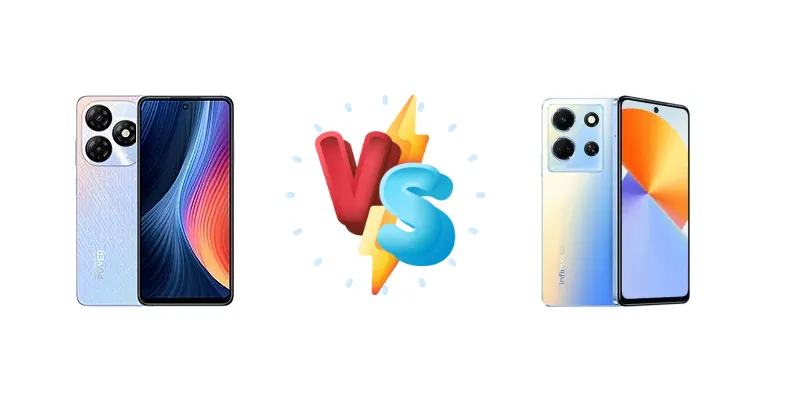
The itel P55 and Infinix Note 30 5G represent compelling options in the sub-$200 smartphone market. While both aim to deliver essential features, they diverge significantly in their approach to performance and charging speed. This comparison dissects these differences, helping you determine which device best suits your needs.
🏆 Quick Verdict
For the average user prioritizing responsiveness and future-proofing, the Infinix Note 30 5G is the clear winner. Its Mediatek Dimensity 6080 chipset and 45W charging offer a substantial upgrade over the itel P55’s Unisoc T606 and 18W charging, justifying the potential price difference.
| Network |
|---|
| 2G bands | GSM 850 / 900 / 1800 / 1900 | GSM 850 / 900 / 1800 / 1900 |
| 3G bands | HSDPA 850 / 900 / 2100 | HSDPA 850 / 900 / 1700(AWS) / 1900 / 2100 |
| 4G bands | LTE | 1, 2, 3, 4, 5, 7, 8, 12, 17, 20, 28, 38, 40, 41, 66 |
| 5G bands | - | 1, 3, 5, 7, 8, 12, 22, 28, 38, 40, 41, 66, 77, 78 |
| Speed | HSPA, LTE | HSPA, LTE, 5G |
| Technology | GSM / HSPA / LTE | GSM / HSPA / LTE / 5G |
| Launch |
|---|
| Announced | 2024, January 26 | 2023, May 22 |
| Status | Available. Released 2024, January 31 | Available. Released 2023, May 22 |
| Body |
|---|
| Build | - | Glass front, plastic frame, glass or leather back |
| Dimensions | 8.0 mm thickness | 168.5 x 76.5 x 8.5 mm (6.63 x 3.01 x 0.33 in) |
| SIM | Nano-SIM + Nano-SIM | Nano-SIM + Nano-SIM |
| Weight | 190 g (6.70 oz) | 205 g (7.23 oz) |
| Display |
|---|
| Resolution | 720 x 1612 pixels, 20:9 ratio (~267 ppi density) | 1080 x 2460 pixels (~396 ppi density) |
| Size | 6.6 inches, 104.6 cm2 | 6.78 inches, 109.2 cm2 (~84.7% screen-to-body ratio) |
| Type | IPS LCD, 90Hz | IPS LCD, 120Hz, 580 nits (peak) |
| Platform |
|---|
| CPU | Octa-core (2x1.6 GHz Cortex-A75 & 6x1.6 GHz Cortex-A55) | Octa-core (2x2.4 GHz Cortex-A76 & 6x2.0 GHz Cortex-A55) |
| Chipset | Unisoc T606 (12 nm) | Mediatek Dimensity 6080 (6 nm) |
| GPU | Mali-G57 MP1 | Mali-G57 MC2 |
| OS | Android 13 | Android 13 |
| Memory |
|---|
| Card slot | microSDXC | microSDXC (dedicated slot) |
| Internal | 128GB 4GB RAM, 128GB 8GB RAM, 256GB 8GB RAM | 128GB 4GB RAM, 256GB 8GB RAM |
| Main Camera |
|---|
| Features | Dual-LED flash, panorama | Quad-LED flash, HDR, panorama |
| Single | 50 MP
Auxiliary lens | - |
| Triple | - | 108 MP, f/1.75, 26mm (wide), 1/1.67", 0.64µm, PDAF
Auxiliary lenses |
| Video | Yes | 1440p@30fps, 1080p@30/60fps |
| Selfie camera |
|---|
| Features | - | Dual-LED flash, HDR |
| Single | 8 MP | 16 MP, f/2.0, (wide) |
| Video | Yes | 1080p@30fps |
| Sound |
|---|
| 35mm jack | Yes | Yes |
| Loudspeaker | Yes | Yes, with dual speakers |
| Comms |
|---|
| Bluetooth | Yes | Yes |
| NFC | No | Yes |
| Positioning | GPS | GPS |
| Radio | Unspecified | FM radio |
| USB | USB Type-C, OTG | USB Type-C 2.0, OTG |
| WLAN | Yes | Wi-Fi 802.11 a/b/g/n/ac, dual-band, Wi-Fi Direct |
| Features |
|---|
| Sensors | Fingerprint (side-mounted); unspecified sensors | Fingerprint (side-mounted), accelerometer, gyro, proximity, compass |
| Battery |
|---|
| Charging | 18W wired | 45W wired, bypass charging |
| Type | 5000 mAh | 5000 mAh |
| Misc |
|---|
| Colors | Aurora Blue, Brilliant Gold, Moonlit Black, Starry Purple | Magic Black, Interstellar Blue, Sunset Gold |
| Models | A666L, A666LN, P666L | X6711 |
itel P55
- Potentially longer battery life due to less power-hungry chipset
- More affordable price point
- Reliable for basic smartphone tasks
- Significantly slower performance
- Slow 18W charging
- Less capable camera system
Infinix Note 30 5G
- Faster and more responsive performance
- 45W fast charging with bypass charging
- Brighter and more vibrant display
- Potentially slightly shorter battery life
- Higher price compared to itel P55
- May run slightly warmer under heavy load
Display Comparison
The Infinix Note 30 5G boasts a brighter display, reaching a measured 607 nits, compared to the itel P55 which lacks published brightness data. This higher peak brightness translates to better visibility outdoors. While both likely utilize IPS LCD panels, the Note 30 5G’s 1521:1 contrast ratio suggests a more vibrant image. The itel P55’s display specifications are less detailed, suggesting a more basic panel aimed at cost savings. Bezels are likely comparable given the price points, but the Note 30 5G’s superior brightness is a clear advantage.
Camera Comparison
Detailed camera specifications are limited for both devices. However, given the market segment, it’s safe to assume both rely on primary sensors around the 13-50MP range. The Infinix Note 30 5G likely benefits from Mediatek’s image signal processor (ISP) within the Dimensity 6080, potentially offering better image processing and noise reduction. The itel P55’s Unisoc T606 ISP is less sophisticated. The presence of a 2MP macro camera on both devices is largely a marketing tactic, offering minimal practical benefit due to the small sensor size and lack of optical image stabilization (OIS).
Performance
The core difference lies in the chipsets. The Infinix Note 30 5G’s Mediatek Dimensity 6080 (6nm) is a significant step up from the itel P55’s Unisoc T606 (12nm). The Dimensity 6080 features newer Cortex-A76 cores clocked at 2.4 GHz, versus the older Cortex-A75 cores at 1.6 GHz in the T606. This architectural improvement, coupled with the smaller 6nm process node, results in noticeably faster application loading times and smoother multitasking. The Dimensity 6080 also offers a more capable GPU for gaming. While both phones likely feature similar RAM configurations, the chipset difference will be the primary bottleneck for the itel P55.
Battery Life
Both phones likely feature battery capacities around 5000mAh, but the charging speeds are drastically different. The Infinix Note 30 5G’s 45W wired charging is a game-changer, enabling significantly faster top-ups. The itel P55’s 18W charging is comparatively slow. The Note 30 5G also supports bypass charging, allowing the phone to be powered directly from the charger while in use, reducing heat and battery stress during gaming. While the itel P55 may offer slightly longer overall battery life due to the less powerful chipset, the convenience of the Note 30 5G’s faster charging is a major advantage.
Buying Guide
Buy the itel P55 if you prioritize maximizing battery life and are comfortable with a more basic user experience. It’s ideal for users who primarily need a reliable phone for calls, texts, and light social media. Buy the Infinix Note 30 5G if you value faster performance for apps and games, and appreciate the convenience of significantly quicker charging – a boon for those constantly on the move.
Frequently Asked Questions
❓ Does the Dimensity 6080 in the Infinix Note 30 5G get hot during prolonged gaming sessions?
While the Dimensity 6080 is a capable chipset, sustained gaming will generate heat. However, the 6nm process node and the inclusion of bypass charging (allowing power directly from the charger) help mitigate thermal throttling compared to the itel P55’s Unisoc T606. Expect some performance reduction after extended play, but it should be manageable.
❓ Is the 18W charging on the itel P55 slow enough to be a major inconvenience?
Yes, 18W charging is considerably slower than the 45W charging on the Infinix Note 30 5G. A full charge will take significantly longer – potentially over 3 hours – making it less ideal for users who frequently need to top up their battery quickly. This is a key area where the Note 30 5G excels.
❓ How does the Unisoc T606 in the itel P55 handle multitasking compared to the Dimensity 6080?
The Unisoc T606 will struggle with heavy multitasking. While it can handle a few apps simultaneously, switching between them or running demanding applications will result in noticeable lag. The Dimensity 6080, with its newer CPU cores and more efficient architecture, offers a much smoother multitasking experience.
❓ Are the camera differences between these phones noticeable in everyday photos?
While both phones likely have similar megapixel counts, the Infinix Note 30 5G’s image processing capabilities, driven by the Dimensity 6080’s ISP, should result in more detailed and vibrant photos, particularly in challenging lighting conditions. Expect better dynamic range and noise reduction on the Note 30 5G.