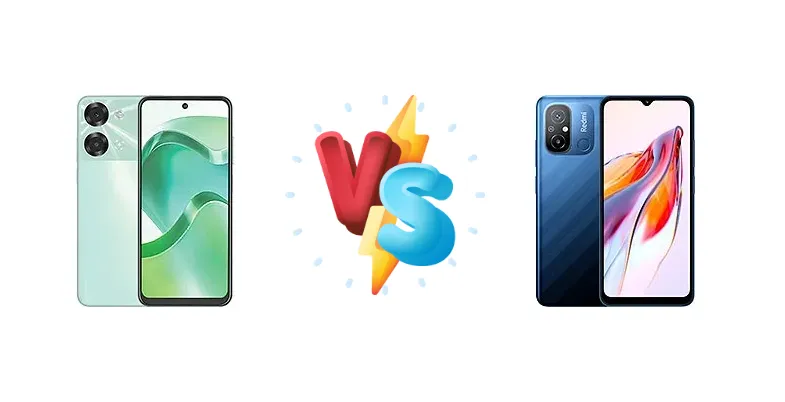
The sub-$150 smartphone market is fiercely competitive. Both the itel P40+ and Xiaomi Redmi 12C aim to deliver essential smartphone functionality at an incredibly accessible price point. However, they take different approaches to achieving this, primarily through their chipset choices. This comparison dissects those differences, revealing which device offers the best experience for your money.
🏆 Quick Verdict
For most users, the Xiaomi Redmi 12C emerges as the better choice. Its Helio G85 chipset provides a noticeable performance edge over the itel P40+'s Unisoc T606, making it more responsive for everyday tasks and light gaming. While the itel P40+ boasts slightly faster charging, the Redmi 12C’s overall performance advantage outweighs this benefit.
| Network |
|---|
| 2G bands | GSM 850 / 900 / 1800 / 1900 | GSM 850 / 900 / 1800 / 1900 |
| 3G bands | HSDPA 850 / 900 / 2100 | HSDPA 850 / 900 / 2100 |
| 4G bands | 1, 3, 5, 8, 38, 40, 41 LTE | 1, 3, 5, 7, 8, 20, 28, 38, 40, 41 - International |
| Speed | HSPA, LTE | HSPA, LTE |
| Technology | GSM / HSPA / LTE | GSM / CDMA / HSPA / EVDO / LTE |
| | - | CDMA2000 1xEV-DO |
| Launch |
|---|
| Announced | 2023 | 2022, December 31 |
| Status | Available. Released 2023 | Available. Released 2023, January 01 |
| Body |
|---|
| Dimensions | 8.9 mm thickness | 168.8 x 76.4 x 8.8 mm (6.65 x 3.01 x 0.35 in) |
| SIM | Dual SIM | Nano-SIM + Nano-SIM |
| Weight | - | 192 g (6.77 oz) |
| Display |
|---|
| Resolution | 720 x 1640 pixels (~263 ppi density) | 720 x 1650 pixels (~268 ppi density) |
| Size | 6.8 inches, 109.8 cm2 | 6.71 inches, 106.5 cm2 (~82.6% screen-to-body ratio) |
| Type | IPS LCD, 90Hz | IPS LCD, 500 nits (typ) |
| Platform |
|---|
| CPU | Octa-core (2x1.6 GHz Cortex-A75 & 6x1.6 GHz Cortex-A55) | Octa-core (2x2.0 GHz Cortex-A75 & 6x1.8 GHz Cortex-A55) |
| Chipset | Unisoc T606 (12 nm) | Mediatek MT6769Z Helio G85 (12 nm) |
| GPU | Mali-G57 MP1 | Mali-G52 MC2 |
| OS | Android 12 or 13 | Android 12, MIUI 13 |
| Memory |
|---|
| Card slot | microSDXC | microSDXC (dedicated slot) |
| Internal | 128GB 4GB RAM | 32GB 2GB RAM, 32GB 3GB RAM, 32GB 4GB RAM, 64GB 3GB RAM, 64GB 4GB RAM, 128GB 3GB RAM, 128GB 4GB RAM, 128GB 6GB RAM |
| | - | eMMC 5.1 |
| Main Camera |
|---|
| Dual | - | 50 MP, (wide), PDAF
0.08 MP (depth) |
| Features | LED flash | LED flash, HDR |
| Single | 13 MP
Auxiliary lens | 50 MP, f/1.8, (wide), 1/2.76", PDAF
Auxiliary lens |
| Video | 1080p@30fps | 1080p@30fps |
| Selfie camera |
|---|
| Single | 8 MP | 5 MP, f/2.2, (wide) |
| Video | Yes | 1080p@30fps |
| Sound |
|---|
| 3.5mm jack | - | Yes |
| 35mm jack | Yes | Yes |
| Loudspeaker | Yes | Yes |
| Comms |
|---|
| Bluetooth | Yes | 5.1, A2DP, LE |
| NFC | No | Yes (market/region dependent) |
| Positioning | GPS | GPS, GLONASS, BDS, GALILEO |
| Radio | Unspecified | FM radio |
| USB | USB Type-C | microUSB 2.0 |
| WLAN | Yes | Wi-Fi 802.11 a/b/g/n/ac, dual-band, Wi-Fi Direct |
| Features |
|---|
| Sensors | Fingerprint (side-mounted), accelerometer | Fingerprint (rear-mounted), accelerometer |
| | - | Virtual proximity sensing |
| Battery |
|---|
| Charging | 18W wired | 10W wired |
| Type | 7000 mAh | Li-Po 5000 mAh |
| Misc |
|---|
| Colors | Force Black, Ice Cyan | Graphite Gray, Ocean Blue, Mint Green, Lavender Purple |
| Models | P683L | 22120RN86G, 22120RN86I, 22126RN91Y, 2212ARNC4L |
| Price | - | £ 132.99 / € 107.41 |
| SAR | - | 1.08 W/kg (head) 0.64 W/kg (body) |
| SAR EU | - | 0.98 W/kg (head) 0.99 W/kg (body) |
itel P40+
- Faster 18W charging
- Potentially longer battery life due to conservative chipset
- Competitive price point
- Less powerful Unisoc T606 chipset
- Likely inferior GPU performance
- May struggle with multitasking
Xiaomi Redmi 12C
- More powerful MediaTek Helio G85 chipset
- Smoother performance for everyday tasks
- Better GPU for casual gaming
- Slower 10W charging
- Potentially shorter battery life under heavy load
- May be slightly more expensive
Display Comparison
Neither device is expected to deliver a premium display experience. Both likely utilize LCD panels, and detailed specs like resolution and peak brightness are not provided. However, the focus should be on usability. The Redmi 12C’s larger screen size (typically 6.71 inches vs. the P40+'s 6.6 inches) will be preferable for media consumption. Without specific data, we can assume both displays will be adequate for their price range, but the Redmi 12C’s size offers a slight advantage.
Camera Comparison
Both phones are likely to feature basic camera setups. Without detailed sensor information, it’s difficult to make a definitive judgment. However, the Redmi 12C often includes a 50MP main sensor, which, while not flagship-level, will generally outperform the likely 13MP or lower sensor found in the itel P40+. Image processing will also play a role, and Xiaomi’s software is typically more refined. The presence of low-resolution auxiliary cameras (often 2MP) on both devices is largely marketing fluff and should be disregarded.
Performance
The core difference lies in the chipsets. The Xiaomi Redmi 12C’s MediaTek Helio G85 (2x2.0 GHz Cortex-A75 & 6x1.8 GHz Cortex-A55) has a clear advantage over the itel P40+'s Unisoc T606 (2x1.6 GHz Cortex-A75 & 6x1.6 GHz Cortex-A55). The higher clock speeds on the G85’s Cortex-A75 cores translate to faster application loading times and smoother multitasking. While both are 12nm chips, the G85 is generally more efficient and offers better GPU performance, making it more suitable for casual gaming. The Unisoc T606 is adequate for basic tasks, but will struggle with demanding applications.
Battery Life
The itel P40+ features 18W wired charging, while the Redmi 12C is limited to 10W. This means the P40+ will charge faster, potentially reducing 0-100% charge time by 30-60 minutes. However, battery capacity is not specified. Even with slower charging, the Redmi 12C’s superior chipset efficiency may result in comparable or even better real-world battery life, as the Unisoc T606 is known to be less power-efficient under load. The faster charging of the P40+ is a benefit, but not a game-changer.
Buying Guide
Buy the itel P40+ if you prioritize slightly faster charging speeds and are primarily focused on basic smartphone functions like calls, messaging, and light social media use. Buy the Xiaomi Redmi 12C if you value a smoother, more responsive user experience, especially when multitasking or playing casual games. The Redmi 12C is the better option for anyone who doesn't want to constantly wait for their phone to catch up.
Frequently Asked Questions
❓ Will the Redmi 12C be able to run popular games like PUBG Mobile or Call of Duty Mobile?
The Redmi 12C’s Helio G85 chipset can handle PUBG Mobile and Call of Duty Mobile, but you’ll likely need to play at lower graphics settings (Medium or Low) and frame rates to maintain a smooth experience. Don't expect flagship-level performance, but it's certainly playable for casual gaming.
❓ How long will it take to fully charge the itel P40+ with the 18W charger?
While the exact 0-100% charge time isn't specified, the 18W charging should take approximately 2-2.5 hours, depending on usage during charging. This is faster than the Redmi 12C’s 10W charging, but the difference may not be significant for all users.
❓ Is the Unisoc T606 chipset in the itel P40+ sufficient for everyday tasks like browsing and social media?
Yes, the Unisoc T606 is capable of handling basic tasks like web browsing, social media, and messaging without significant issues. However, you may experience some lag when opening multiple apps or switching between them quickly. It's best suited for users with light smartphone usage.
❓ Does the Redmi 12C support VoLTE and VoWiFi for improved call quality?
The Redmi 12C generally supports VoLTE (Voice over LTE) and VoWiFi (Voice over Wi-Fi) depending on the carrier and region. It's best to check with your mobile carrier to confirm compatibility in your area for the best call quality.