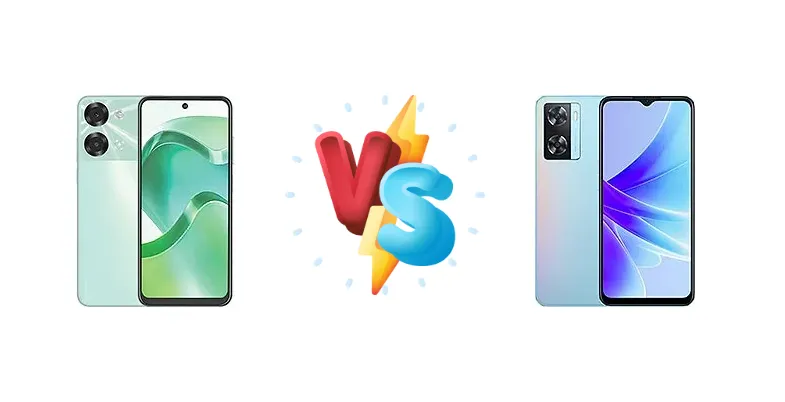
The itel P40+ and Oppo A57s represent compelling options in the ultra-budget smartphone segment. Both aim to deliver essential features at a low price point, but they take different approaches to achieving this. The itel P40+ prioritizes a potentially longer-lasting experience with a focus on efficiency, while the Oppo A57s emphasizes quicker charging and a slightly more powerful, though less efficient, processor.
🏆 Quick Verdict
For the average user prioritizing fast charging and a marginally snappier experience for everyday tasks, the Oppo A57s is the better choice. Its 33W charging significantly reduces downtime. However, users who value potential battery longevity and a more efficient processor will find the itel P40+ a viable alternative.
| Network |
|---|
| 2G bands | GSM 850 / 900 / 1800 / 1900 | GSM 850 / 900 / 1800 / 1900 |
| 3G bands | HSDPA 850 / 900 / 2100 | HSDPA 850 / 900 / 2100 |
| 4G bands | 1, 3, 5, 8, 38, 40, 41 LTE | 1, 3, 5, 7, 8, 20, 28, 38, 40, 41 |
| Speed | HSPA, LTE | HSPA, LTE |
| Technology | GSM / HSPA / LTE | GSM / HSPA / LTE |
| Launch |
|---|
| Announced | 2023 | 2022, August 31 |
| Status | Available. Released 2023 | Available. Released 2022, September 12 |
| Body |
|---|
| Build | - | Glass front (Panda Glass), plastic frame, plastic back |
| Dimensions | 8.9 mm thickness | 163.8 x 75 x 8 mm (6.45 x 2.95 x 0.31 in) |
| SIM | Dual SIM | Nano-SIM + Nano-SIM |
| Weight | - | 187 g (6.60 oz) |
| | - | IP5X (dust), IPX4 (water) resistance |
| Display |
|---|
| Protection | - | Panda Glass |
| Resolution | 720 x 1640 pixels (~263 ppi density) | 720 x 1612 pixels, 20:9 ratio (~269 ppi density) |
| Size | 6.8 inches, 109.8 cm2 | 6.56 inches, 103.4 cm2 (~84.2% screen-to-body ratio) |
| Type | IPS LCD, 90Hz | IPS LCD, 480 nits (typ), 600 nits (HBM) |
| Platform |
|---|
| CPU | Octa-core (2x1.6 GHz Cortex-A75 & 6x1.6 GHz Cortex-A55) | Octa-core (4x2.3 GHz Cortex-A53 & 4x1.8 GHz Cortex-A53) |
| Chipset | Unisoc T606 (12 nm) | Mediatek MT6765G Helio G35 (12 nm) |
| GPU | Mali-G57 MP1 | PowerVR GE8320 |
| OS | Android 12 or 13 | Android 12, ColorOS 12.1 |
| Memory |
|---|
| Card slot | microSDXC | microSDXC |
| Internal | 128GB 4GB RAM | 64GB 4GB RAM, 128GB 4GB RAM |
| | - | eMMC 5.1 |
| Main Camera |
|---|
| Dual | - | 50 MP, f/1.8, 27mm (wide), PDAF
Auxiliary lens |
| Features | LED flash | LED flash, HDR, panorama |
| Single | 13 MP
Auxiliary lens | 8 MP, f/2.0, 26mm (wide) |
| Video | 1080p@30fps | 1080p@30fps |
| Selfie camera |
|---|
| Features | - | Panorama |
| Single | 8 MP | 8 MP, f/2.0, 26mm (wide) |
| Video | Yes | 1080p@30fps |
| Sound |
|---|
| 3.5mm jack | - | Yes |
| 35mm jack | Yes | Yes |
| Loudspeaker | Yes | Yes, with stereo speakers |
| Comms |
|---|
| Bluetooth | Yes | 5.3, A2DP, LE, aptX HD |
| NFC | No | Yes |
| Positioning | GPS | GPS, GLONASS, BDS, GALILEO, QZSS |
| Radio | Unspecified | No |
| USB | USB Type-C | USB Type-C 2.0, OTG |
| WLAN | Yes | Wi-Fi 802.11 a/b/g/n/ac, dual-band, Wi-Fi Direct |
| Features |
|---|
| Sensors | Fingerprint (side-mounted), accelerometer | Fingerprint (side-mounted), accelerometer, proximity, compass |
| Battery |
|---|
| Charging | 18W wired | 33W wired, 100% in 69 min |
| Type | 7000 mAh | Li-Po 5000 mAh |
| Misc |
|---|
| Colors | Force Black, Ice Cyan | Starry Black, Sky Blue |
| Models | P683L | CPH2385 |
itel P40+
- Potentially better battery life due to efficient Unisoc T606 chipset.
- Smoother sustained performance thanks to Cortex-A75 cores.
- More efficient processor leading to less heat generation.
- Slower 18W charging.
- Likely less responsive for demanding tasks compared to the Oppo A57s.
Oppo A57s
- Faster 33W charging (100% in 69 minutes).
- Higher clock speeds on the Helio G35 for quicker app launches.
- Potentially better performance in short bursts.
- Less efficient Helio G35 chipset leading to shorter battery life.
- Older Cortex-A53 architecture may struggle with sustained workloads.
Display Comparison
Neither device boasts a standout display. Both utilize 12nm chipsets, suggesting similar power constraints impacting display capabilities. While specific display specs (resolution, panel type) are missing, the focus here is on performance. The lack of high refresh rates or advanced panel technologies is expected at this price point. Bezels are likely comparable, prioritizing cost reduction over premium aesthetics.
Camera Comparison
Camera performance is likely to be similar, with both phones targeting the entry-level market. Without specific sensor details, it's safe to assume both rely on basic image processing. The presence of a 2MP macro camera on either device is largely a marketing tactic, offering limited practical benefit due to the small sensor size and lack of optical image stabilization (OIS). Image quality will heavily depend on software optimization and lighting conditions. Expect acceptable results in good light, but struggles in low-light scenarios.
Performance
The core difference lies in the chipsets. The itel P40+ features the Unisoc T606, employing a big.LITTLE architecture with 2x Cortex-A75 cores for performance and 6x Cortex-A55 cores for efficiency. The Oppo A57s uses the MediaTek Helio G35, utilizing 4x Cortex-A53 cores at a higher clock speed (2.3 GHz) alongside another 4x Cortex-A53 cores. While the Helio G35's higher clock speed *appears* advantageous, the older Cortex-A53 architecture is less efficient than the Cortex-A75 found in the Unisoc chip. This means the Oppo A57s will likely deliver slightly better peak performance in short bursts, but the itel P40+ should maintain smoother performance over extended periods and potentially exhibit better thermal management. The Unisoc T606's architecture is better suited for sustained workloads.
Battery Life
The Oppo A57s takes a clear lead in charging speed with its 33W wired charging, promising a full charge in just 69 minutes. The itel P40+ is limited to 18W charging, resulting in a significantly longer charging time. While battery capacity isn't specified, the Unisoc T606's efficiency could offset a potentially smaller battery size, offering comparable real-world battery life. However, the Oppo A57s' faster charging is a significant convenience factor for users who frequently need to top up their device.
Buying Guide
Buy the itel P40+ if you need a phone that can reliably last through a full day of moderate use and appreciate a processor designed for efficiency. This is ideal for users who primarily browse, message, and make calls. Buy the Oppo A57s if you prefer quicker charging times and a slightly more responsive experience when multitasking or launching apps, even if it means potentially shorter battery life between charges. This suits users who are frequently on the go and need to top up quickly.
Frequently Asked Questions
❓ Will the Helio G35 in the Oppo A57s overheat during prolonged gaming sessions?
The Helio G35 is a relatively low-power chipset, but its less efficient architecture compared to the Unisoc T606 means it's more prone to thermal throttling during extended gaming. Expect reduced performance after 30-45 minutes of demanding games. It's not designed for hardcore gaming.
❓ How much faster is the charging on the Oppo A57s compared to the itel P40+ in real-world use?
The Oppo A57s' 33W charging will likely take around 1 hour and 40 minutes to fully charge from 0%, while the itel P40+'s 18W charging could take over 2.5 hours. This difference is substantial for users who need to quickly top up their phone throughout the day.
❓ Is the Unisoc T606 a reliable processor for everyday tasks like browsing and social media?
Yes, the Unisoc T606 is perfectly capable of handling everyday tasks smoothly. Its Cortex-A75 cores provide a noticeable performance boost over older Cortex-A53 designs, ensuring a responsive experience for browsing, social media, and messaging.
❓ Does either phone support any form of fast charging protocols beyond standard USB Power Delivery?
While not explicitly stated, the Oppo A57s likely supports Oppo's proprietary VOOC charging protocol, which is compatible with SuperVOOC. The itel P40+ likely relies on standard USB Power Delivery, meaning it won't benefit from Oppo's faster charging speeds even with a compatible charger.