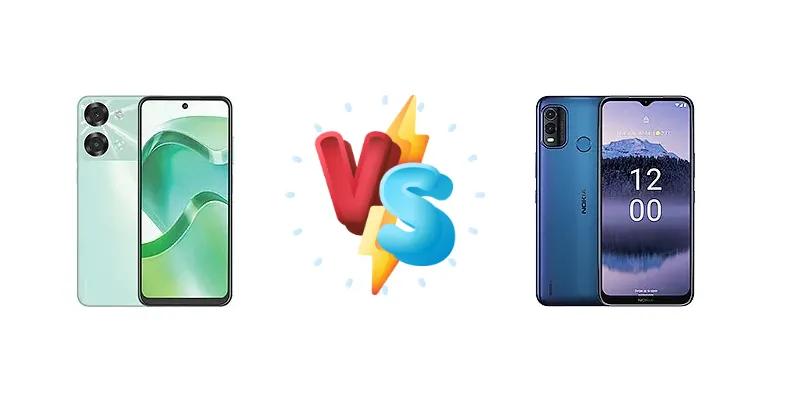
The itel P40+ and Nokia G11 Plus represent the fiercely competitive sub-$150 smartphone market. Both devices utilize the Unisoc T606 chipset, suggesting similar performance on paper. However, key differences in charging speed and software approach create distinct user experiences, making a direct comparison crucial for budget-conscious buyers.
🏆 Quick Verdict
For most users, the itel P40+ emerges as the better choice. While both phones share the same Unisoc T606 processor, the P40+'s 18W charging significantly reduces downtime compared to the Nokia G11 Plus’s slower 10W charging. This makes the itel P40+ more practical for daily use.
| Network |
|---|
| 2G bands | GSM 850 / 900 / 1800 / 1900 | GSM 850 / 900 / 1800 / 1900 |
| 3G bands | HSDPA 850 / 900 / 2100 | HSDPA 850 / 900 / 2100 - International |
| 4G bands | 1, 3, 5, 8, 38, 40, 41 LTE | 1, 3, 5, 7, 8, 20, 28, 38, 40, 41 - International |
| Speed | HSPA, LTE | HSPA 42.2/5.76 Mbps, LTE Cat4 150/50 Mbps |
| Technology | GSM / HSPA / LTE | GSM / HSPA / LTE |
| | - | 1, 3, 5, 8, 40, 41 - India |
| Launch |
|---|
| Announced | 2023 | 2022, June 29 |
| Status | Available. Released 2023 | Available. Released 2022, July 20 |
| Body |
|---|
| Build | - | Glass front, plastic frame, plastic back |
| Dimensions | 8.9 mm thickness | 164.8 x 75.9 x 8.6 mm (6.49 x 2.99 x 0.34 in) |
| SIM | Dual SIM | · Nano-SIM· Nano-SIM + Nano-SIM |
| Weight | - | 192 g (6.77 oz) |
| | - | Splash protection |
| Display |
|---|
| Resolution | 720 x 1640 pixels (~263 ppi density) | 720 x 1600 pixels, 20:9 ratio (~269 ppi density) |
| Size | 6.8 inches, 109.8 cm2 | 6.52 inches, 102.6 cm2 (~82.1% screen-to-body ratio) |
| Type | IPS LCD, 90Hz | IPS LCD, 90Hz, 400 nits (typ) |
| Platform |
|---|
| CPU | Octa-core (2x1.6 GHz Cortex-A75 & 6x1.6 GHz Cortex-A55) | Octa-core (2x1.6 GHz Cortex-A75 & 6x1.6 GHz Cortex-A55) |
| Chipset | Unisoc T606 (12 nm) | Unisoc T606 (12 nm) |
| GPU | Mali-G57 MP1 | Mali-G57 MP1 |
| OS | Android 12 or 13 | Android 12, upgradable to Android 13 |
| Memory |
|---|
| Card slot | microSDXC | microSDXC (dedicated slot) |
| Internal | 128GB 4GB RAM | 32GB 3GB RAM, 64GB 3GB RAM, 64GB 4GB RAM, 128GB 3GB RAM |
| | - | eMMC 5.1 |
| Main Camera |
|---|
| Dual | - | 50 MP, f/1.8, (wide), 1/2.67", PDAF
Auxiliary lens |
| Features | LED flash | LED flash |
| Single | 13 MP
Auxiliary lens | 8 MP, f/2.0, (wide), 1/4.0" |
| Video | 1080p@30fps | 1080p@30fps |
| Selfie camera |
|---|
| Single | 8 MP | 8 MP, f/2.0, (wide), 1/4.0" |
| Video | Yes | 1080p@30fps |
| Sound |
|---|
| 3.5mm jack | - | Yes |
| 35mm jack | Yes | Yes |
| Loudspeaker | Yes | Yes |
| Comms |
|---|
| Bluetooth | Yes | 5.0, A2DP, LE |
| NFC | No | No |
| Positioning | GPS | GPS |
| Radio | Unspecified | FM radio |
| USB | USB Type-C | USB Type-C 2.0, OTG |
| WLAN | Yes | Wi-Fi 802.11 a/b/g/n/ac, dual-band, Wi-Fi Direct |
| Features |
|---|
| Sensors | Fingerprint (side-mounted), accelerometer | Fingerprint (rear-mounted), accelerometer, proximity |
| Battery |
|---|
| Charging | 18W wired | 10W wired |
| Type | 7000 mAh | Li-Ion 5000 mAh |
| Misc |
|---|
| Colors | Force Black, Ice Cyan | Lake Blue, Charcoal Grey |
| Models | P683L | - |
| Price | - | About 130 EUR |
itel P40+
- Faster 18W charging for quicker top-ups
- Potentially better value for money
- Similar performance to Nokia G11 Plus
- Software experience may be less refined than Nokia
- Limited information on display quality
Nokia G11 Plus
- Cleaner, near-stock Android experience
- Nokia’s reputation for software updates
- Potentially more refined image processing
- Slower 10W charging
- May be slightly more expensive for similar performance
Display Comparison
Neither itel nor Nokia provide detailed display specifications beyond the panel type. Given the price point, both likely utilize LCD panels with 720p+ resolution. The absence of information regarding peak brightness or color gamut suggests neither device will excel in outdoor visibility or color accuracy. Bezels are expected to be relatively thick on both models, consistent with their budget positioning. The user experience will likely be similar in terms of visual quality.
Camera Comparison
Camera details are sparse for both devices. While both likely feature a multi-camera setup, the emphasis should be on the main sensor. Without knowing the sensor size or aperture, it’s difficult to assess image quality. The inclusion of 2MP macro or depth sensors is common in this segment but offers limited practical benefit. Image processing will likely be a key differentiator, with Nokia potentially offering more refined algorithms, but this remains speculative without detailed testing. Expect acceptable results in good lighting conditions, but struggles in low light.
Performance
Both the itel P40+ and Nokia G11 Plus are powered by the Unisoc T606 (12 nm) chipset, featuring an octa-core CPU configuration with 2x1.6 GHz Cortex-A75 and 6x1.6 GHz Cortex-A55 cores. This means CPU performance will be virtually identical between the two devices. The 12nm fabrication process is relatively mature, offering a balance between power efficiency and performance. However, the lack of a dedicated GPU specification suggests gaming performance will be limited to lighter titles and lower graphical settings. RAM configurations are not specified, but will heavily influence multitasking capabilities.
Battery Life
Battery capacity is not specified for either device. However, the key difference lies in charging speed. The itel P40+ supports 18W wired charging, while the Nokia G11 Plus is limited to 10W. This translates to a significantly faster charging time for the itel P40+. While a larger battery capacity on the Nokia G11 Plus could partially offset this, the convenience of faster charging is a substantial advantage for the itel P40+, especially for users who frequently need to top up their phone throughout the day. A full 0-100% charge on the itel P40+ is expected to be considerably quicker than on the Nokia G11 Plus.
Buying Guide
Buy the itel P40+ if you prioritize minimizing charging times and need a phone that can quickly top up between uses. This is ideal for users who are frequently on the go or dislike overnight charging. Buy the Nokia G11 Plus if you prefer a cleaner, near-stock Android experience and value Nokia’s brand reputation for software updates, even if it means sacrificing charging speed. This suits users who prioritize simplicity and long-term software support.
Frequently Asked Questions
❓ Will the Unisoc T606 in the itel P40+ handle demanding games like PUBG Mobile?
The Unisoc T606 is a budget chipset. While it can run PUBG Mobile, you'll likely need to play at lower graphical settings and frame rates to maintain a smooth experience. Expect some stuttering during intense action sequences.
❓ How much faster is the 18W charging on the itel P40+ compared to the 10W charging on the Nokia G11 Plus?
The 18W charging on the itel P40+ will significantly reduce charging times. While exact figures depend on battery capacity, expect a 0-100% charge to be at least 30-50% faster on the itel P40+ compared to the Nokia G11 Plus.
❓ Does the Nokia G11 Plus receive regular Android updates?
Nokia is known for providing relatively consistent software updates, even for its budget devices. While the G11 Plus may not receive updates as frequently as flagship models, it's likely to receive at least one major Android version update and regular security patches.
❓ Is the itel P40+ a good choice for someone who uses their phone heavily for social media and browsing?
Yes, the Unisoc T606 chipset is perfectly adequate for everyday tasks like social media, web browsing, and messaging. The faster charging on the itel P40+ will also be beneficial for heavy users who need to quickly top up their battery throughout the day.