
itel P40+ vs Motorola Moto G Play (2023): A Deep Dive into Budget Smartphone Choices
| Phones Images | |||||
|---|---|---|---|---|---|
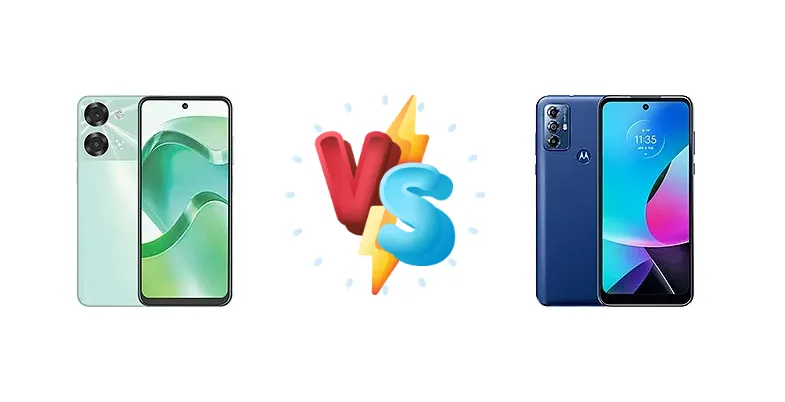
|
🏆 Quick Verdict
For the average user prioritizing quick top-ups and potentially slightly smoother multitasking, the itel P40+ is the better choice. Its 18W charging significantly outperforms the Moto G Play’s 10W, and the Unisoc T606’s Cortex-A75 cores offer a performance edge in demanding tasks. However, the Moto G Play benefits from Motorola’s software support.
| PHONES | ||
|---|---|---|
| Phone Names | itel P40+ | Motorola Moto G Play (2023) |
| Network | ||
|---|---|---|
| 2G bands | GSM 850 / 900 / 1800 / 1900 | GSM 850 / 900 / 1800 / 1900 |
| 3G bands | HSDPA 850 / 900 / 2100 | HSDPA 850 / 900 / 1700(AWS) / 1900 / 2100 |
| 4G bands | 1, 3, 5, 8, 38, 40, 41 LTE | 1, 2, 3, 4, 5, 7, 8, 12, 13, 14, 17, 18, 19, 20, 25, 26, 29, 30, 38, 39, 40, 41, 66, 71 |
| Speed | HSPA, LTE | HSPA, LTE |
| Technology | GSM / HSPA / LTE | GSM / CDMA / HSPA / LTE |
| - | CDMA 800 / 1900 | |
| Launch | ||
|---|---|---|
| Announced | 2023 | 2022, December 08 |
| Status | Available. Released 2023 | Available. Released 2022, December 12 |
| Body | ||
|---|---|---|
| Build | - | Plastic frame, plastic back |
| Dimensions | 8.9 mm thickness | 167.2 x 76.5 x 9.4 mm (6.58 x 3.01 x 0.37 in) |
| SIM | Dual SIM | Nano-SIM |
| Weight | - | 203 g (7.20 oz) |
| - | Water-repellent coating | |
| Display | ||
|---|---|---|
| Resolution | 720 x 1640 pixels (~263 ppi density) | 720 x 1600 pixels, 20:9 ratio (~270 ppi density) |
| Size | 6.8 inches, 109.8 cm2 | 6.5 inches, 102.0 cm2 (~79.7% screen-to-body ratio) |
| Type | IPS LCD, 90Hz | IPS LCD, 90Hz |
| Platform | ||
|---|---|---|
| CPU | Octa-core (2x1.6 GHz Cortex-A75 & 6x1.6 GHz Cortex-A55) | Octa-core (4x2.3 GHz Cortex-A53 & 4x1.8 GHz Cortex-A53) |
| Chipset | Unisoc T606 (12 nm) | Mediatek MT6765 Helio G37 (12 nm) |
| GPU | Mali-G57 MP1 | PowerVR GE8320 |
| OS | Android 12 or 13 | Android 12 |
| Memory | ||
|---|---|---|
| Card slot | microSDXC | microSDXC (dedicated slot) |
| Internal | 128GB 4GB RAM | 32GB 3GB RAM |
| - | eMMC 5.1 | |
| Main Camera | ||
|---|---|---|
| Features | LED flash | LED flash, HDR, panorama |
| Single | 13 MP Auxiliary lens | - |
| Triple | - | 16 MP, f/2.2, (wide), 1.12µm, PDAF 2 MP (macro) Auxiliary lens |
| Video | 1080p@30fps | 1080p@30/60fps |
| Selfie camera | ||
|---|---|---|
| Features | - | HDR |
| Single | 8 MP | 5 MP, f/2.4, (wide), 1.12µm |
| Video | Yes | 1080p@30fps |
| Sound | ||
|---|---|---|
| 3.5mm jack | - | Yes |
| 35mm jack | Yes | Yes |
| Loudspeaker | Yes | Yes |
| Comms | ||
|---|---|---|
| Bluetooth | Yes | 5.0, A2DP, LE |
| NFC | No | No |
| Positioning | GPS | GPS, GLONASS |
| Radio | Unspecified | No |
| USB | USB Type-C | USB Type-C 2.0 |
| WLAN | Yes | Wi-Fi 802.11 a/b/g/n/ac, dual-band |
| Features | ||
|---|---|---|
| Sensors | Fingerprint (side-mounted), accelerometer | Fingerprint (rear-mounted), accelerometer, proximity, barometer |
| Battery | ||
|---|---|---|
| Charging | 18W wired | 10W wired |
| Type | 7000 mAh | Li-Po 5000 mAh |
| Misc | ||
|---|---|---|
| Colors | Force Black, Ice Cyan | Deep Indigo |
| Models | P683L | XT2271-1, XT2271-3, XT2271-5, XT2271-4 |
| Price | - | $ 54.00 / C$ 129.00 |
itel P40+
- Faster 18W charging for quicker top-ups
- Unisoc T606 offers better CPU architecture for multitasking
- Potentially smoother app performance due to Cortex-A75 cores
- Less established brand recognition than Motorola
- Software updates may be less frequent
Motorola Moto G Play (2023)
- Motorola’s reputation for reliable software
- Established brand with wider service network
- Potentially cleaner Android experience
- Slower 10W charging
- Helio G37’s older CPU architecture may limit performance
- Less efficient CPU cores
Display Comparison
Neither device boasts a standout display. Both are likely utilizing LCD panels, typical for this price bracket. Detailed specs like resolution and peak brightness are missing, but we can assume they are similar – around 720p+ and modest brightness levels. The focus here isn't on visual fidelity, but on basic usability. Bezels are likely to be substantial on both devices, contributing to a larger overall footprint.
Camera Comparison
Camera performance is likely to be similar, and largely dependent on software processing. Both devices will likely feature a primary camera and potentially a depth or macro sensor (often of limited utility). Without specific sensor size or aperture information, it’s difficult to make a definitive judgment. However, the Unisoc T606’s ISP (Image Signal Processor) may offer slightly better image processing capabilities, potentially leading to more detailed photos in good lighting conditions. Expect both to struggle in low-light scenarios.
Performance
The core difference lies in the chipsets. The itel P40+ uses the Unisoc T606, featuring a dual-cluster configuration with 2x 1.6 GHz Cortex-A75 cores and 6x 1.6 GHz Cortex-A55 cores. This architecture provides a noticeable boost in single-core performance compared to the Motorola’s MediaTek Helio G37. The G37 utilizes four Cortex-A53 cores clocked at 2.3 GHz and another four at 1.8 GHz. While the G37’s higher clock speed *sounds* better, the older A53 architecture is less efficient and offers lower IPC (Instructions Per Clock) than the A75 cores in the Unisoc chip. This translates to potentially smoother app switching and faster response times on the itel, especially with multiple apps open. Both are 12nm chips, so thermal efficiency will be comparable.
Battery Life
Both phones likely house batteries in the 4000-5000 mAh range, a common capacity for this segment. However, the itel P40+’s 18W wired charging is a significant advantage over the Moto G Play’s 10W charging. This means the itel can replenish its battery much faster, reducing downtime. While a larger battery capacity *sounds* better, the faster charging of the itel P40+ can effectively mitigate the impact of a slightly smaller battery, as users can quickly top up throughout the day.
Buying Guide
Buy the itel P40+ if you need faster charging speeds and a chipset with more capable high-performance cores for occasional gaming or multitasking. This phone is ideal for users who frequently find themselves needing to quickly replenish battery life. Buy the Motorola Moto G Play (2023) if you prefer the reliability of a well-known brand like Motorola and value a potentially cleaner software experience, even if it means sacrificing charging speed and a small performance advantage.