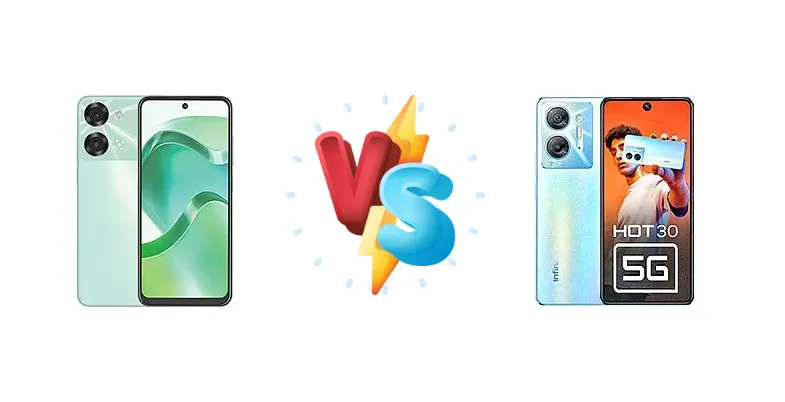
The sub-$200 smartphone market is fiercely competitive, and the itel P40+ and Infinix Hot 30 5G represent two compelling options. While both aim to deliver 5G connectivity at an accessible price, they take distinctly different approaches to achieving this. The itel P40+ focuses on maximizing value, while the Infinix Hot 30 5G prioritizes a more modern chipset for improved performance.
🏆 Quick Verdict
For most users, the Infinix Hot 30 5G is the better choice. Its Mediatek Dimensity 6020 chipset, built on a 7nm process, provides a noticeable performance uplift over the itel P40+'s Unisoc T606. While both offer 18W charging, the Infinix’s superior processing power makes it more future-proof and capable of handling demanding tasks.
| Network |
|---|
| 2G bands | GSM 850 / 900 / 1800 / 1900 | GSM 850 / 900 / 1800 / 1900 |
| 3G bands | HSDPA 850 / 900 / 2100 | HSDPA 850 / 900 / 1700(AWS) / 1900 / 2100 |
| 4G bands | 1, 3, 5, 8, 38, 40, 41 LTE | LTE |
| 5G bands | - | 1, 3, 5, 8, 28, 38, 40, 41, 77, 78 SA/NSA |
| Speed | HSPA, LTE | HSPA, LTE, 5G |
| Technology | GSM / HSPA / LTE | GSM / HSPA / LTE / 5G |
| Launch |
|---|
| Announced | 2023 | 2023, July 14 |
| Status | Available. Released 2023 | Available. Released 2023, July 18 |
| Body |
|---|
| Build | - | Glass front, plastic frame, plastic back |
| Dimensions | 8.9 mm thickness | 168.5 x 76.5 x 9.2 mm (6.63 x 3.01 x 0.36 in) |
| SIM | Dual SIM | Nano-SIM + Nano-SIM |
| Weight | - | 215 g (7.58 oz) |
| Display |
|---|
| Resolution | 720 x 1640 pixels (~263 ppi density) | 1080 x 2460 pixels (~396 ppi density) |
| Size | 6.8 inches, 109.8 cm2 | 6.78 inches, 109.2 cm2 (~84.7% screen-to-body ratio) |
| Type | IPS LCD, 90Hz | IPS LCD, 120Hz, 580 nits (peak) |
| Platform |
|---|
| CPU | Octa-core (2x1.6 GHz Cortex-A75 & 6x1.6 GHz Cortex-A55) | Octa-core (2x2.2 GHz Cortex-A76 & 6x2.0 GHz Cortex-A55) |
| Chipset | Unisoc T606 (12 nm) | Mediatek Dimensity 6020 (7 nm) |
| GPU | Mali-G57 MP1 | Mali-G57 MC2 |
| OS | Android 12 or 13 | Android 13, XOS 13 |
| Memory |
|---|
| Card slot | microSDXC | microSDXC (dedicated slot) |
| Internal | 128GB 4GB RAM | 128GB 4GB RAM, 128GB 8GB RAM |
| Main Camera |
|---|
| Features | LED flash | Quad-LED flash, HDR, panorama |
| Single | 13 MP
Auxiliary lens | 50 MP, f/1.6, (wide), 1/2.55", AF
Auxiliary lens |
| Video | 1080p@30fps | 1440p@30fps, 1080p@30fps |
| Selfie camera |
|---|
| Features | - | Dual-LED flash |
| Single | 8 MP | 8 MP, f/2.0, (wide) |
| Video | Yes | 1080p@30fps |
| Sound |
|---|
| 35mm jack | Yes | Yes |
| Loudspeaker | Yes | Yes, with stereo speakers |
| Comms |
|---|
| Bluetooth | Yes | 5.1, A2DP, LE |
| NFC | No | No |
| Positioning | GPS | GPS, GLONASS, GALILEO, BDS |
| Radio | Unspecified | FM radio |
| USB | USB Type-C | USB Type-C 2.0 |
| WLAN | Yes | Wi-Fi 802.11 a/b/g/n/ac, dual-band |
| Features |
|---|
| Sensors | Fingerprint (side-mounted), accelerometer | Fingerprint (side-mounted), accelerometer, proximity, compass |
| Battery |
|---|
| Charging | 18W wired | 18W wired |
| Type | 7000 mAh | 5000 mAh |
| Misc |
|---|
| Colors | Force Black, Ice Cyan | Knight Black, Aurora Blue |
| Models | P683L | X6832 |
| Price | - | About 140 EUR |
itel P40+
- Most affordable option
- Functional for basic tasks
- Decent battery life (estimated)
- Outdated Unisoc T606 chipset
- Limited performance for gaming
- Likely basic camera performance
Infinix Hot 30 5G
- More powerful Mediatek Dimensity 6020
- Smoother multitasking and gaming
- Better power efficiency
- Slightly higher price point
- 18W charging is relatively slow
- Camera quality may still be limited by sensor size
Display Comparison
Neither device boasts a standout display. Both likely utilize LCD panels, a common cost-saving measure in this segment. The key difference lies under the hood: the chipset's ability to drive the display efficiently. While specific display specs (resolution, brightness) are unavailable, the Dimensity 6020’s more powerful GPU in the Infinix Hot 30 5G will likely result in smoother animations and a more responsive touch experience. Bezels are expected to be similar on both, reflecting their budget positioning.
Camera Comparison
Without detailed camera specifications, a direct comparison is difficult. However, it's safe to assume both phones feature basic camera setups geared towards casual photography. The presence of a 2MP macro camera on either device is likely more for marketing than practical use. Image processing will likely be more refined on the Infinix Hot 30 5G, leveraging the Dimensity 6020’s image signal processor (ISP) for better dynamic range and noise reduction. Sensor size is the critical factor here, and without that data, it's hard to declare a clear winner.
Performance
This is where the Infinix Hot 30 5G truly shines. The Mediatek Dimensity 6020 (7nm) is a significant upgrade over the Unisoc T606 (12nm) found in the itel P40+. The 7nm fabrication process allows for greater transistor density and improved power efficiency, translating to better sustained performance and less thermal throttling. The CPU configuration – 2x2.2 GHz Cortex-A76 & 6x2.0 GHz Cortex-A55 in the Infinix versus 2x1.6 GHz Cortex-A75 & 6x1.6 GHz Cortex-A55 in the itel – further emphasizes this advantage. Users who engage in gaming or multitasking will experience a noticeably smoother experience on the Infinix.
Battery Life
Both devices feature 18W wired charging, suggesting similar charging speeds – likely around 2-3 hours for a full charge. While battery capacity isn't specified, the more efficient Dimensity 6020 in the Infinix Hot 30 5G will likely result in better battery life despite potentially having a similar capacity to the itel P40+. The 7nm process reduces power consumption, allowing the Infinix to extract more usage from each charge.
Buying Guide
Buy the itel P40+ if you need a functional smartphone for basic tasks like calls, messaging, and light social media use, and your budget is extremely tight. Buy the Infinix Hot 30 5G if you prioritize smoother multitasking, occasional gaming, and a more responsive user experience, even if it means spending a little more.
Frequently Asked Questions
❓ Will the Dimensity 6020 in the Infinix Hot 30 5G overheat during prolonged gaming sessions?
The Dimensity 6020 is a relatively efficient chipset. While some heat generation is inevitable during gaming, the 7nm process and Infinix’s thermal management (likely passive cooling) should prevent significant overheating and throttling, allowing for extended gameplay sessions.
❓ Is the 18W charging on either phone fast enough for daily use?
18W charging is considered relatively slow by today's standards. Expect a full charge to take around 2-3 hours. However, given the likely battery capacities of these phones (around 5000mAh), 18W is sufficient for overnight charging or topping up throughout the day.
❓ How does the Unisoc T606 perform with 5G connectivity? Will I experience slow speeds?
The Unisoc T606 supports 5G, but its modem is less advanced than those found in MediaTek or Qualcomm chipsets. While you'll be able to connect to 5G networks, you may not achieve the peak speeds possible with more premium hardware. Expect reliable connectivity for browsing and streaming, but potentially slower download speeds in congested areas.
❓ Can the Infinix Hot 30 5G handle popular games like PUBG Mobile or Call of Duty Mobile?
The Infinix Hot 30 5G, with its Dimensity 6020, can run PUBG Mobile and Call of Duty Mobile, but you'll likely need to use medium or low graphics settings for a smooth experience. The chipset's GPU is capable, but it's not a high-end gaming processor.