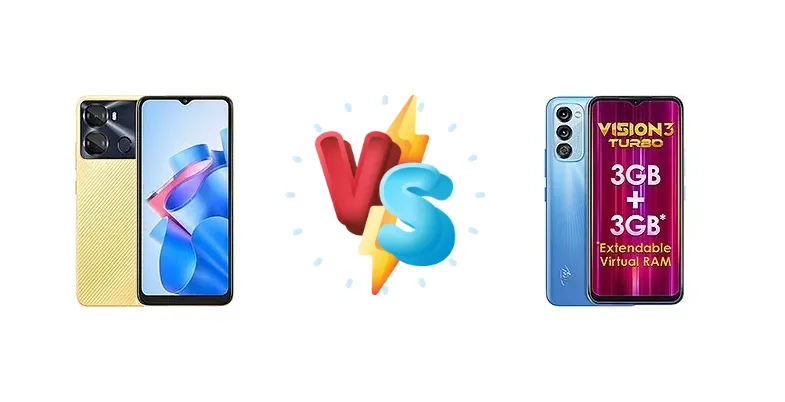
The itel P40 and itel Vision 3 Turbo present a curious case: two smartphones from the same manufacturer, targeting a similar budget-conscious audience, yet vying for attention. The core hardware – the Unisoc SC9863A chipset – is identical. This comparison aims to dissect any meaningful differences beyond branding and marketing, helping you determine which device offers the best value for your money.
🏆 Quick Verdict
For the average user prioritizing pure affordability, the itel Vision 3 Turbo likely represents the better buy. Given the identical Unisoc SC9863A chipset and 18W charging, any price difference will likely be better spent on accessories or data plans, as performance will be virtually indistinguishable.
| Network |
|---|
| 2G bands | GSM 850 / 900 / 1800 / 1900 | GSM 850 / 900 / 1800 / 1900 |
| 3G bands | HSDPA 850 / 900 / 2100 | HSDPA 850 / 900 / 2100 |
| 4G bands | LTE | LTE |
| Speed | HSPA, LTE | HSPA, LTE |
| Technology | GSM / HSPA / LTE | GSM / HSPA / LTE |
| Launch |
|---|
| Announced | 2023 | 2022 |
| Status | Available. Released 2023 | Available. Released 2022 |
| Body |
|---|
| Dimensions | - | - |
| SIM | Dual SIM | Dual SIM |
| Weight | - | - |
| Display |
|---|
| Resolution | 720 x 1612 pixels, 20:9 ratio (~267 ppi density) | 720 x 1600 pixels, 20:9 ratio (~266 ppi density) |
| Size | 6.6 inches, 104.6 cm2 | 6.6 inches, 105.2 cm2 |
| Type | IPS LCD | IPS LCD |
| Platform |
|---|
| CPU | Octa-core (4x1.6 GHz Cortex-A55 & 4x1.2 GHz Cortex-A55) | Octa-core (4x1.6 GHz Cortex-A55 & 4x1.2 GHz Cortex-A55) |
| Chipset | Unisoc SC9863A (28 nm) | Unisoc SC9863A (28 nm) |
| GPU | IMG8322 | IMG8322 |
| OS | Android 12 (Go edition) | Android 11 (Go edition) |
| Memory |
|---|
| Card slot | microSDXC | microSDXC |
| Internal | 32GB 3GB RAM, 64GB 2GB RAM, 64GB 4GB RAM | 64GB 3GB RAM |
| Main Camera |
|---|
| Dual | 13 MP
0.3 MP | - |
| Features | LED flash | LED flash |
| Single | - | 8 MP (wide)
Auxiliary lens |
| Video | 1080p@30fps | 1080p@30fps |
| Selfie camera |
|---|
| Single | 5 MP | 5 MP |
| Video | Yes | Yes |
| Sound |
|---|
| 35mm jack | Yes | Yes |
| Loudspeaker | Yes | Yes |
| Comms |
|---|
| Bluetooth | Yes | Yes |
| NFC | No | No |
| Positioning | GPS | GPS |
| Radio | Unspecified | Unspecified |
| USB | microUSB | microUSB |
| WLAN | Yes | Yes |
| Features |
|---|
| Sensors | Fingerprint (rear-mounted), accelerometer | Fingerprint (rear-mounted), accelerometer |
| Battery |
|---|
| Charging | 18W wired | 18W wired |
| Type | 6000 mAh | 5000 mAh |
| Misc |
|---|
| Colors | Force Black, Dreamy Blue, Luxurious Gold | Blue |
| Models | P662L, P662LN | - |
| Price | About 130 EUR | - |
itel P40
- Potentially lower price point
- Reliable basic functionality
- Efficient chipset for long battery life
- Likely older model
- May have less frequent software updates
itel Vision 3 Turbo
- Potentially newer model
- May have slightly improved software
- Efficient chipset for long battery life
- Potentially higher price point
- Performance identical to itel P40
Display Comparison
Both the itel P40 and Vision 3 Turbo are expected to feature LCD panels, given their price point. However, specific details like screen size, resolution, and peak brightness are not provided. The 28nm Unisoc SC9863A chipset isn't a power hog, suggesting reasonable battery life even with a lower-brightness display. Without knowing the panel characteristics, it's impossible to assess color accuracy or viewing angles, but expectations should be tempered given the budget nature of these devices.
Camera Comparison
Camera specifications are not detailed, but it's safe to assume both phones will feature a multi-camera setup with a primary sensor and potentially auxiliary lenses. Given the target market, image quality will likely be adequate for social media sharing but won't compete with higher-end smartphones. The absence of details regarding sensor size, aperture, or image stabilization suggests a focus on quantity over quality in the camera department. Expect basic image processing algorithms and limited low-light performance.
Performance
The heart of both devices is the Unisoc SC9863A, an octa-core processor built on a 28nm process. This chipset features four Cortex-A55 cores clocked at 1.6 GHz and another four at 1.2 GHz. This configuration is geared towards efficiency rather than raw power, making it suitable for everyday tasks like browsing, messaging, and light app usage. Gaming performance will be limited to less demanding titles. The identical chipset and likely similar RAM configurations (details not provided) mean performance will be nearly identical between the two phones. Thermal throttling is unlikely to be a major concern given the chipset's low power draw.
Battery Life
Both devices support 18W wired charging, a reasonable charging speed for their class. Battery capacity is not specified, but given the efficient Unisoc SC9863A chipset, both phones should offer all-day battery life with moderate usage. The 18W charging will likely take around 2-3 hours for a full charge, depending on the battery capacity. Without knowing the mAh rating, it's difficult to definitively say which phone offers better battery life, but the chipset's efficiency suggests similar performance.
Buying Guide
Buy the itel P40 if you find it significantly discounted and are solely focused on basic smartphone functionality – calls, texts, and light social media. Buy the itel Vision 3 Turbo if you prefer a potentially newer model with a slightly more modern software experience, assuming the price difference isn't substantial. Both are aimed at first-time smartphone users or those needing a reliable secondary device.
Frequently Asked Questions
❓ Will the Unisoc SC9863A handle popular games like PUBG Mobile or Call of Duty?
The Unisoc SC9863A is not a gaming-focused chipset. While it can run less demanding games, PUBG Mobile and Call of Duty will likely require the lowest graphics settings and may still experience frame rate drops. It's best suited for casual gaming rather than competitive titles.
❓ What type of storage does each phone use – eMMC or UFS?
The storage type (eMMC or UFS) is not specified. However, given the price point, it's highly probable that both devices utilize eMMC storage, which is slower than UFS. This will impact app loading times and overall system responsiveness.
❓ How often will these phones receive software updates?
itel's update track record is not known for being particularly frequent. Expect limited software updates, primarily security patches, and potentially a single major Android version upgrade, if any. Don't rely on these phones for the latest Android features.