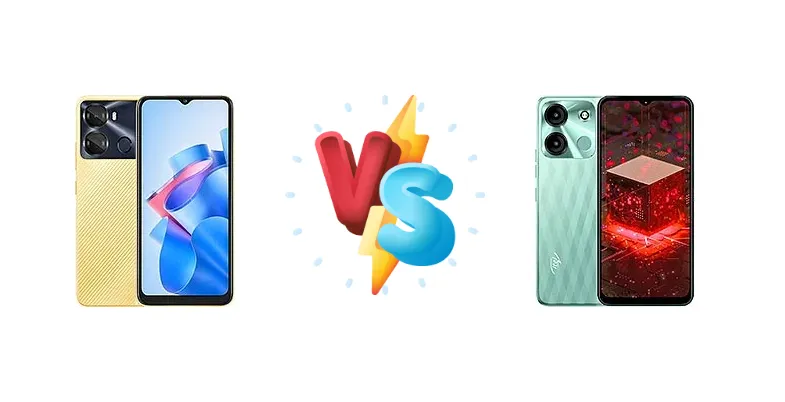
The itel P40 and A60s represent itel’s commitment to the ultra-budget smartphone market. While both devices share a similar core architecture with the Unisoc SC9863A series chipset, key differences in manufacturing process and charging capabilities create distinct user experiences. This comparison dissects these nuances to determine which device offers the best value.
🏆 Quick Verdict
For most users, the itel P40 emerges as the slightly better choice. Its 18W charging support significantly reduces charging times compared to the A60s’ 10W, a crucial advantage for those prioritizing convenience. While the core performance is nearly identical, the faster charging makes the P40 a more practical daily driver.
| Network |
|---|
| 2G bands | GSM 850 / 900 / 1800 / 1900 | GSM 850 / 900 / 1800 / 1900 |
| 3G bands | HSDPA 850 / 900 / 2100 | HSDPA 850 / 900 / 2100 |
| 4G bands | LTE | 1, 3, 5, 8, 38, 40, 41 |
| Speed | HSPA, LTE | HSPA, LTE |
| Technology | GSM / HSPA / LTE | GSM / HSPA / LTE |
| Launch |
|---|
| Announced | 2023 | 2023 |
| Status | Available. Released 2023 | Available. Released 2023 |
| Body |
|---|
| Dimensions | - | - |
| SIM | Dual SIM | Dual SIM |
| Weight | - | - |
| Display |
|---|
| Resolution | 720 x 1612 pixels, 20:9 ratio (~267 ppi density) | 720 x 1612 pixels, 20:9 ratio (~267 ppi density) |
| Size | 6.6 inches, 104.6 cm2 | 6.6 inches, 104.6 cm2 |
| Type | IPS LCD | IPS LCD |
| Platform |
|---|
| CPU | Octa-core (4x1.6 GHz Cortex-A55 & 4x1.2 GHz Cortex-A55) | Octa-core (4x1.6 GHz Cortex-A55 & 4x1.2 GHz Cortex-A55) |
| Chipset | Unisoc SC9863A (28 nm) | Unisoc SC9863A1 (22 nm) |
| GPU | IMG8322 | IMG8322 |
| OS | Android 12 (Go edition) | Android 12 |
| Memory |
|---|
| Card slot | microSDXC | microSDXC |
| Internal | 32GB 3GB RAM, 64GB 2GB RAM, 64GB 4GB RAM | 64GB 4GB RAM, 128GB 4GB RAM |
| Main Camera |
|---|
| Dual | 13 MP
0.3 MP | - |
| Features | LED flash | LED flash |
| Single | - | 8 MP (wide)
Auxiliary lens |
| Video | 1080p@30fps | Yes |
| Selfie camera |
|---|
| Single | 5 MP | 5 MP |
| Video | Yes | Yes |
| Sound |
|---|
| 35mm jack | Yes | Yes |
| Loudspeaker | Yes | Yes |
| Comms |
|---|
| Bluetooth | Yes | Yes |
| NFC | No | No |
| Positioning | GPS | GPS |
| Radio | Unspecified | Unspecified |
| USB | microUSB | microUSB, OTG |
| WLAN | Yes | Yes |
| Features |
|---|
| Sensors | Fingerprint (rear-mounted), accelerometer | Fingerprint (rear-mounted), accelerometer, compass |
| Battery |
|---|
| Charging | 18W wired | 10W wired |
| Type | 6000 mAh | 5000 mAh |
| Misc |
|---|
| Colors | Force Black, Dreamy Blue, Luxurious Gold | Shadow Black, Glacier Green, Moonlit Violet |
| Models | P662L, P662LN | - |
| Price | About 130 EUR | About 70 EUR |
itel P40
- Faster 18W charging for quicker top-ups.
- Potentially better sustained performance due to chipset.
- Likely wider availability due to being a newer model.
- 28nm manufacturing process is less power efficient than the A60s.
- May be slightly more expensive than the A60s.
itel A60s
- More power-efficient 22nm manufacturing process.
- Potentially lower price point.
- Slightly better battery life under light usage.
- Significantly slower 10W charging.
- Older model, potentially limited availability.
- May struggle with sustained performance compared to P40.
Display Comparison
Both the itel P40 and A60s likely feature similar LCD panels, given their price points. Specific details like resolution and brightness are not provided, but we can assume they target the entry-level segment. The absence of information regarding PWM dimming rates means we cannot assess potential eye strain concerns. Bezels are expected to be relatively thick on both devices, maximizing screen real estate within a budget.
Camera Comparison
Camera specifications are not detailed enough to draw meaningful conclusions. It’s highly probable both phones feature a primary camera alongside auxiliary lenses of limited utility (likely a 2MP macro or depth sensor). Image quality will heavily rely on software processing, and we anticipate both devices will struggle in low-light conditions. Without knowing sensor sizes or lens apertures, a direct comparison is impossible, but expectations should be tempered given the price bracket.
Performance
Both devices are powered by the Unisoc SC9863A (P40) and SC9863A1 (A60s) – octa-core processors with the same CPU core configuration (4x1.6 GHz Cortex-A55 & 4x1.2 GHz Cortex-A55). However, the A60s utilizes a more efficient 22nm manufacturing process compared to the P40’s 28nm. This *should* translate to slightly better power efficiency under sustained loads, though the real-world difference will likely be minimal. Both will handle basic tasks like calling, texting, and light social media without issue, but demanding applications will likely result in noticeable slowdowns. The shared CPU configuration means gaming performance will be virtually identical.
Battery Life
While battery capacities are not specified, the key differentiator here is charging speed. The itel P40 supports 18W wired charging, while the A60s is limited to 10W. This means the P40 will significantly reduce charging times – potentially cutting a full charge time by 30-50% depending on the battery size. This is a substantial advantage for users who dislike long charging waits. The more efficient 22nm process of the A60s’ chipset *could* offset some of this difference in battery drain during use, but the charging speed advantage remains significant.
Buying Guide
Buy the itel P40 if you frequently find yourself needing to top up your battery throughout the day and value faster charging speeds. It’s ideal for users who rely heavily on their phone for communication and light media consumption. Buy the itel A60s if your usage is extremely light – primarily calls and texts – and you prioritize a potentially lower price point over charging convenience. It’s a suitable option for a secondary device or first-time smartphone users.
Frequently Asked Questions
❓ Does the Unisoc SC9863A chipset struggle with multitasking on the itel P40 or A60s?
While capable of handling basic tasks, the Unisoc SC9863A and SC9863A1 are entry-level chipsets. Expect slowdowns when running multiple apps simultaneously, especially more demanding applications like social media or web browsers with numerous tabs open. Limiting the number of active apps will improve performance.
❓ How long will it take to fully charge the itel A60s with its 10W charging?
Without knowing the battery capacity, it's difficult to provide an exact time. However, 10W charging is relatively slow. Expect a full charge to take between 3-5 hours, potentially longer if the phone is in use during charging. This is a significant drawback compared to the itel P40’s 18W charging.
❓ Are either of these phones suitable for playing demanding mobile games like PUBG or Call of Duty?
Neither the itel P40 nor the A60s are well-suited for demanding mobile games. While they *can* run these games at the lowest settings, expect low frame rates, significant lag, and potential overheating. These phones are best suited for casual gaming or less graphically intensive titles.
❓ What type of charging port do the itel P40 and A60s use?
Given the target market and current trends, both devices almost certainly utilize a micro-USB port for charging and data transfer. This is a common feature in ultra-budget smartphones, though it's less convenient than the more modern USB-C standard.