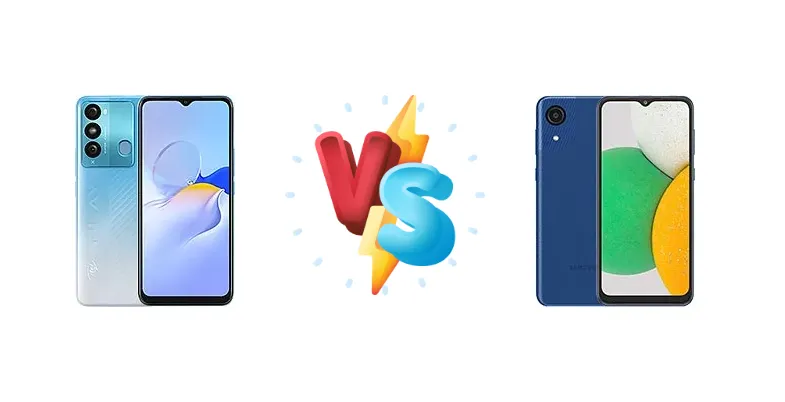
The itel P38 and Samsung Galaxy A03 Core represent the extreme end of the smartphone price spectrum. Both aim to deliver essential smartphone functionality at a minimal cost, but they take different approaches. The A03 Core leverages a more modern, octa-core chipset, while the P38 opts for a simpler quad-core configuration. This comparison dissects their strengths and weaknesses to determine which offers the best value for budget-conscious consumers.
🏆 Quick Verdict
For the average user prioritizing multitasking and smoother app performance, the Samsung Galaxy A03 Core is the better choice. Its Unisoc SC9863A chipset, with its eight cores, provides a noticeable advantage over the itel P38’s quad-core processor, despite the P38’s potentially simpler software overhead.
| Network |
|---|
| 2G bands | GSM 850 / 900 / 1800 / 1900 | GSM 850 / 900 / 1800 / 1900 |
| 3G bands | HSDPA 850 / 900 / 2100 | HSDPA 850 / 900 / 2100 |
| 4G bands | LTE | 1, 3, 5, 7, 8, 20, 28, 38, 40, 41 |
| Speed | HSPA, LTE | HSPA 21.1/5.76 Mbps, LTE |
| Technology | GSM / HSPA / LTE | GSM / HSPA / LTE |
| Launch |
|---|
| Announced | 2022 | 2021, November 15 |
| Status | Available. Released 2022 | Available. Released 2021, December 06 |
| Body |
|---|
| Build | - | Plastic back, plastic frame |
| Dimensions | - | 164.2 x 75.9 x 9.1 mm (6.46 x 2.99 x 0.36 in) |
| SIM | Dual SIM | · Nano-SIM· Nano-SIM + Nano-SIM |
| Weight | - | 211 g (7.44 oz) |
| Display |
|---|
| Resolution | 720 x 1612 pixels, 20:9 ratio (~267 ppi density) | 720 x 1600 pixels, 20:9 ratio (~270 ppi density) |
| Size | 6.6 inches, 104.6 cm2 | 6.5 inches, 102.0 cm2 (~81.8% screen-to-body ratio) |
| Type | IPS LCD | PLS LCD |
| Platform |
|---|
| CPU | Quad-core 1.3 GHz | Octa-core (4x1.6 GHz Cortex-A55 & 4x1.2 GHz Cortex-A55) |
| Chipset | - | Unisoc SC9863A (28 nm) |
| GPU | - | IMG8322 |
| OS | Android 11 (Go edition) | Android 11 (Go edition) |
| Memory |
|---|
| Card slot | microSDXC | microSDXC (dedicated slot) |
| Internal | 32GB 2GB RAM | 32GB 2GB RAM |
| | - | eMMC 5.1 |
| Main Camera |
|---|
| Features | LED flash | LED flash |
| Single | 8 MP (wide)
Auxiliary lens | 8 MP, f/2.0, AF |
| Video | Yes | 1080p@30fps |
| Selfie camera |
|---|
| Single | 5 MP | 5 MP, f/2.2 |
| Video | Yes | - |
| Sound |
|---|
| 3.5mm jack | - | Yes |
| 35mm jack | Yes | Yes |
| Loudspeaker | Yes | Yes |
| Comms |
|---|
| Bluetooth | Yes | 4.2, A2DP |
| NFC | No | No |
| Positioning | GPS | GPS, GLONASS |
| Radio | Unspecified | Unspecified |
| USB | microUSB | microUSB 2.0, OTG |
| WLAN | Yes | Wi-Fi 802.11 b/g/n, Wi-Fi Direct |
| Features |
|---|
| Sensors | Fingerprint (rear-mounted), accelerometer | Accelerometer, proximity |
| Battery |
|---|
| Charging | 15W wired | - |
| Type | 5000 mAh | Li-Ion 5000 mAh |
| Misc |
|---|
| Colors | Galaxy Blue, Spruce Green, Nebula Black | Black, Blue |
| Models | - | SM-A032F, SM-A032F/DS, SM-A032M |
| Price | - | £ 74.99 |
| SAR | - | 0.30 W/kg (head) |
| SAR EU | - | 0.24 W/kg (head) 1.39 W/kg (body) |
itel P38
- Potentially simpler software experience leading to less bloatware.
- 15W wired charging is a standard feature.
- May be more readily available in certain regional markets.
- Quad-core processor is significantly less powerful than the A03 Core.
- Likely to struggle with multitasking and demanding apps.
- Limited future-proofing.
Samsung Galaxy A03 Core
- Octa-core processor offers superior performance.
- More efficient chipset potentially leading to better battery life.
- Samsung brand recognition and software support.
- Unisoc chipset may not be as widely supported with software updates.
- Potential for more pre-installed bloatware.
- May be slightly more expensive than the itel P38.
Display Comparison
Neither device is expected to deliver a premium display experience. Specifics regarding panel type (IPS vs. TFT) and resolution are missing for both, but given the price point, TFT panels are highly probable. The focus here is on functionality, not fidelity. Bezels are likely to be substantial on both devices, maximizing screen real estate within a compact form factor. Color accuracy and viewing angles will likely be limited on both.
Camera Comparison
Camera performance is likely to be similar on both devices, leaning towards basic functionality. Details regarding sensor size and image processing are unavailable, but both are expected to feature a primary camera and potentially a secondary depth sensor. The A03 Core may benefit from slightly more sophisticated image processing capabilities due to the more powerful chipset, but don't expect flagship-level results. Any 2MP macro or VGA sensors present on either device should be considered largely for marketing purposes and offer minimal practical benefit.
Performance
The core difference lies in the chipset. The Samsung Galaxy A03 Core’s Unisoc SC9863A is an octa-core processor built on a 28nm process, featuring four Cortex-A55 cores clocked at 1.6 GHz and four at 1.2 GHz. This configuration allows for efficient handling of background tasks and smoother multitasking compared to the itel P38’s quad-core 1.3 GHz processor. While the P38’s processor may be sufficient for basic operations, the A03 Core’s architecture provides a significant advantage in app launch times and overall responsiveness. The 28nm process node of the Unisoc chip, while not cutting-edge, is a reasonable compromise for this price segment.
Battery Life
The itel P38 features 15W wired charging. Battery capacity is not specified for either device, but both are likely to house batteries in the 4000-5000 mAh range. The A03 Core’s more efficient chipset *could* translate to slightly better battery life under moderate usage, despite potentially having a similar capacity. The 15W charging on the P38 is a standard rate for this segment, and neither device is expected to offer particularly fast charging speeds. Expect a full charge to take several hours.
Buying Guide
Buy the itel P38 if you need a basic, reliable phone for calls, texts, and light social media use, and prioritize simplicity. It's ideal for first-time smartphone users or as a backup device. Buy the Samsung Galaxy A03 Core if you prefer a phone capable of handling more demanding tasks like multiple apps simultaneously, streaming video, or playing less intensive mobile games. The octa-core processor offers a more future-proof experience.
Frequently Asked Questions
❓ Will the Unisoc SC9863A in the A03 Core overheat during prolonged use, like video streaming?
The Unisoc SC9863A is a relatively low-power chipset designed for efficiency. While it can handle video streaming, extended periods of high usage *could* lead to some thermal throttling, but it's unlikely to cause significant overheating or performance degradation. The 28nm process isn't the most efficient, but the chip is designed for budget devices and isn't pushed to its limits.
❓ Is the itel P38 a good choice for someone upgrading from a feature phone?
Yes, the itel P38 is a suitable option for first-time smartphone users. Its simple interface and basic functionality make it easy to learn, and it provides essential smartphone features like calling, texting, and access to basic apps. However, users should be aware of its limitations in terms of performance and multitasking.
❓ Can the Samsung Galaxy A03 Core handle popular games like PUBG Mobile?
The Samsung Galaxy A03 Core can *run* PUBG Mobile, but not at high settings. Expect to play at the lowest graphics settings and potentially with a lower frame rate to maintain a playable experience. The Unisoc SC9863A isn't a gaming powerhouse, so it's best suited for less demanding mobile games.