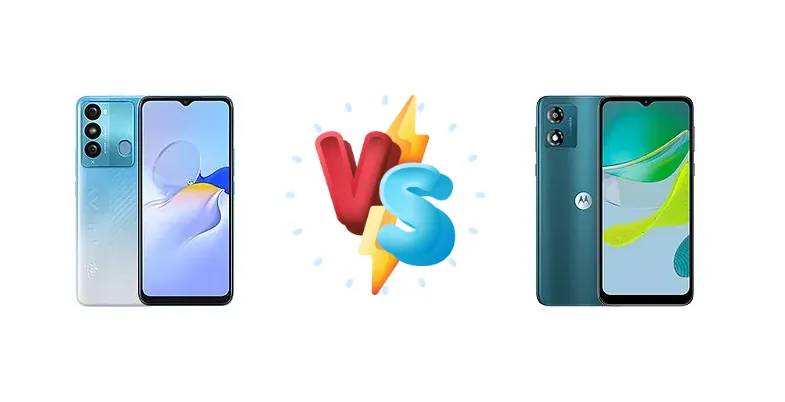
The sub-$150 smartphone market is fiercely competitive. Both the itel P38 and Motorola Moto E13 aim to deliver essential smartphone functionality at an incredibly accessible price point. However, they take different approaches: the itel P38 focuses on simplicity, while the Moto E13 attempts to offer a more modern chipset for improved performance. This comparison will dissect their key differences to help you choose the right device.
🏆 Quick Verdict
For most users, the Motorola Moto E13 is the better choice. Its Unisoc T606 chipset provides a significantly faster and more responsive experience than the itel P38’s quad-core processor. While the itel P38 offers slightly faster wired charging, the performance gains of the Moto E13 outweigh this advantage for everyday tasks and light gaming.
| Network |
|---|
| 2G bands | GSM 850 / 900 / 1800 / 1900 | GSM 850 / 900 / 1800 / 1900 |
| 3G bands | HSDPA 850 / 900 / 2100 | HSDPA 850 / 900 / 2100 |
| 4G bands | LTE | 1, 3, 5, 7, 8, 28, 38, 40, 41 |
| Speed | HSPA, LTE | HSPA, LTE |
| Technology | GSM / HSPA / LTE | GSM / HSPA / LTE |
| | - | 1, 3, 5, 7, 8, 20, 28, 38, 40, 41 |
| Launch |
|---|
| Announced | 2022 | 2023, January 24 |
| Status | Available. Released 2022 | Available. Released 2023, February 13 |
| Body |
|---|
| Build | - | Glass front, plastic frame, plastic back |
| Dimensions | - | 164.2 x 75 x 8.5 mm (6.46 x 2.95 x 0.33 in) |
| SIM | Dual SIM | Nano-SIM + Nano-SIM |
| Weight | - | 179.5 g (6.35 oz) |
| | - | Water-resistant design |
| Display |
|---|
| Resolution | 720 x 1612 pixels, 20:9 ratio (~267 ppi density) | 720 x 1600 pixels, 20:9 ratio (~270 ppi density) |
| Size | 6.6 inches, 104.6 cm2 | 6.5 inches, 102.0 cm2 (~82.8% screen-to-body ratio) |
| Type | IPS LCD | IPS LCD |
| Platform |
|---|
| CPU | Quad-core 1.3 GHz | Octa-core (2x1.6 GHz Cortex-A75 & 6x1.6 GHz Cortex-A55) |
| Chipset | - | Unisoc T606 (12 nm) |
| GPU | - | Mali-G57 MP1 |
| OS | Android 11 (Go edition) | Android 13 (Go edition) |
| Memory |
|---|
| Card slot | microSDXC | microSDXC (dedicated slot) |
| Internal | 32GB 2GB RAM | 32GB 2GB RAM, 64GB 2GB RAM, 64GB 4GB RAM, 128GB 8GB RAM |
| | - | eMMC 5.1 |
| Main Camera |
|---|
| Features | LED flash | LED flash, HDR, panorama |
| Single | 8 MP (wide)
Auxiliary lens | 13 MP, f/2.2, (wide), 1.12µm, PDAF |
| Video | Yes | 1080p@30fps |
| Selfie camera |
|---|
| Single | 5 MP | 5 MP, f/2.4, (wide), 1/5.0", 1.12µm |
| Video | Yes | 1080p@30fps |
| Sound |
|---|
| 3.5mm jack | - | Yes |
| 35mm jack | Yes | Yes |
| Loudspeaker | Yes | Yes |
| Comms |
|---|
| Bluetooth | Yes | 5.0, A2DP, LE |
| NFC | No | No |
| Positioning | GPS | GPS, GLONASS, GALILEO |
| Radio | Unspecified | FM radio, recording |
| USB | microUSB | USB Type-C 2.0, OTG |
| WLAN | Yes | Wi-Fi 802.11 a/b/g/n/ac, dual-band |
| Features |
|---|
| Sensors | Fingerprint (rear-mounted), accelerometer | Accelerometer, proximity |
| Battery |
|---|
| Charging | 15W wired | 10W wired |
| Type | 5000 mAh | Li-Po 5000 mAh |
| Misc |
|---|
| Colors | Galaxy Blue, Spruce Green, Nebula Black | Cosmic Black, Creamy White, Aurora Green |
| Price | - | $ 119.99 / € 104.99 |
itel P38
- Faster wired charging (15W)
- Simpler, potentially more streamlined software experience
- Potentially longer battery life due to less demanding processor
- Significantly slower processor
- Less responsive user interface
- Limited multitasking capabilities
Motorola Moto E13
- Faster and more efficient Unisoc T606 chipset
- Smoother multitasking and app performance
- More responsive user experience
- Better GPU for light gaming
- Slower wired charging (10W)
- Potentially shorter battery life under heavy load
- May have more pre-installed bloatware
Display Comparison
Neither device boasts a standout display. Both are likely to feature LCD panels, typical for this price bracket. The lack of specified resolution or refresh rate suggests both are targeting 720p at 60Hz. The key difference lies under the hood; the Moto E13’s Unisoc T606 chipset has an integrated GPU that will provide a smoother experience when scrolling and navigating the UI compared to the itel P38’s older architecture. While neither will offer vibrant colors or high brightness, the Moto E13’s GPU will be the deciding factor for visual fluidity.
Camera Comparison
Both phones likely feature basic camera setups. Without detailed sensor information, it’s difficult to make a definitive judgment. However, given the price point, expect both to rely heavily on software processing. The Moto E13’s more powerful chipset *could* translate to slightly better image processing capabilities, but the quality will ultimately depend on the sensor and lens used. It's safe to assume both will struggle in low-light conditions. The presence of a 2MP macro camera on either device is largely a marketing gimmick and unlikely to produce usable results.
Performance
The Motorola Moto E13’s Unisoc T606 chipset is the clear winner here. Its octa-core configuration (2x1.6 GHz Cortex-A75 & 6x1.6 GHz Cortex-A55) represents a substantial leap over the itel P38’s quad-core 1.3 GHz processor. The Cortex-A75 cores in the Moto E13 provide significantly more processing power for demanding tasks, while the Cortex-A55 cores handle background processes efficiently. This translates to faster app loading times, smoother multitasking, and a more responsive overall experience. The 12nm process node of the Unisoc T606 also contributes to better power efficiency compared to the likely older, larger node process used in the itel P38.
Battery Life
The itel P38’s 15W wired charging is faster than the Moto E13’s 10W charging. This means a quicker top-up time, potentially reducing downtime. However, the Moto E13’s more efficient Unisoc T606 chipset could offset this difference in real-world usage. The itel P38’s less powerful processor will consume less energy, potentially leading to longer battery life during moderate use. The actual battery capacity of both devices is not specified, but the efficiency of the chipset will be a more significant factor than a small difference in mAh.
Buying Guide
Buy the itel P38 if you prioritize absolute simplicity and minimal software overhead, and your usage is limited to basic calling, texting, and very light app use. You'll appreciate its straightforward interface and potentially longer battery life due to the less demanding processor. Buy the Motorola Moto E13 if you want a more fluid user experience, smoother multitasking, and the ability to run more demanding apps without significant lag. The Unisoc T606 chipset makes it a better choice for anyone who wants a phone that feels more responsive and capable.
Frequently Asked Questions
❓ Will the Motorola Moto E13 struggle with popular social media apps like TikTok and Instagram?
While the Unisoc T606 isn't a powerhouse, it's capable of running TikTok and Instagram smoothly for most users. Expect some occasional lag when switching between apps or scrolling through feeds, but it shouldn't be a deal-breaker for casual social media use. The itel P38 will likely exhibit more noticeable lag in these scenarios.
❓ Is the Motorola Moto E13 a good option for playing mobile games?
The Moto E13 can handle light gaming, such as casual puzzle games and older titles. However, it's not designed for demanding games like PUBG or Call of Duty. You'll likely need to lower graphics settings significantly and still experience frame drops. The itel P38 is even less suited for gaming due to its weaker processor.
❓ How much bloatware comes pre-installed on the Motorola Moto E13?
Motorola has historically included some pre-installed apps (bloatware) on its budget devices. While it's generally less intrusive than some other brands, expect to find a few pre-loaded apps that you may not need. Fortunately, most can be uninstalled or disabled.
❓ Does the itel P38 support fast charging accessories beyond the included charger?
While the itel P38 supports 15W charging, it's unlikely to benefit significantly from using a more powerful charger. The phone's internal charging circuitry is likely limited to 15W, so a higher wattage charger won't deliver faster charging speeds.