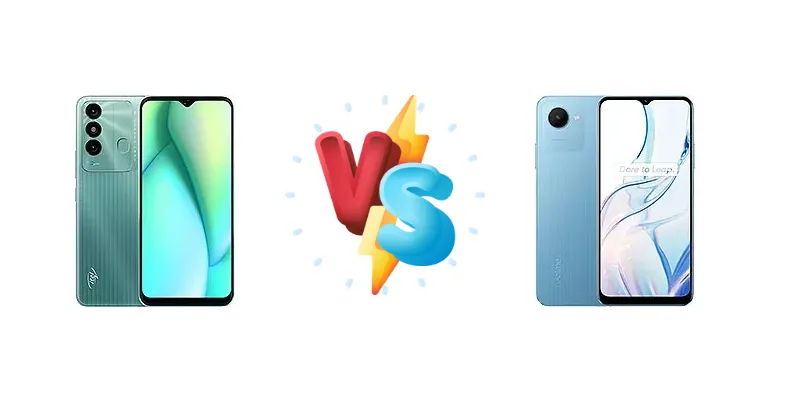
The itel P38 Pro and Realme C30s represent the fiercely competitive entry-level smartphone market. Both aim to deliver essential smartphone functionality at an incredibly affordable price point, but they take slightly different approaches. The itel P38 Pro emphasizes faster charging, while the Realme C30s focuses on a streamlined user experience. This comparison dissects their key specifications to determine which device offers the best value.
🏆 Quick Verdict
For the average user prioritizing faster charging and potentially more responsive multitasking, the itel P38 Pro emerges as the better choice. Its 18W charging significantly reduces downtime compared to the Realme C30s’ 10W charging, and the Unisoc SC9863A chipset, while not a powerhouse, offers a more complex core configuration.
| Network |
|---|
| 2G bands | GSM 850 / 900 / 1800 / 1900 | GSM 850 / 900 / 1800 / 1900 |
| 3G bands | HSDPA 850 / 900 / 2100 | HSDPA 850 / 900 / 2100 |
| 4G bands | LTE | 1, 3, 5, 8, 38, 40, 41 |
| Speed | HSPA, LTE | HSPA, LTE |
| Technology | GSM / HSPA / LTE | GSM / HSPA / LTE |
| Launch |
|---|
| Announced | 2022 | 2022, September 14 |
| Status | Available. Released 2022 | Available. Released 2022, September 23 |
| Body |
|---|
| Build | - | Glass front, plastic frame, plastic back |
| Dimensions | - | 164.2 x 75.7 x 8.5 mm (6.46 x 2.98 x 0.33 in) |
| SIM | Dual SIM | Nano-SIM + Nano-SIM |
| Weight | - | 186 g (6.56 oz) |
| Display |
|---|
| Resolution | 720 x 1612 pixels, 20:9 ratio (~260 ppi density) | 720 x 1600 pixels, 20:9 ratio (~270 ppi density) |
| Size | 6.8 inches, 111.1 cm2 | 6.5 inches, 102.0 cm2 (~82.1% screen-to-body ratio) |
| Type | IPS LCD | IPS LCD |
| Platform |
|---|
| CPU | Octa-core (4x1.6 GHz Cortex-A55 & 4x1.2 GHz Cortex-A55) | Octa-core 1.6 GHz Cortex-A55 |
| Chipset | Unisoc SC9863A (28 nm) | - |
| GPU | IMG8322 | IMG8322 |
| OS | Android 11 (Go edition) | Android 12, Realme UI Go |
| Memory |
|---|
| Card slot | microSDXC | microSDXC (dedicated slot) |
| Internal | 64GB 2GB RAM | 32GB 2GB RAM, 32GB 3GB RAM, 64GB 3GB RAM, 64GB 4GB RAM |
| Main Camera |
|---|
| Dual | 13 MP
0.3 MP | - |
| Features | LED flash | LED flash, HDR, panorama |
| Single | - | 8 MP, (wide), 1/4.0", 1.12µm |
| Video | 1080p@30fps | 1080p@30fps |
| Selfie camera |
|---|
| Features | - | HDR |
| Single | 5 MP | 5 MP, (wide), 1/5.0", 1.12µm |
| Video | Yes | 720p@30fps |
| Sound |
|---|
| 3.5mm jack | - | Yes |
| 35mm jack | Yes | Yes |
| Loudspeaker | Yes | Yes |
| Comms |
|---|
| Bluetooth | Yes | 4.2, A2DP |
| NFC | No | No |
| Positioning | GPS | GPS, GLONASS |
| Radio | Unspecified | Unspecified |
| USB | microUSB | microUSB 2.0, OTG |
| WLAN | Yes | Wi-Fi 802.11 b/g/n |
| Features |
|---|
| Sensors | Fingerprint (rear-mounted), accelerometer | Fingerprint (side-mounted), accelerometer, proximity |
| Battery |
|---|
| Charging | 18W wired | 10W wired |
| Type | 6000 mAh | 5000 mAh |
| Misc |
|---|
| Colors | Mint Green, Ocean Blue, Night Black | Stripe Blue, Stripe Black |
| Models | - | RMX3690 |
| Price | - | About 100 EUR |
itel P38 Pro
- Faster 18W charging for quicker top-ups.
- Octa-core chipset with a tiered core configuration potentially improving multitasking.
- Potentially better value for users prioritizing charging speed.
- Unisoc chipset may not be as well-optimized as MediaTek alternatives.
- Limited information available regarding display quality.
Realme C30s
- Likely cleaner software experience, typical of Realme.
- Potentially more efficient power consumption due to simpler CPU design.
- Realme’s brand recognition and support network.
- Slower 10W charging significantly increases charging times.
- Homogenous CPU core configuration may limit multitasking performance.
- Limited information available regarding display quality.
Display Comparison
Neither itel nor Realme provide display specifications beyond size. Given the price bracket, both likely utilize LCD panels with 720p+ resolution. The absence of details like peak brightness or color gamut suggests a focus on cost reduction. Bezels are expected to be substantial on both devices, impacting the overall screen-to-body ratio. Color accuracy is unlikely to be a strong point on either model.
Camera Comparison
Camera details are sparse for both devices. Without sensor size or aperture information, a direct comparison is difficult. It's safe to assume both phones feature basic camera setups geared towards casual photography. The absence of Optical Image Stabilization (OIS) on either device means image quality will suffer in low-light conditions. Any secondary cameras (often 2MP macro lenses) are likely to offer limited practical benefit, serving primarily as marketing features.
Performance
The itel P38 Pro’s Unisoc SC9863A chipset features an octa-core configuration split into 4x1.6 GHz Cortex-A55 and 4x1.2 GHz Cortex-A55 cores. This tiered approach allows for efficient task allocation, potentially offering better performance in multi-threaded applications than the Realme C30s’ homogenous octa-core 1.6 GHz Cortex-A55 CPU. While both CPUs are based on the Cortex-A55 architecture, the itel’s configuration *could* translate to slightly smoother performance when running multiple apps simultaneously. However, both chipsets are entry-level and will struggle with graphically intensive games. RAM specifications are not provided, but both are likely to ship with 2GB or 3GB, which will further limit multitasking capabilities.
Battery Life
Battery capacity is not specified for either device. However, the key differentiator here is charging speed. The itel P38 Pro supports 18W wired charging, while the Realme C30s is limited to 10W. This 8W difference is significant in the budget segment. An 18W charger will substantially reduce charging times, allowing users to quickly replenish their battery. While a larger battery capacity on the Realme C30s *could* offset the slower charging, the itel P38 Pro’s faster charging is likely to be more beneficial for most users.
Buying Guide
Buy the itel P38 Pro if you frequently find yourself needing to top up your battery quickly and value a chipset with a more diverse core arrangement for handling multiple apps. Buy the Realme C30s if you prioritize a clean, uncluttered software experience and are less concerned with rapid charging or demanding multitasking. The Realme C30s is ideal for users who primarily use their phone for calls, texts, and light social media.
Frequently Asked Questions
❓ Will the Unisoc SC9863A in the itel P38 Pro struggle with popular apps like WhatsApp and Facebook?
While the Unisoc SC9863A is an entry-level chipset, it should be sufficient for running common apps like WhatsApp and Facebook. However, expect some lag when switching between multiple apps or when using more demanding features within those apps. The 2GB/3GB of RAM (likely configuration) will be a limiting factor.
❓ How long will it take to fully charge the Realme C30s with the 10W charger?
Without knowing the battery capacity, it's difficult to provide an exact time. However, 10W charging is relatively slow. Expect a full charge to take between 3 to 5 hours, depending on the battery size and usage during charging. This is significantly longer than the itel P38 Pro's 18W charging.
❓ Is the Realme C30s a good choice for someone who primarily uses their phone for calls and texts?
Yes, the Realme C30s is an excellent choice for basic communication. Its streamlined software and efficient processor are well-suited for calls, texts, and light web browsing. The slower charging is less of a concern for users who don't heavily use their phones.
❓ Does the itel P38 Pro support fast charging protocols beyond standard 18W?
Information regarding support for specific fast charging protocols (like Quick Charge or Power Delivery) is not available. It's likely to support standard 18W charging, but compatibility with other protocols is uncertain.