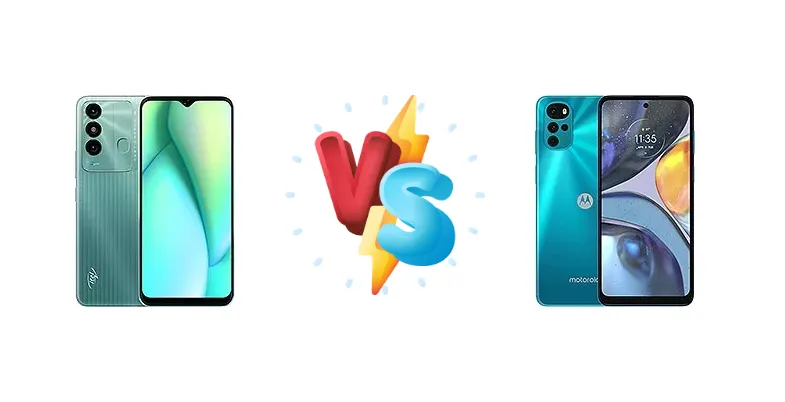
The sub-$150 smartphone market is fiercely competitive. The itel P38 Pro and Motorola Moto G22 both aim to deliver essential features at an accessible price point, but they take different approaches. The itel prioritizes a potentially longer-lasting battery, while the Motorola opts for a more modern, albeit still entry-level, chipset. This comparison dissects their key differences to help you choose the right device.
🏆 Quick Verdict
For the average user prioritizing basic functionality and a slightly faster processor, the Motorola Moto G22 is the better choice. Its Helio G37 chipset, built on a more efficient 12nm process, offers a noticeable performance edge over the itel P38 Pro’s Unisoc SC9863A. However, the itel P38 Pro may appeal to those who absolutely prioritize maximizing battery life.
| Network |
|---|
| 2G bands | GSM 850 / 900 / 1800 / 1900 | GSM 850 / 900 / 1800 / 1900 |
| 3G bands | HSDPA 850 / 900 / 2100 | HSDPA 850 / 900 / 1900 / 2100 |
| 4G bands | LTE | 1, 3, 5, 7, 8, 20, 38, 40, 41 |
| Speed | HSPA, LTE | HSPA 42.2/5.76 Mbps, LTE Cat4 150/50 Mbps |
| Technology | GSM / HSPA / LTE | GSM / HSPA / LTE |
| Launch |
|---|
| Announced | 2022 | 2022, March 04 |
| Status | Available. Released 2022 | Available. Released 2022, March 04 |
| Body |
|---|
| Build | - | Glass front, plastic frame, plastic back |
| Dimensions | - | 164 x 75 x 8.5 mm (6.46 x 2.95 x 0.33 in) |
| SIM | Dual SIM | · Nano-SIM· Nano-SIM + Nano-SIM |
| Weight | - | 185 g (6.53 oz) |
| | - | Water-repellent design |
| Display |
|---|
| Resolution | 720 x 1612 pixels, 20:9 ratio (~260 ppi density) | 720 x 1600 pixels, 20:9 ratio (~268 ppi density) |
| Size | 6.8 inches, 111.1 cm2 | 6.5 inches, 103.5 cm2 (~84.2% screen-to-body ratio) |
| Type | IPS LCD | IPS LCD, 90Hz |
| Platform |
|---|
| CPU | Octa-core (4x1.6 GHz Cortex-A55 & 4x1.2 GHz Cortex-A55) | Octa-core (4x2.3 GHz Cortex-A53 & 4x1.8 GHz Cortex-A53) |
| Chipset | Unisoc SC9863A (28 nm) | Mediatek MT6765V/CB Helio G37 (12 nm) |
| GPU | IMG8322 | PowerVR GE8320 |
| OS | Android 11 (Go edition) | Android 12 |
| Memory |
|---|
| Card slot | microSDXC | microSDXC (dedicated slot) |
| Internal | 64GB 2GB RAM | 64GB 4GB RAM, 128GB 4GB RAM |
| Main Camera |
|---|
| Dual | 13 MP
0.3 MP | - |
| Features | LED flash | LED flash, HDR, panorama |
| Quad | - | 50 MP, f/1.8, (wide), 0.64µm, PDAF
8 MP, f/2.2, 118˚ (ultrawide), 1/4.0", 1.12µm
2 MP (macro)
Auxiliary lens |
| Video | 1080p@30fps | 1080p@30fps |
| Selfie camera |
|---|
| Features | - | HDR |
| Single | 5 MP | 16 MP, f/2.5, (wide), 1.0µm |
| Video | Yes | 1080p@30fps |
| Sound |
|---|
| 3.5mm jack | - | Yes |
| 35mm jack | Yes | Yes |
| Loudspeaker | Yes | Yes |
| Comms |
|---|
| Bluetooth | Yes | 5.0, A2DP, LE |
| NFC | No | Yes (market/region dependent) |
| Positioning | GPS | GPS, GLONASS, GALILEO |
| Radio | Unspecified | Unspecified |
| USB | microUSB | USB Type-C 2.0 |
| WLAN | Yes | Wi-Fi 802.11 a/b/g/n/ac, dual-band, Wi-Fi Direct |
| Features |
|---|
| Sensors | Fingerprint (rear-mounted), accelerometer | Fingerprint (side-mounted), accelerometer, gyro, proximity, compass |
| Battery |
|---|
| Charging | 18W wired | 20W wired (India)
15W wired (Global) |
| Type | 6000 mAh | Li-Po 5000 mAh |
| Misc |
|---|
| Colors | Mint Green, Ocean Blue, Night Black | Pearl White, Iceberg Blue, Cosmic Black, Mint Green |
| Models | - | XT2231-1, XT2231-2, XT2231-5 |
| Price | - | About 120 EUR |
itel P38 Pro
- Potentially longer battery life due to less powerful chipset.
- May be more affordable depending on region.
- Simple and straightforward user experience.
- Significantly slower performance compared to the Moto G22.
- Older, less efficient chipset (Unisoc SC9863A).
- Likely limited software support.
Motorola Moto G22
- Faster and more responsive performance with the Helio G37.
- More efficient chipset (12nm process).
- Potentially better software support from Motorola.
- May require more frequent charging.
- Camera performance likely similar to the itel P38 Pro.
- Slightly higher price point.
Display Comparison
Neither device boasts a standout display. Details regarding panel type, resolution, and brightness are absent from the provided data, suggesting both utilize basic LCD panels common in this price bracket. The focus here isn't on visual fidelity. However, the lack of information on refresh rates suggests both are limited to standard 60Hz, which is typical for this segment. Bezels are likely to be substantial on both devices, maximizing screen real estate within a budget.
Camera Comparison
Camera performance is likely to be similar, leaning towards basic functionality on both devices. Without sensor size or aperture information, it’s difficult to make definitive claims. However, the inclusion of a 2MP macro camera on both is largely a marketing tactic, offering limited real-world benefit due to the small sensor size and lack of optical image stabilization (OIS). Image processing will likely be heavily reliant on software algorithms to enhance photos, and image quality will be heavily dependent on lighting conditions. Expect acceptable results in good light, but significant noise and softness in low-light scenarios.
Performance
The core difference lies in the chipsets. The Motorola Moto G22’s MediaTek Helio G37, fabricated on a 12nm process, represents a significant architectural advantage over the itel P38 Pro’s Unisoc SC9863A (28nm). The 12nm process allows for greater transistor density and improved power efficiency, translating to better sustained performance and less heat generation. While both are octa-core CPUs, the G37 utilizes Cortex-A53 cores clocked at 2.3 GHz, while the P38 Pro uses a mix of A55 cores clocked lower at 1.6 GHz and 1.2 GHz. This means the G37 will handle multitasking and app launches more efficiently. The Unisoc chip's older 28nm process will likely result in more throttling under sustained load.
Battery Life
The itel P38 Pro’s battery capacity is not specified, but its 18W charging suggests a focus on longevity rather than rapid replenishment. The Motorola Moto G22 offers 20W charging (in India, 15W globally), providing a slightly faster charging experience. However, the more efficient Helio G37 chipset in the Moto G22 means it will likely consume less power during typical usage, potentially offsetting the difference in charging speed. Real-world battery life will depend heavily on usage patterns, but the itel P38 Pro may offer a slight edge for users with minimal demands.
Buying Guide
Buy the itel P38 Pro if you need a phone that can reliably last through a full day of very light use, and are willing to sacrifice performance for that longevity. It’s ideal for users who primarily make calls, send texts, and occasionally browse social media. Buy the Motorola Moto G22 if you prefer a smoother, more responsive experience for everyday tasks like web browsing, video streaming, and light gaming, even if it means slightly more frequent charging.
Frequently Asked Questions
❓ Will the Unisoc SC9863A in the itel P38 Pro struggle with popular apps like Facebook or WhatsApp?
While the itel P38 Pro can run these apps, the Unisoc SC9863A’s limited processing power and older architecture may result in slower loading times, occasional lag, and a less fluid experience compared to the Motorola Moto G22. It's best suited for light usage.
❓ Does the Motorola Moto G22 support fast charging, and how long does it take to fully charge?
The Motorola Moto G22 supports 20W fast charging in India, while globally it's limited to 15W. A full charge from 0-100% will likely take between 1.5 to 2.5 hours, depending on the charger and usage during charging. This is faster than the itel P38 Pro's 18W charging.
❓ Are either of these phones suitable for playing mobile games like PUBG Mobile or Call of Duty?
Neither phone is ideal for demanding games. The Helio G37 in the Moto G22 can handle lighter games at lower settings, but PUBG Mobile or Call of Duty will likely be unplayable or experience significant lag and frame drops. The Unisoc SC9863A in the itel P38 Pro will struggle even more.