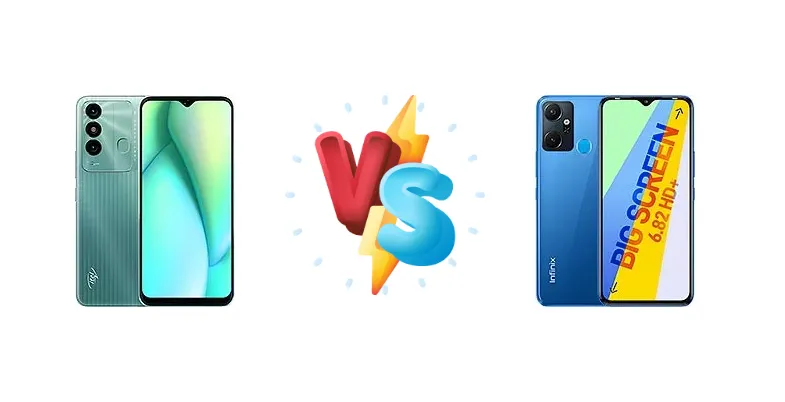
The sub-$150 smartphone market is fiercely competitive. Both the itel P38 Pro and the Infinix Smart 6 Plus (India) aim to deliver essential smartphone functionality at an incredibly accessible price point. However, they take different approaches to achieving this, with the itel prioritizing a larger battery and the Infinix focusing on a more modern, albeit still entry-level, chipset. This comparison will dissect their key differences to help you choose the right device.
🏆 Quick Verdict
For the average user prioritizing overall responsiveness and slightly better gaming capabilities, the Infinix Smart 6 Plus (India) is the better choice. Its MediaTek Helio G25, built on a 12nm process, offers a noticeable performance advantage over the itel P38 Pro’s older Unisoc SC9863A. While the itel boasts 18W charging, the Infinix’s efficiency mitigates the battery capacity difference.
| Network |
|---|
| 2G bands | GSM 850 / 900 / 1800 / 1900 | GSM 850 / 900 / 1800 / 1900 |
| 3G bands | HSDPA 850 / 900 / 2100 | HSDPA 850 / 900 / 2100 |
| 4G bands | LTE | 1, 3, 5, 8, 38, 40, 41 |
| Speed | HSPA, LTE | HSPA, LTE |
| Technology | GSM / HSPA / LTE | GSM / HSPA / LTE |
| Launch |
|---|
| Announced | 2022 | 2022, July 29 |
| Status | Available. Released 2022 | Available. Released 2022, August 03 |
| Body |
|---|
| Build | - | Glass front, plastic back, plastic frame |
| Dimensions | - | 172.6 x 77.7 x 8.7 mm (6.80 x 3.06 x 0.34 in) |
| SIM | Dual SIM | Nano-SIM + Nano-SIM |
| Weight | - | 202 g (7.13 oz) |
| Display |
|---|
| Protection | - | Panda Glass |
| Resolution | 720 x 1612 pixels, 20:9 ratio (~260 ppi density) | 720 x 1600 pixels, 20:9 ratio (~257 ppi density) |
| Size | 6.8 inches, 111.1 cm2 | 6.82 inches, 112.3 cm2 (~83.7% screen-to-body ratio) |
| Type | IPS LCD | IPS LCD, 440 nits (typ) |
| Platform |
|---|
| CPU | Octa-core (4x1.6 GHz Cortex-A55 & 4x1.2 GHz Cortex-A55) | Octa-core (4x2.0 GHz Cortex-A53 & 4x1.5 GHz Cortex-A53) |
| Chipset | Unisoc SC9863A (28 nm) | Mediatek MT6762G Helio G25 (12 nm) |
| GPU | IMG8322 | PowerVR GE8320 |
| OS | Android 11 (Go edition) | Android 12 (Go edition) |
| Memory |
|---|
| Card slot | microSDXC | microSDXC (dedicated slot) |
| Internal | 64GB 2GB RAM | 64GB 2GB RAM, 64GB 3GB RAM |
| | - | eMMC 5.1 |
| Main Camera |
|---|
| Dual | 13 MP
0.3 MP | 8 MP, f/2.0, AF
Auxiliary lens |
| Features | LED flash | Dual-LED flash, HDR, panorama |
| Single | - | 5 MP, f/2.0 |
| Video | 1080p@30fps | 1080p@30fps |
| Selfie camera |
|---|
| Features | - | LED flash |
| Single | 5 MP | 5 MP, f/2.0 |
| Video | Yes | 720p@30fps |
| Sound |
|---|
| 3.5mm jack | - | Yes |
| 35mm jack | Yes | Yes |
| Loudspeaker | Yes | Yes |
| Comms |
|---|
| Bluetooth | Yes | 5.0, A2DP, LE |
| NFC | No | No |
| Positioning | GPS | GPS |
| Radio | Unspecified | FM radio |
| USB | microUSB | microUSB 2.0, OTG |
| WLAN | Yes | Wi-Fi 802.11 a/b/g/n |
| Features |
|---|
| Sensors | Fingerprint (rear-mounted), accelerometer | Fingerprint (rear-mounted), accelerometer, proximity |
| Battery |
|---|
| Charging | 18W wired | - |
| Type | 6000 mAh | 5000 mAh |
| Misc |
|---|
| Colors | Mint Green, Ocean Blue, Night Black | Tranquil Sea Blue, Miracle Black |
| Models | - | X6823C, X6823 |
| Price | - | About 100 EUR |
itel P38 Pro
- Faster 18W wired charging
- Potentially longer battery life due to larger capacity (speculation)
- Lower price point (likely)
- Older, less efficient Unisoc SC9863A chipset
- Larger 28nm process node leads to more heat
- Slower app loading and multitasking
Infinix Smart 6 Plus (India)
- More efficient MediaTek Helio G25 chipset
- Smaller 12nm process node for better performance
- Smoother multitasking and app launches
- Potentially better image processing
- Slower charging speed (likely)
- Potentially shorter battery life (depending on usage)
- May be slightly more expensive
Display Comparison
Neither device is expected to deliver a premium display experience. Specific display specs (resolution, panel type) are not provided, but both will likely feature LCD panels. The key difference lies under the hood: the Infinix benefits from the more modern chipset’s image signal processor, potentially leading to slightly better color reproduction. However, without detailed panel specifications, this remains speculative. Bezels are likely to be substantial on both devices, typical of this price segment.
Camera Comparison
Camera performance is likely to be similar, with both devices targeting basic photography needs. Details on sensor sizes and apertures are unavailable, but it’s safe to assume both will feature a primary camera alongside auxiliary lenses of limited utility (likely a 2MP macro). The Helio G25’s ISP in the Infinix may offer slightly better image processing, potentially resulting in more detailed and vibrant photos, but the difference will be marginal. Expect both to struggle in low-light conditions.
Performance
The core of the difference lies in the chipsets. The Infinix Smart 6 Plus utilizes the MediaTek Helio G25, fabricated on a 12nm process, featuring an octa-core CPU clocked up to 2.0 GHz using Cortex-A53 cores. This is a significant advantage over the itel P38 Pro’s Unisoc SC9863A, built on a larger 28nm node, with a CPU peaking at 1.6 GHz and utilizing Cortex-A55 cores. While both are octa-core, the newer architecture and smaller process node of the Helio G25 translate to better performance and power efficiency. The A53 cores in the Infinix, while older than the A55 in the itel, benefit from the more efficient manufacturing process. This means the Infinix will handle multitasking and app launches more smoothly, and is more likely to maintain performance during extended use.
Battery Life
The itel P38 Pro’s 18W charging is its standout feature. While battery capacity isn’t specified, the faster charging will allow for quicker top-ups. However, the Infinix Smart 6 Plus’s more efficient Helio G25 chipset will consume less power during everyday tasks. This means that despite potentially having a smaller battery, the Infinix could offer comparable, or even slightly better, real-world battery life. The 12nm process node of the Helio G25 is a key factor in this efficiency.
Buying Guide
Buy the itel P38 Pro if you absolutely need the fastest possible charging speed within this price bracket and anticipate minimal demanding app usage. It’s suited for users who primarily make calls, send texts, and browse social media. Buy the Infinix Smart 6 Plus (India) if you prefer a more responsive user experience, occasionally play light mobile games, and value a more efficient processor that won’t throttle as quickly under sustained load. This is the better option for those who want a phone that feels a bit more future-proof.
Frequently Asked Questions
❓ Will the Helio G25 in the Infinix Smart 6 Plus handle popular games like PUBG Mobile?
The Helio G25 is an entry-level gaming chip. While it can run PUBG Mobile, you'll need to stick to low graphics settings and expect frame rate drops during intense action. It's suitable for casual gaming, but not for demanding titles.
❓ Is the Unisoc SC9863A in the itel P38 Pro known to overheat during prolonged use?
The Unisoc SC9863A, being built on a 28nm process, is more prone to thermal throttling than the Helio G25. Extended gaming or heavy multitasking could lead to noticeable performance slowdowns as the chip heats up.
❓ How long will it take to fully charge the itel P38 Pro with the 18W charger?
While 18W is relatively fast for this price range, the actual charging time will depend on the battery capacity (which isn't specified). Expect a full charge to take between 2-3 hours, potentially less if the battery is relatively small.
❓ Does the Infinix Smart 6 Plus (India) support VoLTE for 4G calling?
The Infinix Smart 6 Plus (India) *should* support VoLTE, as it's a standard feature for 4G smartphones in India. However, compatibility depends on your carrier, so it's best to check with your mobile provider to confirm.