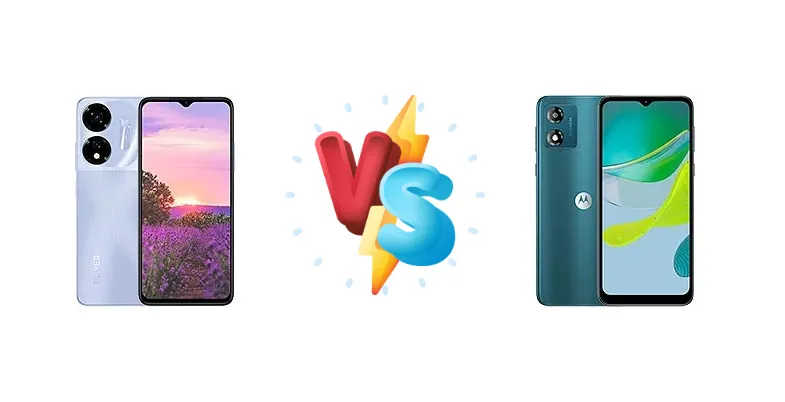
The sub-$150 smartphone market is fiercely competitive, and the itel Color Pro and Motorola Moto E13 are two contenders vying for your attention. While both aim to deliver essential smartphone functionality at an accessible price, they take distinctly different approaches to achieving this. The itel prioritizes processing power with a newer Mediatek Dimensity chipset, while the Moto E13 focuses on a streamlined experience with a Unisoc processor and Motorola’s software optimizations.
🏆 Quick Verdict
For users prioritizing performance and faster charging, the itel Color Pro is the clear winner. Its Mediatek Dimensity 6080 chipset offers a significant performance uplift over the Moto E13’s Unisoc T606. However, the Moto E13 remains a viable option for those seeking a basic, reliable smartphone experience on a tighter budget.
| Network |
|---|
| 2G bands | GSM 850 / 900 / 1800 / 1900 | GSM 850 / 900 / 1800 / 1900 |
| 3G bands | HSDPA 850 / 900 / 2100 | HSDPA 850 / 900 / 2100 |
| 4G bands | 1, 3, 5, 8, 38, 40, 41 | 1, 3, 5, 7, 8, 28, 38, 40, 41 |
| 5G bands | 1, 3, 5, 8, 28, 40, 41, 77, 78 SA/NSA | - |
| Speed | HSPA, LTE, 5G | HSPA, LTE |
| Technology | GSM / HSPA / LTE / 5G | GSM / HSPA / LTE |
| | - | 1, 3, 5, 7, 8, 20, 28, 38, 40, 41 |
| Launch |
|---|
| Announced | 2024, July 17 | 2023, January 24 |
| Status | Available. Released 2024, July | Available. Released 2023, February 13 |
| Body |
|---|
| Build | - | Glass front, plastic frame, plastic back |
| Dimensions | 8.4 mm thickness | 164.2 x 75 x 8.5 mm (6.46 x 2.95 x 0.33 in) |
| SIM | Nano-SIM + Nano-SIM | Nano-SIM + Nano-SIM |
| Weight | - | 179.5 g (6.35 oz) |
| | - | Water-resistant design |
| Display |
|---|
| Resolution | 720 x 1612 pixels, 20:9 ratio (~269 ppi density) | 720 x 1600 pixels, 20:9 ratio (~270 ppi density) |
| Size | 6.56 inches, 103.4 cm2 | 6.5 inches, 102.0 cm2 (~82.8% screen-to-body ratio) |
| Type | IPS LCD, 90Hz | IPS LCD |
| Platform |
|---|
| CPU | Octa-core (2x2.4 GHz Cortex-A76 & 6x2.0 GHz Cortex-A55) | Octa-core (2x1.6 GHz Cortex-A75 & 6x1.6 GHz Cortex-A55) |
| Chipset | Mediatek Dimensity 6080 (6 nm) | Unisoc T606 (12 nm) |
| GPU | Mali-G57 MC2 | Mali-G57 MP1 |
| OS | Android 13, itel OS 13 | Android 13 (Go edition) |
| Memory |
|---|
| Card slot | Unspecified | microSDXC (dedicated slot) |
| Internal | 128GB 6GB RAM | 32GB 2GB RAM, 64GB 2GB RAM, 64GB 4GB RAM, 128GB 8GB RAM |
| | - | eMMC 5.1 |
| Main Camera |
|---|
| Features | LED flash, panorama | LED flash, HDR, panorama |
| Single | 50 MP, (wide), AF
Auxiliary lens | 13 MP, f/2.2, (wide), 1.12µm, PDAF |
| Video | 1080p@30fps | 1080p@30fps |
| Selfie camera |
|---|
| Single | 8 MP | 5 MP, f/2.4, (wide), 1/5.0", 1.12µm |
| Video | Yes | 1080p@30fps |
| Sound |
|---|
| 3.5mm jack | - | Yes |
| 35mm jack | Yes | Yes |
| Loudspeaker | Yes | Yes |
| Comms |
|---|
| Bluetooth | 5.0, A2DP, LE | 5.0, A2DP, LE |
| NFC | No | No |
| Positioning | GPS | GPS, GLONASS, GALILEO |
| Radio | Unspecified | FM radio, recording |
| USB | USB Type-C | USB Type-C 2.0, OTG |
| WLAN | Yes | Wi-Fi 802.11 a/b/g/n/ac, dual-band |
| Features |
|---|
| Sensors | Fingerprint (side-mounted), accelerometer | Accelerometer, proximity |
| Battery |
|---|
| Charging | 18W wired | 10W wired |
| Type | Li-Po 5000 mAh | Li-Po 5000 mAh |
| Misc |
|---|
| Colors | River Blue, Lavender Fantasy | Cosmic Black, Creamy White, Aurora Green |
| Price | About 100 EUR | $ 119.99 / € 104.99 |
itel Color Pro
- Significantly faster processor for smoother performance
- Faster 18W charging for reduced downtime
- More efficient 6nm chipset potentially improving battery life under load
- May be slightly more expensive than the Moto E13
- Software experience may not be as refined as Motorola’s
Motorola Moto E13
- More affordable price point
- Clean and streamlined Motorola software experience
- Potentially longer battery life during light usage
- Slower processor resulting in sluggish performance
- Slow 10W charging
- Less capable for demanding tasks and gaming
Display Comparison
Neither device boasts a standout display. While specific display specs (resolution, panel type) are missing, the focus here is on the underlying processing power impacting the user interface. The itel Color Pro’s more powerful chipset will likely translate to smoother animations and faster response times when navigating the UI, even if the panel itself is similar to the Moto E13’s. Bezels are likely comparable given the price point, and color accuracy is unlikely to be a strong suit on either device.
Camera Comparison
Without detailed camera specifications, a direct comparison is difficult. However, given the price bracket, both phones likely feature basic camera setups. The itel Color Pro’s more powerful ISP (Image Signal Processor) integrated within the Dimensity 6080 could offer slightly better image processing, particularly in low-light conditions. It’s reasonable to assume both phones will include a primary camera and potentially a depth or macro sensor, but image quality will be heavily reliant on software optimization rather than cutting-edge hardware. Expect limited detail and dynamic range from both.
Performance
The core difference lies in the chipsets. The itel Color Pro’s Mediatek Dimensity 6080, built on a 6nm process, offers a substantial advantage over the Motorola Moto E13’s Unisoc T606 (12nm). The Dimensity 6080’s Cortex-A76 cores, clocked at 2.4 GHz, are significantly faster than the Moto E13’s Cortex-A75 cores at 1.6 GHz. This translates to a noticeable difference in app launch speeds, multitasking capabilities, and overall system responsiveness. The 6nm process also implies better power efficiency, potentially mitigating the performance gap under sustained loads. The Moto E13 will handle basic tasks adequately, but will struggle with demanding applications or games.
Battery Life
While battery capacity isn’t specified, the itel Color Pro’s 18W charging is a significant advantage over the Moto E13’s 10W charging. This means the itel Color Pro will recharge much faster, reducing downtime. The Unisoc T606’s 12nm process, while less efficient than the Dimensity 6080’s 6nm, may contribute to slightly longer battery life during light usage. However, the faster charging of the itel Color Pro will likely offset any minor battery life differences for most users.
Buying Guide
Buy the itel Color Pro if you need a phone capable of handling moderate gaming, multitasking, and benefit from quicker app loading times. It’s ideal for users who frequently use social media, stream videos, or require a more responsive user experience. Buy the Motorola Moto E13 if you prefer a simple, no-frills smartphone focused on core functionality like calls, texts, and basic app usage. It’s a good choice for first-time smartphone users or those who prioritize battery life over raw performance.
Frequently Asked Questions
❓ Will the itel Color Pro handle popular games like PUBG Mobile or Call of Duty?
The Mediatek Dimensity 6080 is capable of running PUBG Mobile and Call of Duty, but likely at medium or low graphics settings to maintain a playable frame rate. Expect some frame drops during intense action sequences. The Moto E13 will struggle with these titles.
❓ How much faster is the charging on the itel Color Pro compared to the Moto E13?
The itel Color Pro’s 18W charging is nearly double the speed of the Moto E13’s 10W charging. This translates to a significantly shorter charging time – potentially reducing a full charge from over 3 hours on the Moto E13 to around 1.5-2 hours on the itel Color Pro.
❓ Is the Unisoc T606 chipset in the Moto E13 sufficient for everyday tasks like browsing and social media?
Yes, the Unisoc T606 is adequate for basic tasks like web browsing, social media, and making calls. However, you may experience occasional lag or slowdowns when multitasking or opening multiple apps. It’s not ideal for demanding applications.
❓ Does either phone support VoLTE or VoWiFi calling?
Support for VoLTE and VoWiFi depends on the carrier and region. It's best to check with your mobile carrier to confirm compatibility with either the itel Color Pro or the Motorola Moto E13 before purchasing.