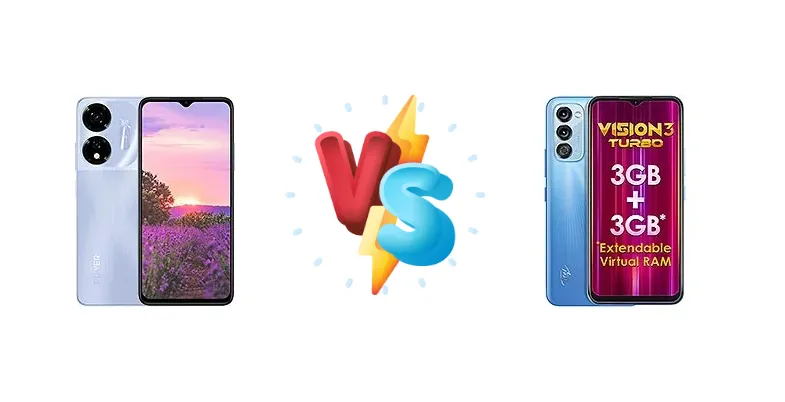
The itel Color Pro and Vision 3 Turbo represent two distinct approaches to the budget smartphone market. The Color Pro aims for a performance edge with its Mediatek Dimensity 6080 chipset, while the Vision 3 Turbo focuses on delivering essential features at an even lower price point, utilizing the Unisoc SC9863A. This comparison dissects the key differences to determine which device offers the best value for your money.
🏆 Quick Verdict
For users prioritizing smooth multitasking and occasional gaming, the itel Color Pro is the clear winner. Its Dimensity 6080 chipset provides a significantly more responsive experience than the Vision 3 Turbo’s Unisoc SC9863A. While both offer 18W charging, the Color Pro’s superior processing power justifies its slightly higher price.
| Network |
|---|
| 2G bands | GSM 850 / 900 / 1800 / 1900 | GSM 850 / 900 / 1800 / 1900 |
| 3G bands | HSDPA 850 / 900 / 2100 | HSDPA 850 / 900 / 2100 |
| 4G bands | 1, 3, 5, 8, 38, 40, 41 | LTE |
| 5G bands | 1, 3, 5, 8, 28, 40, 41, 77, 78 SA/NSA | - |
| Speed | HSPA, LTE, 5G | HSPA, LTE |
| Technology | GSM / HSPA / LTE / 5G | GSM / HSPA / LTE |
| Launch |
|---|
| Announced | 2024, July 17 | 2022 |
| Status | Available. Released 2024, July | Available. Released 2022 |
| Body |
|---|
| Dimensions | 8.4 mm thickness | - |
| SIM | Nano-SIM + Nano-SIM | Dual SIM |
| Weight | - | - |
| Display |
|---|
| Resolution | 720 x 1612 pixels, 20:9 ratio (~269 ppi density) | 720 x 1600 pixels, 20:9 ratio (~266 ppi density) |
| Size | 6.56 inches, 103.4 cm2 | 6.6 inches, 105.2 cm2 |
| Type | IPS LCD, 90Hz | IPS LCD |
| Platform |
|---|
| CPU | Octa-core (2x2.4 GHz Cortex-A76 & 6x2.0 GHz Cortex-A55) | Octa-core (4x1.6 GHz Cortex-A55 & 4x1.2 GHz Cortex-A55) |
| Chipset | Mediatek Dimensity 6080 (6 nm) | Unisoc SC9863A (28 nm) |
| GPU | Mali-G57 MC2 | IMG8322 |
| OS | Android 13, itel OS 13 | Android 11 (Go edition) |
| Memory |
|---|
| Card slot | Unspecified | microSDXC |
| Internal | 128GB 6GB RAM | 64GB 3GB RAM |
| Main Camera |
|---|
| Features | LED flash, panorama | LED flash |
| Single | 50 MP, (wide), AF
Auxiliary lens | 8 MP (wide)
Auxiliary lens |
| Video | 1080p@30fps | 1080p@30fps |
| Selfie camera |
|---|
| Single | 8 MP | 5 MP |
| Video | Yes | Yes |
| Sound |
|---|
| 35mm jack | Yes | Yes |
| Loudspeaker | Yes | Yes |
| Comms |
|---|
| Bluetooth | 5.0, A2DP, LE | Yes |
| NFC | No | No |
| Positioning | GPS | GPS |
| Radio | Unspecified | Unspecified |
| USB | USB Type-C | microUSB |
| WLAN | Yes | Yes |
| Features |
|---|
| Sensors | Fingerprint (side-mounted), accelerometer | Fingerprint (rear-mounted), accelerometer |
| Battery |
|---|
| Charging | 18W wired | 18W wired |
| Type | Li-Po 5000 mAh | 5000 mAh |
| Misc |
|---|
| Colors | River Blue, Lavender Fantasy | Blue |
| Price | About 100 EUR | - |
itel Color Pro
- Significantly faster processor for smoother performance
- More efficient 6nm chipset for better thermal management
- Potentially better camera image processing
- Improved multitasking capabilities
- Likely a slightly higher price point
- May not offer drastically improved battery life over the Vision 3 Turbo with minimal usage
itel Vision 3 Turbo
- More affordable price point
- Potentially longer battery life with very light usage
- Sufficient for basic smartphone tasks
- Simple and easy-to-use interface
- Slow processor and limited performance
- Noticeable lag and slow app loading times
- Less capable camera image processing
- Poor multitasking performance
Display Comparison
Both devices lack detailed display specifications in the provided data. However, given the price segments, it's reasonable to assume both utilize LCD panels. The Color Pro, positioned slightly higher, may benefit from a marginally higher peak brightness. The larger difference will be in image processing, potentially offering more vibrant colors on the Color Pro due to the more powerful chipset's ability to handle image enhancements. Bezels are likely comparable, reflecting cost-saving measures in both designs.
Camera Comparison
Without specific camera sensor details, a direct comparison is limited. However, the Color Pro’s more powerful chipset allows for more sophisticated image processing, potentially resulting in better dynamic range and noise reduction. It’s likely both phones feature a primary camera and a depth sensor, with the Vision 3 Turbo potentially including a lower-resolution secondary camera. The Color Pro’s ISP (Image Signal Processor) within the Dimensity 6080 will likely handle image capture and processing more efficiently, leading to sharper and more detailed photos, particularly in challenging lighting conditions. Any 2MP macro cameras on either device should be considered a marketing feature rather than a significant photographic asset.
Performance
The core difference lies in the chipsets. The itel Color Pro’s Mediatek Dimensity 6080, built on a 6nm process, offers a substantial performance advantage over the Vision 3 Turbo’s Unisoc SC9863A (28nm). The Dimensity 6080’s octa-core configuration, featuring two high-performance Cortex-A76 cores clocked at 2.4GHz, provides significantly faster processing speeds for demanding tasks. The Vision 3 Turbo’s SC9863A, with its four Cortex-A55 cores at 1.6GHz and another four at 1.2GHz, is geared towards basic functionality. This translates to noticeable lag and slower app loading times on the Vision 3 Turbo, especially when multitasking. The 6nm node of the Dimensity 6080 also implies better thermal efficiency, reducing the likelihood of performance throttling during extended use.
Battery Life
Both devices feature 18W wired charging, suggesting similar charging speeds from 0-100%. The actual battery capacity isn’t specified, but the Vision 3 Turbo’s less power-hungry chipset will likely result in slightly longer battery life under light usage. However, the Color Pro’s more efficient 6nm chipset and optimized power management could mitigate this difference, especially with moderate usage. The Dimensity 6080’s ability to quickly process tasks and then return to an idle state can contribute to overall battery conservation.
Buying Guide
Buy the itel Color Pro if you need a phone capable of handling demanding apps, light gaming, and smoother overall performance. It’s ideal for students, social media enthusiasts, and anyone who wants a responsive experience without breaking the bank. Buy the itel Vision 3 Turbo if you prioritize absolute affordability and only need a phone for basic tasks like calls, texts, and light web browsing. It’s a good option for first-time smartphone users or as a reliable backup device.
Frequently Asked Questions
❓ Will the itel Color Pro handle popular games like PUBG Mobile or Call of Duty?
The Dimensity 6080 in the itel Color Pro is capable of running PUBG Mobile and Call of Duty, but likely at medium graphics settings to maintain a stable frame rate. Expect some occasional frame drops during intense action. The Vision 3 Turbo’s Unisoc SC9863A will struggle with these titles, offering a significantly less enjoyable gaming experience.
❓ Is the Unisoc SC9863A chipset in the itel Vision 3 Turbo known to overheat during prolonged use?
The Unisoc SC9863A is a low-power chipset and generally doesn't overheat significantly. However, its limited processing capabilities mean it may struggle with even moderate multitasking, leading to perceived slowdowns rather than thermal throttling. The 28nm process is less efficient than the 6nm Dimensity 6080, but overheating isn't a primary concern.
❓ How much faster is the itel Color Pro in real-world usage compared to the Vision 3 Turbo?
The itel Color Pro is noticeably faster in almost all scenarios. App launch times will be significantly quicker, multitasking will be smoother, and web browsing will be more responsive. Expect a 30-50% performance improvement in CPU-intensive tasks and a similar boost in GPU performance, making the Color Pro a much more enjoyable daily driver.