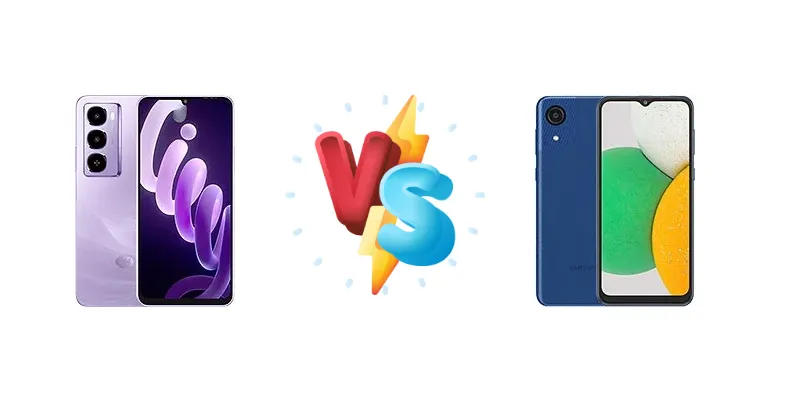
The sub-$100 smartphone market is fiercely competitive, and the itel City 100 and Samsung Galaxy A03 Core are two contenders vying for your attention. While both aim to deliver essential smartphone functionality at an accessible price, they take drastically different approaches to achieving this, particularly in their core processing power. This comparison dissects these differences to determine which device offers the best value for budget-conscious consumers.
🏆 Quick Verdict
For the average user prioritizing responsiveness and future-proofing, the itel City 100 emerges as the stronger choice. Its Unisoc T7250 chipset, built on a more modern 12nm process, delivers significantly better CPU performance than the Galaxy A03 Core’s older 28nm Unisoc SC9863A, making everyday tasks smoother and more enjoyable.
| Network |
|---|
| 2G bands | GSM 850 / 900 / 1800 / 1900 | GSM 850 / 900 / 1800 / 1900 |
| 3G bands | HSDPA 850 / 900 / 2100 | HSDPA 850 / 900 / 2100 |
| 4G bands | LTE | 1, 3, 5, 7, 8, 20, 28, 38, 40, 41 |
| Speed | HSPA, LTE | HSPA 21.1/5.76 Mbps, LTE |
| Technology | GSM / HSPA / LTE | GSM / HSPA / LTE |
| Launch |
|---|
| Announced | 2025, April 27 | 2021, November 15 |
| Status | Available. Released 2025, April 27 | Available. Released 2021, December 06 |
| Body |
|---|
| Build | - | Plastic back, plastic frame |
| Dimensions | 167.7 x 77.5 x 7.7 mm (6.60 x 3.05 x 0.30 in) | 164.2 x 75.9 x 9.1 mm (6.46 x 2.99 x 0.36 in) |
| SIM | Nano-SIM + Nano-SIM | · Nano-SIM· Nano-SIM + Nano-SIM |
| Weight | 185 g (6.53 oz) | 211 g (7.44 oz) |
| Display |
|---|
| Resolution | 720 x 1600 pixels, 20:9 ratio (~260 ppi density) | 720 x 1600 pixels, 20:9 ratio (~270 ppi density) |
| Size | 6.75 inches, 110.0 cm2 (~84.6% screen-to-body ratio) | 6.5 inches, 102.0 cm2 (~81.8% screen-to-body ratio) |
| Type | IPS LCD, 90Hz, 700 nits (HBM) | PLS LCD |
| Platform |
|---|
| CPU | Octa-core (2x1.8 GHz Cortex-A75 & 6x1.6 GHz Cortex-A55) | Octa-core (4x1.6 GHz Cortex-A55 & 4x1.2 GHz Cortex-A55) |
| Chipset | Unisoc T7250 (12 nm) | Unisoc SC9863A (28 nm) |
| GPU | Mali-G57 MP1 | IMG8322 |
| OS | Android 14, Pure 14.5 OS | Android 11 (Go edition) |
| Memory |
|---|
| Card slot | microSDXC | microSDXC (dedicated slot) |
| Internal | 128GB 4GB RAM, 128GB 6GB RAM, 128GB 8GB RAM, 256GB 4GB RAM | 32GB 2GB RAM |
| | - | eMMC 5.1 |
| Main Camera |
|---|
| Features | LED flash, HDR, panorama | LED flash |
| Single | 13 MP | 8 MP, f/2.0, AF |
| Video | Yes | 1080p@30fps |
| Selfie camera |
|---|
| Single | 8 MP | 5 MP, f/2.2 |
| Video | Yes | - |
| Sound |
|---|
| 3.5mm jack | - | Yes |
| 35mm jack | Yes | Yes |
| Loudspeaker | Yes | Yes |
| Comms |
|---|
| Bluetooth | Yes | 4.2, A2DP |
| Infrared port | Yes | - |
| NFC | No | No |
| Positioning | GPS | GPS, GLONASS |
| Radio | Unspecified | Unspecified |
| USB | USB Type-C, OTG | microUSB 2.0, OTG |
| WLAN | Yes | Wi-Fi 802.11 b/g/n, Wi-Fi Direct |
| Features |
|---|
| Sensors | Fingerprint (side-mounted); unspecified sensors | Accelerometer, proximity |
| Battery |
|---|
| Charging | 18W wired
Reverse wired | - |
| Type | 5200 mAh | Li-Ion 5000 mAh |
| Misc |
|---|
| Colors | Navy Blue, Pure Titanium, Fairy Purple | Black, Blue |
| Models | C671L | SM-A032F, SM-A032F/DS, SM-A032M |
| Price | About 80 EUR | £ 74.99 |
| SAR | - | 0.30 W/kg (head) |
| SAR EU | - | 0.24 W/kg (head) 1.39 W/kg (body) |
itel City 100
- Significantly faster CPU performance due to the Unisoc T7250.
- More efficient 12nm chipset for better battery life.
- Faster 18W wired charging.
- Potential for smoother multitasking.
- Brand recognition is lower than Samsung.
- Software updates may be less frequent.
Samsung Galaxy A03 Core
- Strong brand recognition and trust.
- Potentially more refined software experience.
- May have slightly better color accuracy in the display.
- Wider availability in some markets.
- Significantly slower CPU performance.
- Less efficient 28nm chipset.
- Likely slower charging speeds.
- Potential for thermal throttling under load.
Display Comparison
Neither device boasts a standout display. Both are likely to feature LCD panels, typical for this price bracket. However, details like resolution and peak brightness are missing. The A03 Core’s display is likely to be more color-accurate due to Samsung’s display expertise, but the itel City 100’s display size is unknown, potentially offering a larger viewing area. The older manufacturing process of the A03 Core’s chipset may also impact its ability to drive a higher-quality display.
Camera Comparison
Camera performance is likely to be similar, with both phones expected to feature basic camera setups. Details on sensor sizes and apertures are unavailable, but given the price point, expectations should be tempered. The A03 Core may benefit from Samsung’s image processing algorithms, potentially offering slightly more refined photos in good lighting conditions. However, the older chipset may limit its ability to handle complex image processing tasks. The presence of a 2MP macro camera on either device is largely a marketing gimmick and unlikely to deliver significant improvements in image quality.
Performance
The performance gap is the most significant differentiator. The itel City 100’s Unisoc T7250, fabricated on a 12nm process, features a more modern CPU architecture with two Cortex-A75 cores alongside six Cortex-A55 cores. This contrasts sharply with the Galaxy A03 Core’s Unisoc SC9863A, built on a dated 28nm process, and utilizing only Cortex-A55 cores. The A75 cores in the itel City 100 provide a substantial boost in single-core performance, crucial for app launch times and general responsiveness. The 28nm process of the SC9863A also implies higher power consumption and potentially more thermal throttling under sustained load. The itel City 100 will handle multitasking and moderately demanding apps with greater ease.
Battery Life
Battery capacity details are missing for both devices. However, the itel City 100’s 18W wired charging is a clear advantage over the A03 Core’s likely slower charging speed. The more efficient 12nm Unisoc T7250 in the itel City 100 will also contribute to better battery life, even if the battery capacity is similar. The 18W charging will allow for significantly faster top-ups, reducing downtime.
Buying Guide
Buy the itel City 100 if you need a phone that feels responsive for basic tasks like browsing, social media, and messaging, and you appreciate the faster charging capabilities. Buy the Samsung Galaxy A03 Core if you prioritize brand recognition and a potentially more streamlined software experience, understanding that you’ll be making a performance trade-off. The A03 Core is best suited for extremely light users.
Frequently Asked Questions
❓ Will the Unisoc T7250 in the itel City 100 handle popular apps like WhatsApp and Facebook smoothly?
Yes, the Unisoc T7250’s octa-core configuration, including the more powerful Cortex-A75 cores, is more than capable of handling everyday apps like WhatsApp, Facebook, and web browsing without noticeable lag. This is a significant improvement over the Galaxy A03 Core’s SC9863A, which may struggle with even moderate multitasking.
❓ Is the 18W charging on the itel City 100 a significant advantage over the Galaxy A03 Core?
Absolutely. While the exact charging speed of the Galaxy A03 Core is unknown, it’s likely to be significantly slower. 18W charging on the itel City 100 will allow you to replenish the battery much faster, reducing downtime and making it more convenient to top up throughout the day. This is especially important for users who rely heavily on their smartphones.
❓ Does the older 28nm process of the Unisoc SC9863A in the Galaxy A03 Core affect its battery life?
Yes, the 28nm process is less efficient than the 12nm process used in the Unisoc T7250. This means the Galaxy A03 Core’s chipset will consume more power for the same tasks, resulting in shorter battery life compared to the itel City 100, even if both phones have similar battery capacities.