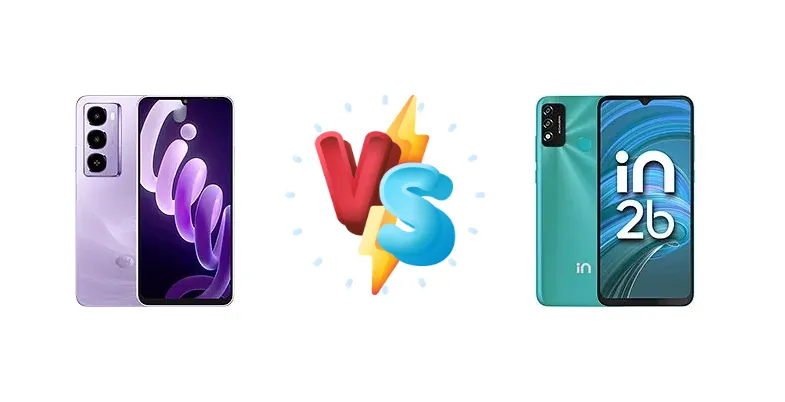
The sub-$150 smartphone market is fiercely competitive, and the itel City 100 and Micromax In 2b are two contenders vying for your attention. Both leverage Unisoc chipsets to deliver an affordable experience, but key differences in CPU configuration and charging capabilities create distinct user experiences. This comparison dives deep into the specs to determine which phone offers the best value.
🏆 Quick Verdict
For most users, the itel City 100 emerges as the stronger choice. While both phones utilize a 12nm process, the City 100’s slightly more efficient CPU configuration and significantly faster 18W charging provide a noticeable advantage in daily use and convenience, justifying its potential slight price premium.
| Network |
|---|
| 2G bands | GSM 850 / 900 / 1800 / 1900 | GSM 850 / 900 / 1800 / 1900 |
| 3G bands | HSDPA 850 / 900 / 2100 | HSDPA 850 / 2100 |
| 4G bands | LTE | 1, 3, 5, 8, 38, 40, 41 |
| Speed | HSPA, LTE | HSPA, LTE |
| Technology | GSM / HSPA / LTE | GSM / HSPA / LTE |
| Launch |
|---|
| Announced | 2025, April 27 | 2021, July 30. Released 2021, August 06 |
| Status | Available. Released 2025, April 27 | Discontinued |
| Body |
|---|
| Dimensions | 167.7 x 77.5 x 7.7 mm (6.60 x 3.05 x 0.30 in) | 164.3 x 75.7 x 8.6 mm (6.47 x 2.98 x 0.34 in) |
| SIM | Nano-SIM + Nano-SIM | Nano-SIM + Nano-SIM |
| Weight | 185 g (6.53 oz) | 190 g (6.70 oz) |
| Display |
|---|
| Resolution | 720 x 1600 pixels, 20:9 ratio (~260 ppi density) | 720 x 1600 pixels, 20:9 ratio (~269 ppi density) |
| Size | 6.75 inches, 110.0 cm2 (~84.6% screen-to-body ratio) | 6.52 inches, 102.6 cm2 (~82.5% screen-to-body ratio) |
| Type | IPS LCD, 90Hz, 700 nits (HBM) | IPS LCD, 400 nits (typ) |
| Platform |
|---|
| CPU | Octa-core (2x1.8 GHz Cortex-A75 & 6x1.6 GHz Cortex-A55) | Octa-core (2x1.8 GHz Cortex-A75 & 6x1.8 GHz Cortex-A55) |
| Chipset | Unisoc T7250 (12 nm) | Unisoc T610 (12 nm) |
| GPU | Mali-G57 MP1 | Mali-G52 MP2 |
| OS | Android 14, Pure 14.5 OS | Android 11 |
| Memory |
|---|
| Card slot | microSDXC | microSDXC (dedicated slot) |
| Internal | 128GB 4GB RAM, 128GB 6GB RAM, 128GB 8GB RAM, 256GB 4GB RAM | 64GB 4GB RAM, 64GB 6GB RAM |
| | - | eMMC 5.1 |
| Main Camera |
|---|
| Dual | - | 13 MP, f/1.8, 27mm (wide), 1/3.0", 1.12µm, PDAF
Auxiliary lens |
| Features | LED flash, HDR, panorama | LED flash, HDR, panorama |
| Single | 13 MP | 5 MP, f/2.2 |
| Video | Yes | 1080p@30fps |
| Selfie camera |
|---|
| Features | - | HDR |
| Single | 8 MP | 5 MP, f/2.2 |
| Video | Yes | Unspecified |
| Sound |
|---|
| 3.5mm jack | - | Yes |
| 35mm jack | Yes | Yes |
| Loudspeaker | Yes | Yes |
| Comms |
|---|
| Bluetooth | Yes | 5.0, A2DP, LE |
| Infrared port | Yes | - |
| NFC | No | No |
| Positioning | GPS | GPS, GLONASS, GALILEO, BDS |
| Radio | Unspecified | Unspecified |
| USB | USB Type-C, OTG | USB Type-C 2.0, OTG |
| WLAN | Yes | Wi-Fi 802.11 a/b/g/n/ac, Wi-Fi Direct |
| Features |
|---|
| Sensors | Fingerprint (side-mounted); unspecified sensors | Fingerprint (rear-mounted), accelerometer, proximity |
| Battery |
|---|
| Charging | 18W wired
Reverse wired | 10W wired |
| Type | 5200 mAh | Li-Po 5000 mAh |
| Misc |
|---|
| Colors | Navy Blue, Pure Titanium, Fairy Purple | Blue, Black, Green |
| Models | C671L | E7544 |
| Price | About 80 EUR | About 90 EUR |
| SAR | - | 0.85 W/kg (head) 1.13 W/kg (body) |
itel City 100
- Faster 18W charging with reverse wired charging
- Potentially smoother multitasking due to Cortex-A75 cores
- More efficient CPU configuration
- May be slightly more expensive
- Detailed display specs are unavailable
Micromax In 2b
- Lower upfront cost
- Slightly higher Cortex-A55 clock speed
- Simple and straightforward user experience
- Significantly slower 10W charging
- Potentially less responsive multitasking
- Limited feature set
Display Comparison
Neither itel nor Micromax provide display specifications beyond the basic panel type. Given the price point, both likely utilize IPS LCD panels. The absence of details like peak brightness or resolution suggests a focus on cost reduction. Bezels are expected to be substantial on both devices. Color accuracy is unlikely to be a strong point, and users shouldn't expect wide color gamut support. Without further data, a clear winner cannot be determined.
Camera Comparison
Camera details are sparse for both devices. It’s safe to assume both feature a primary camera and potentially a depth sensor. Without knowing sensor sizes, apertures, or image processing capabilities, a meaningful comparison is impossible. The presence of a 2MP macro camera on either device is unlikely to significantly enhance the photography experience. Image quality will likely be acceptable for social media sharing in good lighting conditions, but expect significant noise and lack of detail in low light.
Performance
The core difference lies in the CPU configuration. Both phones use the Unisoc T7250 and T610, both built on a 12nm process. However, the itel City 100’s T7250 features 6x1.6 GHz Cortex-A55 cores, while the Micromax In 2b’s T610 has 6x1.8 GHz Cortex-A55 cores. While the clock speed is higher on the In 2b, the T7250’s inclusion of two Cortex-A75 cores provides a performance boost in demanding tasks. This means the itel City 100 will likely handle multitasking and app switching more smoothly. Both phones will struggle with graphically intensive games, but the itel may offer a slightly more playable experience. RAM configurations are not specified, but LPDDR4X is a likely candidate for both, limiting overall memory bandwidth.
Battery Life
Battery capacity is not specified for either device. However, the charging speed is a significant differentiator. The itel City 100 supports 18W wired charging, including reverse wired charging, allowing it to function as a power bank for other devices. The Micromax In 2b is limited to 10W wired charging. This translates to a considerably faster 0-100% charge time for the itel City 100. Even with a similar battery capacity, the faster charging speed provides a substantial convenience advantage for users who value quick top-ups.
Buying Guide
Buy the itel City 100 if you prioritize faster charging speeds and a potentially smoother multitasking experience, even if it means spending a little more. This phone is ideal for users who frequently find themselves needing to top up their battery quickly. Buy the Micromax In 2b if your primary concern is minimizing upfront cost and you’re willing to accept slower charging and potentially slightly less responsive performance. It’s a solid option for basic smartphone tasks and users on a very tight budget.
Frequently Asked Questions
❓ Will the itel City 100’s 18W charging damage the battery over time?
While faster charging can generate more heat, the itel City 100 likely incorporates basic battery protection circuitry to mitigate potential damage. Modern lithium-ion batteries are designed to handle fast charging, and the 18W standard is not considered excessively high. However, consistently charging to 100% and leaving the phone plugged in for extended periods can still contribute to battery degradation over the long term.
❓ Is the Unisoc T610 in the Micromax In 2b capable of running popular social media apps smoothly?
Yes, the Unisoc T610 is sufficient for running most popular social media applications like Facebook, Instagram, and WhatsApp. However, expect some lag when switching between multiple apps or when using demanding features within those apps. The chipset is designed for basic tasks and may struggle with resource-intensive operations.
❓ Can I use the itel City 100 to charge my wireless earbuds or smartwatch using the reverse wired charging feature?
Yes, the itel City 100’s reverse wired charging feature allows you to charge other devices that support charging via USB-C. However, the charging speed will be limited, and it’s best suited for small devices like wireless earbuds or smartwatches. Charging a larger device like a tablet will be very slow and may significantly drain the itel City 100’s battery.