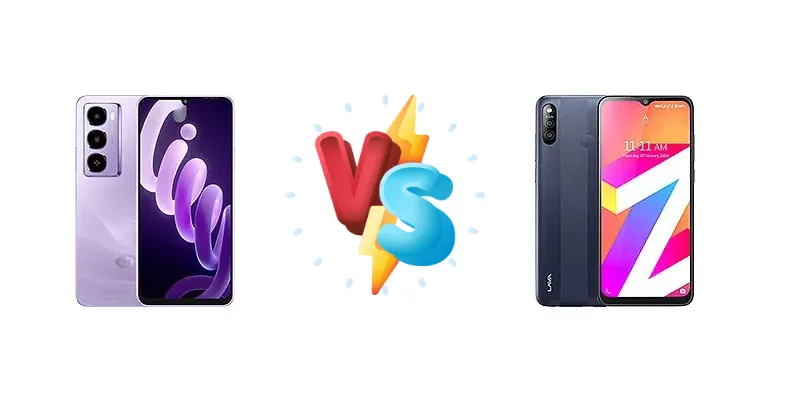
The itel City 100 and Lava Z3 Pro represent the fiercely competitive sub-$150 smartphone market. Both aim to deliver essential functionality at an accessible price, but they take different approaches to achieving this. The key differentiator lies in their chipsets: Unisoc’s T7250 in the itel versus MediaTek’s Helio A25 in the Lava. This comparison will dissect these differences and determine which device offers the best value for budget-conscious consumers.
🏆 Quick Verdict
For most users, the itel City 100 emerges as the stronger choice. Its Unisoc T7250 chipset, featuring Cortex-A75 cores, provides a noticeable performance advantage over the Lava Z3 Pro’s Helio A25, particularly in multitasking and app loading. While both offer similar battery capabilities, the itel’s faster 18W charging adds convenience.
| Network |
|---|
| 2G bands | GSM 850 / 900 / 1800 / 1900 | GSM 900 / 1800 |
| 3G bands | HSDPA 850 / 900 / 2100 | HSDPA 900 / 2100 |
| 4G bands | LTE | 1, 3, 5, 8, 40, 41 |
| Speed | HSPA, LTE | HSPA 42.2/5.76 Mbps, LTE Cat4 150/50 Mbps |
| Technology | GSM / HSPA / LTE | GSM / HSPA / LTE |
| Launch |
|---|
| Announced | 2025, April 27 | 2022, May 18 |
| Status | Available. Released 2025, April 27 | Available. Released 2022, May 18 |
| Body |
|---|
| Build | - | Glass front, plastic back, plastic frame |
| Dimensions | 167.7 x 77.5 x 7.7 mm (6.60 x 3.05 x 0.30 in) | 164.5 x 75.8 x 8.9 mm (6.48 x 2.98 x 0.35 in) |
| SIM | Nano-SIM + Nano-SIM | Nano-SIM + Nano-SIM |
| Weight | 185 g (6.53 oz) | 192 g (6.77 oz) |
| Display |
|---|
| Resolution | 720 x 1600 pixels, 20:9 ratio (~260 ppi density) | 720 x 1600 pixels, 20:9 ratio (~269 ppi density) |
| Size | 6.75 inches, 110.0 cm2 (~84.6% screen-to-body ratio) | 6.52 inches, 102.6 cm2 (~82.3% screen-to-body ratio) |
| Type | IPS LCD, 90Hz, 700 nits (HBM) | IPS LCD |
| Platform |
|---|
| CPU | Octa-core (2x1.8 GHz Cortex-A75 & 6x1.6 GHz Cortex-A55) | Octa-core (4x1.8 GHz Cortex-A53 & 4x1.5 GHz Cortex-A53) |
| Chipset | Unisoc T7250 (12 nm) | Mediatek MT6762D Helio A25 (12 nm) |
| GPU | Mali-G57 MP1 | PowerVR GE8320 |
| OS | Android 14, Pure 14.5 OS | Android 11 |
| Memory |
|---|
| Card slot | microSDXC | microSDXC (dedicated slot) |
| Internal | 128GB 4GB RAM, 128GB 6GB RAM, 128GB 8GB RAM, 256GB 4GB RAM | 32GB 3GB RAM |
| Main Camera |
|---|
| Dual | - | 8 MP, f/2.0, (wide), 1.12µm, AF
Auxiliary lens |
| Features | LED flash, HDR, panorama | LED flash |
| Single | 13 MP | - |
| Video | Yes | 1080p@30fps |
| Selfie camera |
|---|
| Single | 8 MP | 5 MP, f/2.2, (wide) |
| Video | Yes | - |
| Sound |
|---|
| 35mm jack | Yes | Yes |
| Loudspeaker | Yes | Yes |
| Comms |
|---|
| Bluetooth | Yes | 5.0, A2DP, LE |
| Infrared port | Yes | - |
| NFC | No | No |
| Positioning | GPS | GPS |
| Radio | Unspecified | FM radio |
| USB | USB Type-C, OTG | USB Type-C 2.0, OTG |
| WLAN | Yes | Wi-Fi 802.11 b/g/n/ac, Wi-Fi Direct |
| Features |
|---|
| Sensors | Fingerprint (side-mounted); unspecified sensors | Fingerprint (rear-mounted), accelerometer, proximity |
| Battery |
|---|
| Charging | 18W wired
Reverse wired | - |
| Type | 5200 mAh | Li-Po 5000 mAh |
| Misc |
|---|
| Colors | Navy Blue, Pure Titanium, Fairy Purple | Blue, Dark Blue |
| Models | C671L | - |
| Price | About 80 EUR | About 80 EUR |
itel City 100
- Faster processor with Cortex-A75 cores
- 18W fast charging for quicker top-ups
- Potentially smoother multitasking experience
- Battery capacity not specified
- Camera performance likely basic
Lava Z3 Pro
- Potentially longer battery life (depending on capacity)
- Lower price point (likely)
- Simple and straightforward user experience
- Slower processor with older Cortex-A53 cores
- Slower charging speed
- May struggle with demanding apps
Display Comparison
Neither itel nor Lava provide display specifications beyond resolution. Given the price point, both likely utilize IPS LCD panels. The absence of details like peak brightness or color gamut makes direct comparison difficult. However, the focus here is on processing power, not display fidelity. Expect basic viewing experiences on both devices, suitable for everyday tasks but not ideal for media consumption in bright sunlight.
Camera Comparison
Both phones are expected to feature basic camera setups. Without detailed sensor information, it’s difficult to assess image quality. However, the presence of a 2MP macro camera on the Lava Z3 Pro is unlikely to deliver significant photographic value; such sensors often lack the detail and clarity to produce compelling macro shots. The itel City 100’s camera performance will likely be similar, focusing on adequate image capture in good lighting conditions. Expect limited low-light performance from both devices.
Performance
The core difference lies in the chipsets. The itel City 100’s Unisoc T7250 utilizes a more modern CPU architecture with 2x 1.8 GHz Cortex-A75 cores and 6x 1.6 GHz Cortex-A55 cores. This contrasts with the Lava Z3 Pro’s MediaTek Helio A25, which employs 4x 1.8 GHz Cortex-A53 cores and 4x 1.5 GHz Cortex-A53 cores. The A75 cores in the itel offer significantly higher single-core performance, translating to snappier app launches and a more fluid user experience. While both are 12nm chips, the architectural advantage of the Unisoc T7250 is substantial. The Lava Z3 Pro will likely struggle with more demanding applications or heavier multitasking.
Battery Life
Battery capacity isn’t specified for either device, but given the market segment, both likely house batteries in the 4000-5000 mAh range. The itel City 100’s 18W wired charging is a clear advantage over the Lava Z3 Pro, which likely supports standard 10W charging. This faster charging speed will significantly reduce the time spent tethered to a power outlet, offering greater convenience for users who need to quickly top up their battery.
Buying Guide
Buy the itel City 100 if you prioritize responsiveness and smoother multitasking, even if it means potentially sacrificing a small amount of battery longevity. This phone is ideal for users who frequently switch between apps, browse the web, or engage in light social media use. Buy the Lava Z3 Pro if your primary concern is maximizing battery life and you primarily use your phone for basic tasks like calls, texts, and occasional light browsing. It’s a good fit for first-time smartphone users or those on a very tight budget.
Frequently Asked Questions
❓ Will the Unisoc T7250 in the itel City 100 handle popular apps like WhatsApp and Facebook smoothly?
Yes, the Unisoc T7250’s Cortex-A75 cores provide ample processing power for everyday apps like WhatsApp, Facebook, and most social media platforms. You should experience smooth scrolling and quick app loading times, unlike the Lava Z3 Pro which may exhibit noticeable lag.
❓ Is the Lava Z3 Pro a good option for someone who primarily uses their phone for calls and texts?
The Lava Z3 Pro is a viable option for basic communication. Its Helio A25 chipset is sufficient for making calls, sending texts, and managing contacts. However, be aware that it may struggle with more demanding tasks or multitasking, and its slower charging could be inconvenient.
❓ Can either of these phones run PUBG Mobile, and if so, at what settings?
While technically possible to launch PUBG Mobile on both devices, the experience will be far from optimal. The Helio A25 in the Lava Z3 Pro will likely struggle to run the game even at the lowest settings, with significant frame rate drops. The Unisoc T7250 in the itel City 100 might allow for playable performance at the lowest settings, but don't expect a smooth or visually impressive experience.
❓ Does the itel City 100 support reverse wired charging, and what does that mean for users?
Yes, the itel City 100 supports reverse wired charging. This allows you to use the phone as a power bank to charge other devices, such as wireless earbuds or another smartphone, using a USB cable. It's a convenient feature for users who frequently travel or find themselves in situations where they need to share power.