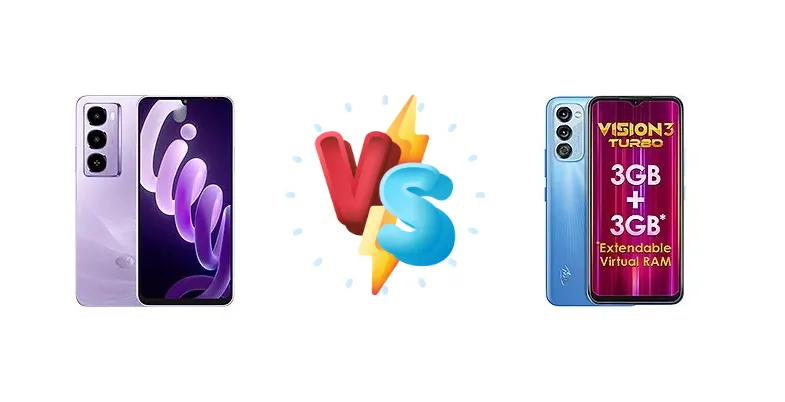
The itel City 100 and Vision 3 Turbo represent itel’s commitment to the ultra-budget smartphone market. While both aim to deliver essential smartphone functionality at a low price point, they differ significantly in their core processing power. This comparison dissects those differences, focusing on how the chipset choices impact real-world performance and user experience.
🏆 Quick Verdict
For users prioritizing responsiveness and multitasking, the itel City 100 emerges as the better choice thanks to its significantly more powerful Unisoc T7250 chipset. While the Vision 3 Turbo offers a comparable feature set, its older and less efficient SC9863A processor will struggle with demanding tasks.
| Network |
|---|
| 2G bands | GSM 850 / 900 / 1800 / 1900 | GSM 850 / 900 / 1800 / 1900 |
| 3G bands | HSDPA 850 / 900 / 2100 | HSDPA 850 / 900 / 2100 |
| 4G bands | LTE | LTE |
| Speed | HSPA, LTE | HSPA, LTE |
| Technology | GSM / HSPA / LTE | GSM / HSPA / LTE |
| Launch |
|---|
| Announced | 2025, April 27 | 2022 |
| Status | Available. Released 2025, April 27 | Available. Released 2022 |
| Body |
|---|
| Dimensions | 167.7 x 77.5 x 7.7 mm (6.60 x 3.05 x 0.30 in) | - |
| SIM | Nano-SIM + Nano-SIM | Dual SIM |
| Weight | 185 g (6.53 oz) | - |
| Display |
|---|
| Resolution | 720 x 1600 pixels, 20:9 ratio (~260 ppi density) | 720 x 1600 pixels, 20:9 ratio (~266 ppi density) |
| Size | 6.75 inches, 110.0 cm2 (~84.6% screen-to-body ratio) | 6.6 inches, 105.2 cm2 |
| Type | IPS LCD, 90Hz, 700 nits (HBM) | IPS LCD |
| Platform |
|---|
| CPU | Octa-core (2x1.8 GHz Cortex-A75 & 6x1.6 GHz Cortex-A55) | Octa-core (4x1.6 GHz Cortex-A55 & 4x1.2 GHz Cortex-A55) |
| Chipset | Unisoc T7250 (12 nm) | Unisoc SC9863A (28 nm) |
| GPU | Mali-G57 MP1 | IMG8322 |
| OS | Android 14, Pure 14.5 OS | Android 11 (Go edition) |
| Memory |
|---|
| Card slot | microSDXC | microSDXC |
| Internal | 128GB 4GB RAM, 128GB 6GB RAM, 128GB 8GB RAM, 256GB 4GB RAM | 64GB 3GB RAM |
| Main Camera |
|---|
| Features | LED flash, HDR, panorama | LED flash |
| Single | 13 MP | 8 MP (wide)
Auxiliary lens |
| Video | Yes | 1080p@30fps |
| Selfie camera |
|---|
| Single | 8 MP | 5 MP |
| Video | Yes | Yes |
| Sound |
|---|
| 35mm jack | Yes | Yes |
| Loudspeaker | Yes | Yes |
| Comms |
|---|
| Bluetooth | Yes | Yes |
| Infrared port | Yes | - |
| NFC | No | No |
| Positioning | GPS | GPS |
| Radio | Unspecified | Unspecified |
| USB | USB Type-C, OTG | microUSB |
| WLAN | Yes | Yes |
| Features |
|---|
| Sensors | Fingerprint (side-mounted); unspecified sensors | Fingerprint (rear-mounted), accelerometer |
| Battery |
|---|
| Charging | 18W wired
Reverse wired | 18W wired |
| Type | 5200 mAh | 5000 mAh |
| Misc |
|---|
| Colors | Navy Blue, Pure Titanium, Fairy Purple | Blue |
| Models | C671L | - |
| Price | About 80 EUR | - |
itel City 100
- Significantly more powerful processor for smoother performance.
- More efficient chipset leading to potentially better battery life.
- Reverse wired charging offers added convenience.
- May be slightly more expensive than the Vision 3 Turbo.
- Detailed display specs are unknown.
itel Vision 3 Turbo
- Likely the more affordable option.
- 18W charging is standard for the price range.
- Suitable for very basic smartphone tasks.
- Less powerful processor resulting in slower performance.
- Less efficient chipset leading to shorter battery life.
- May struggle with multitasking and demanding apps.
Display Comparison
Both devices lack detailed display specifications in the provided data. However, given their price bracket, it’s safe to assume both utilize LCD panels with 720p+ resolution. The absence of information regarding refresh rates suggests both are likely capped at 60Hz. Display quality will likely be similar, focusing on basic visibility rather than color accuracy or brightness.
Camera Comparison
Detailed camera specifications are absent. Given the target market, both phones likely feature basic camera setups. Without sensor size or aperture information, a direct comparison is difficult. However, the processing capabilities of the T7250 in the City 100 may offer slightly better image processing, resulting in marginally improved photo quality, even with similar sensors. The presence of a 2MP macro camera on either device is unlikely to significantly impact the overall camera experience.
Performance
The core difference lies in the chipsets. The itel City 100’s Unisoc T7250, built on a 12nm process, features an octa-core configuration with two Cortex-A75 performance cores clocked at 1.8GHz and six Cortex-A55 efficiency cores at 1.6GHz. This architecture provides a substantial performance advantage over the itel Vision 3 Turbo’s Unisoc SC9863A. The SC9863A, fabricated on a less efficient 28nm process, utilizes four Cortex-A55 cores at 1.6GHz and another four at 1.2GHz. The T7250’s A75 cores offer significantly higher single-core performance, crucial for app launch speeds and general responsiveness. The 12nm process also contributes to better thermal management, potentially reducing throttling during sustained use. The Vision 3 Turbo will likely exhibit noticeable lag when multitasking or running moderately demanding applications.
Battery Life
Both devices support 18W wired charging, suggesting similar charging speeds. While battery capacity isn’t specified, the more efficient Unisoc T7250 in the City 100 will likely translate to better battery life. The 28nm SC9863A in the Vision 3 Turbo consumes more power, reducing the time between charges, even with a potentially larger battery.
Buying Guide
Buy the itel City 100 if you need a smartphone capable of handling everyday tasks like social media, messaging, and light web browsing with reasonable speed. It’s ideal for users who occasionally play less-demanding mobile games. Buy the itel Vision 3 Turbo if your primary needs are basic communication – calls and texts – and you prioritize a slightly lower price point over performance. It’s best suited for first-time smartphone users or those needing a simple backup device.
Frequently Asked Questions
❓ Will the itel Vision 3 Turbo be able to run popular social media apps like Facebook and WhatsApp smoothly?
While the Vision 3 Turbo can *run* these apps, expect a less fluid experience compared to the City 100. The SC9863A processor may exhibit lag when switching between apps or loading content-heavy feeds. Basic functionality will be available, but responsiveness will be noticeably slower.
❓ Is the 18W charging on both phones considered fast charging?
18W charging is considered moderate for current smartphones. While not 'fast' in the flagship sense, it should still provide a reasonable charging speed for these budget devices, taking approximately 2-3 hours for a full charge, assuming a compatible charger is used. The efficiency of the chipset will also affect the actual charging time.
❓ Can I play games like PUBG Mobile on either of these phones?
PUBG Mobile is likely playable on the itel City 100, but only at the lowest graphics settings and frame rates. The Vision 3 Turbo will struggle significantly, potentially experiencing severe lag and frame drops even at the minimum settings. These phones are not designed for demanding gaming.