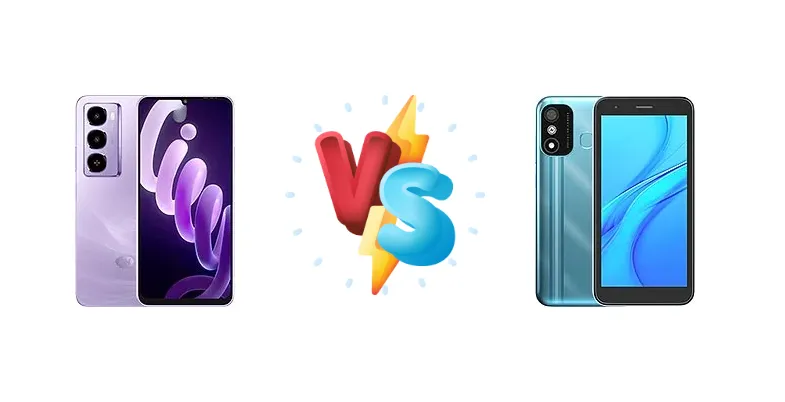
The itel City 100 and itel A27 represent two distinct approaches to the ultra-budget smartphone market. The A27 focuses on affordability, while the City 100 attempts to offer a noticeable performance uplift. This comparison dissects their core components to determine which device provides the best value for users prioritizing everyday tasks and basic smartphone functionality.
🏆 Quick Verdict
For most users, the itel City 100 is the superior choice. Its Unisoc T7250 chipset, built on a more modern 12nm process, delivers significantly improved performance over the A27’s SC9832E. While both phones cater to the entry-level segment, the City 100 offers a smoother user experience for multitasking and app loading.
| Network |
|---|
| 2G bands | GSM 850 / 900 / 1800 / 1900 | GSM 850 / 900 / 1800 / 1900 |
| 3G bands | HSDPA 850 / 900 / 2100 | HSDPA 850 / 900 / 2100 |
| 4G bands | LTE | LTE |
| Speed | HSPA, LTE | HSPA, LTE |
| Technology | GSM / HSPA / LTE | GSM / HSPA / LTE |
| Launch |
|---|
| Announced | 2025, April 27 | 2022 |
| Status | Available. Released 2025, April 27 | Available. Released 2022 |
| Body |
|---|
| Dimensions | 167.7 x 77.5 x 7.7 mm (6.60 x 3.05 x 0.30 in) | - |
| SIM | Nano-SIM + Nano-SIM | Dual SIM |
| Weight | 185 g (6.53 oz) | - |
| Display |
|---|
| Resolution | 720 x 1600 pixels, 20:9 ratio (~260 ppi density) | 480 x 960 pixels, 18:9 ratio (~197 ppi density) |
| Size | 6.75 inches, 110.0 cm2 (~84.6% screen-to-body ratio) | 5.45 inches, 76.7 cm2 |
| Type | IPS LCD, 90Hz, 700 nits (HBM) | IPS LCD |
| Platform |
|---|
| CPU | Octa-core (2x1.8 GHz Cortex-A75 & 6x1.6 GHz Cortex-A55) | Quad-core 1.4 GHz |
| Chipset | Unisoc T7250 (12 nm) | Unisoc SC9832E (28 nm) |
| GPU | Mali-G57 MP1 | Mali-T820 MP1 |
| OS | Android 14, Pure 14.5 OS | Android 11 (Go edition) |
| Memory |
|---|
| Card slot | microSDXC | microSDXC |
| Internal | 128GB 4GB RAM, 128GB 6GB RAM, 128GB 8GB RAM, 256GB 4GB RAM | 32GB 2GB RAM |
| Main Camera |
|---|
| Features | LED flash, HDR, panorama | LED flash |
| Single | 13 MP | 5 MP |
| Video | Yes | Yes |
| Selfie camera |
|---|
| Single | 8 MP | 2 MP |
| Video | Yes | Yes |
| Sound |
|---|
| 35mm jack | Yes | Yes |
| Loudspeaker | Yes | Yes |
| Comms |
|---|
| Bluetooth | Yes | Yes |
| Infrared port | Yes | - |
| NFC | No | No |
| Positioning | GPS | Unspecified |
| Radio | Unspecified | Unspecified |
| USB | USB Type-C, OTG | microUSB |
| WLAN | Yes | Yes |
| Features |
|---|
| Sensors | Fingerprint (side-mounted); unspecified sensors | Fingerprint (rear-mounted), accelerometer |
| Battery |
|---|
| Charging | 18W wired
Reverse wired | - |
| Type | 5200 mAh | 4000 mAh |
| Misc |
|---|
| Colors | Navy Blue, Pure Titanium, Fairy Purple | Blue |
| Models | C671L | - |
| Price | About 80 EUR | - |
itel City 100
- Significantly faster processor for smoother performance
- More efficient chipset for better battery life
- Faster 18W charging with reverse wired charging capability
- Likely slightly higher price point
- May not have a significantly better display
itel A27
- Extremely affordable price
- Simple and easy-to-use interface
- Acceptable for basic communication tasks
- Slow processor leading to lag and sluggishness
- Less power-efficient chipset resulting in shorter battery life
- Limited multitasking capabilities
Display Comparison
Neither itel provides display specifications beyond basic resolution. However, given the price points, both likely utilize LCD panels. The difference in processing power suggests the City 100 could potentially handle slightly more complex display rendering, but this is speculative without further data. Bezels are expected to be substantial on both devices, typical of this market segment. Color accuracy is unlikely to be a strong point on either model.
Camera Comparison
Both phones likely feature basic camera setups. Without specific sensor details, it’s safe to assume image quality will be limited, particularly in low-light conditions. The focus should be on functional photography for social media sharing rather than high-quality images. Any differences in camera performance will likely be attributable to image processing capabilities of the respective chipsets, favoring the City 100 due to its more powerful processor. The presence of a 2MP macro camera on either device is largely a marketing feature with limited practical benefit.
Performance
The core differentiator lies in the chipsets. The itel City 100’s Unisoc T7250, fabricated on a 12nm process, features an octa-core configuration with a mix of Cortex-A75 and A55 cores. This architecture provides a substantial performance advantage over the itel A27’s Unisoc SC9832E, a quad-core processor built on a significantly older 28nm node. The 28nm process is less efficient, meaning the A27 will likely experience more heat and potentially more throttling under sustained load. The A75 cores in the City 100 offer a significant boost in single-core performance, crucial for app launch times and general responsiveness. The City 100 will handle multitasking and app switching far more smoothly.
Battery Life
Battery capacity isn't specified for either device. However, the City 100’s 12nm chipset offers better power efficiency compared to the A27’s 28nm chip. This means the City 100, despite potentially having a similar battery size, will likely deliver longer battery life under typical usage. The City 100 also supports 18W wired charging, a significant advantage over the A27, allowing for faster recharge times. The inclusion of reverse wired charging on the City 100 is a unique feature, allowing it to act as a power bank for other devices, albeit at a slow rate.
Buying Guide
Buy the itel City 100 if you need a phone capable of handling more than just basic calls and texts – if you occasionally browse social media, use messaging apps frequently, or want a slightly more responsive experience. Buy the itel A27 if your primary need is a very affordable device for essential communication and you prioritize absolute minimum cost over performance and responsiveness.
Frequently Asked Questions
❓ Will the itel City 100 handle popular social media apps like Facebook and WhatsApp smoothly?
Yes, the Unisoc T7250 chipset in the City 100 is significantly more capable of running these apps without noticeable lag compared to the A27’s SC9832E. The octa-core processor and more efficient architecture will provide a much smoother user experience.
❓ Is the reverse wired charging feature on the itel City 100 useful for emergency situations?
While the 18W output isn't particularly fast, the reverse wired charging feature can be helpful in a pinch to provide a small amount of charge to another device, such as a Bluetooth earbud or another phone, if you have no other charging options available.
❓ How much of a difference will the 28nm vs 12nm process make in real-world usage?
The difference is substantial. The 28nm process used in the A27’s chipset is significantly less power-efficient. This translates to shorter battery life and potentially more heat generation, leading to performance throttling during extended use. The 12nm process in the City 100 offers a much better balance of performance and efficiency.