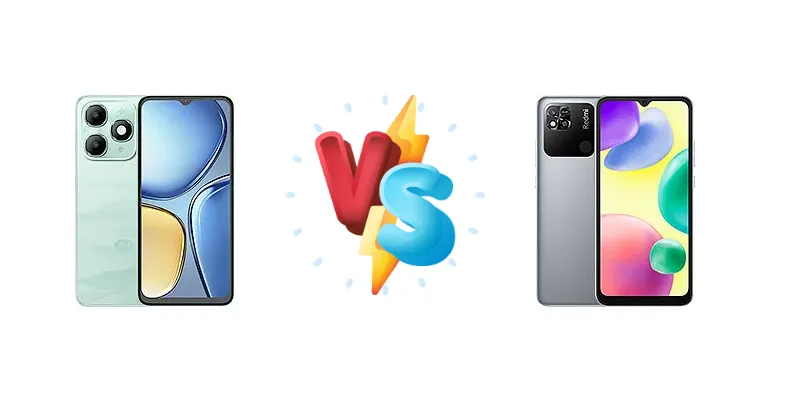
The itel A90 and Xiaomi Redmi 10A represent the extreme end of the smartphone price spectrum, targeting first-time buyers and those needing a reliable secondary device. Both phones prioritize affordability, but key differences in their chipsets and charging capabilities impact daily usability. This comparison dissects these differences to determine which offers the best value.
🏆 Quick Verdict
For most users, the Xiaomi Redmi 10A is the better choice. While the itel A90 offers a slightly newer chipset, the Redmi 10A’s faster CPU clock speeds and more efficient manufacturing process (12nm vs unspecified for the T7100) translate to a snappier user experience, despite the slower charging.
| Network |
|---|
| 2G bands | GSM 850 / 900 / 1800 / 1900 | GSM 850 / 900 / 1800 / 1900 |
| 3G bands | HSDPA 850 / 900 / 2100 | HSDPA 850 / 900 / 2100 |
| 4G bands | LTE | 1, 3, 5, 8, 40, 41 - International |
| Speed | HSPA, LTE | HSPA, LTE |
| Technology | GSM / HSPA / LTE | GSM / HSPA / CDMA2000 / LTE |
| | - | 1, 3, 5, 8, 34, 38, 39, 40, 41 - China |
| Launch |
|---|
| Announced | 2025, April 20 | 2022, March 29 |
| Status | Available. Released 2025, April | Available. Released 2022, March 31 |
| Body |
|---|
| Dimensions | 8.6 mm thickness | 164.9 x 77.1 x 9 mm (6.49 x 3.04 x 0.35 in) |
| SIM | Nano-SIM + Nano-SIM | Nano-SIM + Nano-SIM |
| Weight | 187 g (6.60 oz) | 194 g (6.84 oz) |
| Display |
|---|
| Resolution | 720 x 1612 pixels, 20:9 ratio (~267 ppi density) | 720 x 1600 pixels, 20:9 ratio (~269 ppi density) |
| Size | 6.6 inches, 104.6 cm2 | 6.53 inches, 102.9 cm2 (~81.0% screen-to-body ratio) |
| Type | IPS LCD, 90Hz, 480 nits (typ), 1500 nits (peak) | IPS LCD, 400 nits (typ) |
| Platform |
|---|
| CPU | Octa-core 1.8 GHz | Octa-core (4x2.0 GHz Cortex-A53 & 4x1.5 GHz Cortex-A53) |
| Chipset | Unisoc T7100 | Mediatek MT6762G Helio G25 (12 nm) |
| GPU | PowerVR GE8322 | PowerVR GE8320 |
| OS | Android 14, itel OS 14 | Android 11, MIUI 12.5 |
| Memory |
|---|
| Card slot | microSDXC (dedicated slot) | microSDXC |
| Internal | 64GB 3GB RAM, 64GB 4GB RAM, 128GB 3GB RAM, 128GB 4GB RAM, 256GB 4GB RAM | 32GB 2GB RAM, 32GB 3GB RAM, 64GB 3GB RAM, 64GB 4GB RAM, 128GB 4GB RAM, 128GB 6GB RAM |
| Main Camera |
|---|
| Features | LED flash, HDR, panorama | LED flash |
| Single | 13 MP, AF
Auxiliary lens | 13 MP, f/2.2, (wide), 1.0µm, AF |
| Video | 1080p@30fps | 1080p@30fps |
| Selfie camera |
|---|
| Features | - | HDR |
| Single | 5 MP | 5 MP |
| Video | Yes | 1080p@30fps |
| Sound |
|---|
| 3.5mm jack | - | Yes |
| 35mm jack | Yes | Yes |
| Loudspeaker | Yes | Yes |
| Comms |
|---|
| Bluetooth | Yes | 5.0, A2DP, LE |
| NFC | No | No |
| Positioning | GPS | GPS, GLONASS, BDS |
| Radio | Unspecified | No |
| USB | USB Type-C 2.0, OTG | microUSB 2.0 |
| WLAN | Yes | Wi-Fi 802.11 a/b/g/n, Wi-Fi Direct |
| Features |
|---|
| Sensors | Fingerprint (side-mounted); unspecified sensors | Fingerprint (rear-mounted), accelerometer, proximity |
| Battery |
|---|
| Charging | 15W wired | 10W wired |
| Type | 5000 mAh | Li-Ion 5000 mAh |
| Misc |
|---|
| Colors | Starlit Black, Space Titanium, Aurora Blue, Cosmic Green | Charcoal Black, Sea Blue, Slate Grey |
| Models | A6610L | 220233L2C, 220233L2G, 220233L2I |
| Price | $ 76.23 | € 60.00 / $ 66.55 |
| SAR | - | 0.90 W/kg (head) 0.65 W/kg (body) |
| SAR EU | - | 0.40 W/kg (head) 0.99 W/kg (body) |
itel A90
- Faster charging (15W vs 10W)
- More recent chipset release (Unisoc T7100)
- Potentially better software support (depending on itel's update schedule)
- Uniform CPU core configuration may limit peak performance
- Unisoc chipset's efficiency is unknown compared to MediaTek
Xiaomi Redmi 10A
- Faster CPU clock speeds (2.0 GHz vs 1.8 GHz)
- More efficient 12nm manufacturing process
- Established MediaTek chipset with known performance characteristics
- Slower charging (10W)
- Older chipset design
Display Comparison
Neither device is expected to excel in display quality, given their price point. Specifications are not provided, so we can assume both utilize LCD panels with 720p+ resolution. The focus here is on usability, and the absence of details suggests neither offers features like high refresh rates or wide color gamuts. Bezels are likely to be substantial on both devices, maximizing screen real estate within a compact form factor.
Camera Comparison
Both phones are likely to feature basic camera setups. Without specific sensor details, it’s safe to assume both rely on a primary sensor paired with auxiliary lenses of limited utility (likely 2MP depth or macro sensors). Image quality will be heavily reliant on software processing, and neither phone is expected to deliver exceptional results in low-light conditions. The absence of OIS on either device further limits their photographic capabilities.
Performance
The core difference lies in the chipsets. The Xiaomi Redmi 10A’s MediaTek Helio G25, built on a 12nm process, features an octa-core configuration split into 4x2.0 GHz Cortex-A53 cores and 4x1.5 GHz Cortex-A53 cores. This split architecture aims to balance performance and efficiency. Conversely, the itel A90 utilizes the Unisoc T7100 with a uniform octa-core 1.8 GHz configuration. While the Unisoc is newer, the higher clock speeds of the Redmi 10A’s prime cores suggest superior performance in tasks requiring burst processing power. The 12nm process of the Helio G25 also implies better power efficiency, potentially offsetting the slightly lower battery capacity (assuming similar capacities, which is likely).
Battery Life
The itel A90 supports 15W wired charging, while the Redmi 10A is limited to 10W. This is a significant difference in charging speed. However, the more efficient Helio G25 chipset in the Redmi 10A may mitigate the slower charging, potentially resulting in comparable real-world battery life despite the charging wattage disparity. The actual 0-100% charge times will vary, but the itel A90 will likely achieve a full charge considerably faster.
Buying Guide
Buy the itel A90 if you prioritize a very recent chipset release and are primarily focused on basic communication tasks like calls and messaging. Buy the Xiaomi Redmi 10A if you want a more responsive device for everyday tasks, occasional social media browsing, and light gaming, and are willing to accept slower charging speeds.
Frequently Asked Questions
❓ Will the Redmi 10A struggle with popular apps like WhatsApp and Facebook?
The MediaTek Helio G25 in the Redmi 10A is capable of running apps like WhatsApp and Facebook smoothly. While it's not a powerhouse, these apps are relatively lightweight and optimized for low-end hardware. Expect acceptable performance for everyday social media use.
❓ Is the Unisoc T7100 in the itel A90 a significant upgrade over older MediaTek Helio A22 chips?
Yes, the Unisoc T7100 represents a noticeable improvement over the Helio A22. It offers a more modern architecture and higher clock speeds, resulting in a more responsive user experience. However, the Helio G25 in the Redmi 10A still holds a performance advantage due to its faster cores and efficient manufacturing process.
❓ Can either of these phones handle basic mobile gaming?
Both phones can handle very basic mobile gaming, but don't expect high frame rates or detailed graphics. Games like Subway Surfers or Candy Crush will run adequately. More demanding titles like PUBG Mobile will likely require significant graphics settings reductions and may still experience lag.
❓ Which phone is better for someone completely new to smartphones?
Both are suitable for first-time smartphone users. However, the Redmi 10A's slightly smoother performance might make the initial experience less frustrating. The simpler interface of Xiaomi's MIUI (compared to itel's potentially less refined software) could also be easier to navigate for beginners.