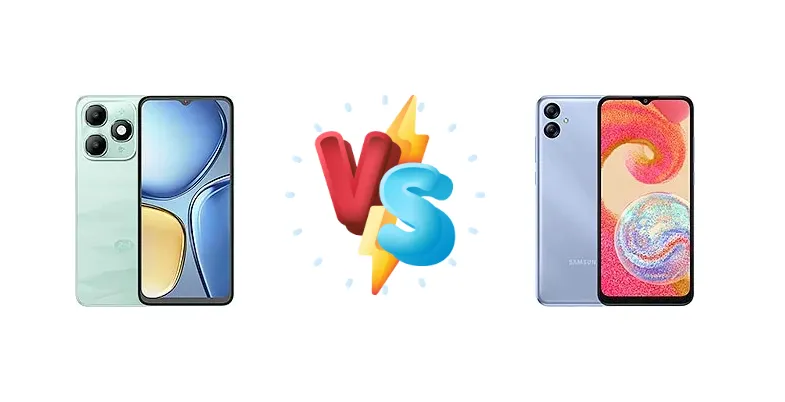
The itel A90 and Samsung Galaxy A04e represent the extreme end of the smartphone price spectrum. Both aim to deliver essential smartphone functionality at an incredibly affordable price point, but they take different approaches to achieving this. This comparison dissects their core components to determine which device offers the best value for users prioritizing performance, battery life, and overall usability.
🏆 Quick Verdict
For the average user seeking the most responsive experience, the Samsung Galaxy A04e edges out the itel A90. While the A90 benefits from a newer chipset, the A04e’s Helio P35, with its higher clock speeds, delivers noticeably smoother performance in everyday tasks, making it the better choice for most.
| Network |
|---|
| 2G bands | GSM 850 / 900 / 1800 / 1900 | GSM 850 / 900 / 1800 / 1900 |
| 3G bands | HSDPA 850 / 900 / 2100 | HSDPA 850 / 900 / 2100 |
| 4G bands | LTE | 1, 3, 5, 7, 8, 20, 28, 38, 40, 41 |
| Speed | HSPA, LTE | HSPA, LTE |
| Technology | GSM / HSPA / LTE | GSM / HSPA / LTE |
| Launch |
|---|
| Announced | 2025, April 20 | 2022, October 21 |
| Status | Available. Released 2025, April | Available. Released 2022, November 07 |
| Body |
|---|
| Build | - | Glass front, plastic back, plastic frame |
| Dimensions | 8.6 mm thickness | 164.2 x 75.9 x 9.1 mm (6.46 x 2.99 x 0.36 in) |
| SIM | Nano-SIM + Nano-SIM | · Nano-SIM· Nano-SIM + Nano-SIM |
| Weight | 187 g (6.60 oz) | 188 g (6.63 oz) |
| Display |
|---|
| Resolution | 720 x 1612 pixels, 20:9 ratio (~267 ppi density) | 720 x 1600 pixels, 20:9 ratio (~270 ppi density) |
| Size | 6.6 inches, 104.6 cm2 | 6.5 inches, 102.0 cm2 (~81.8% screen-to-body ratio) |
| Type | IPS LCD, 90Hz, 480 nits (typ), 1500 nits (peak) | PLS LCD |
| Platform |
|---|
| CPU | Octa-core 1.8 GHz | Octa-core (4x2.3 GHz Cortex-A53 & 4x1.8 GHz Cortex-A53) |
| Chipset | Unisoc T7100 | Mediatek MT6765 Helio P35 (12 nm) |
| GPU | PowerVR GE8322 | PowerVR GE8320 |
| OS | Android 14, itel OS 14 | Android 12, One UI Core 4.1 |
| Memory |
|---|
| Card slot | microSDXC (dedicated slot) | microSDXC (dedicated slot) |
| Internal | 64GB 3GB RAM, 64GB 4GB RAM, 128GB 3GB RAM, 128GB 4GB RAM, 256GB 4GB RAM | 32GB 2GB RAM, 32GB 3GB RAM, 32GB 4GB RAM, 64GB 2GB RAM, 64GB 3GB RAM, 64GB 4GB RAM, 128GB 4GB RAM |
| Main Camera |
|---|
| Dual | - | 13 MP, f/2.2, (wide), AF
Auxiliary lens |
| Features | LED flash, HDR, panorama | LED flash |
| Single | 13 MP, AF
Auxiliary lens | 5 MP, f/2.2 |
| Video | 1080p@30fps | 1080p@30fps |
| Selfie camera |
|---|
| Single | 5 MP | 5 MP, f/2.2 |
| Video | Yes | Yes |
| Sound |
|---|
| 3.5mm jack | - | Yes |
| 35mm jack | Yes | Yes |
| Loudspeaker | Yes | Yes |
| Comms |
|---|
| Bluetooth | Yes | 5.0, A2DP, LE |
| NFC | No | No |
| Positioning | GPS | GPS, GLONASS, GALILEO, BDS |
| Radio | Unspecified | Unspecified |
| USB | USB Type-C 2.0, OTG | USB Type-C 2.0, OTG |
| WLAN | Yes | Wi-Fi 802.11 b/g/n, Wi-Fi Direct |
| Features |
|---|
| Sensors | Fingerprint (side-mounted); unspecified sensors | Accelerometer, proximity |
| Battery |
|---|
| Charging | 15W wired | - |
| Type | 5000 mAh | Li-Po 5000 mAh |
| Misc |
|---|
| Colors | Starlit Black, Space Titanium, Aurora Blue, Cosmic Green | Black, Copper, Light Blue |
| Models | A6610L | SM-A042F, SM-A042F/DS, SM-A042M, SM-A042M/DS |
| Price | $ 76.23 | ₹ 7,999 |
| SAR EU | - | 0.29 W/kg (head) 1.11 W/kg (body) |
itel A90
- Potentially longer software support due to Android Go focus
- Newer Unisoc T7100 chipset
- 15W fast charging
- Lower peak CPU clock speeds
- Potentially less responsive user interface
- Limited camera capabilities
Samsung Galaxy A04e
- Higher CPU clock speeds for smoother performance
- Established Samsung brand and ecosystem
- Potentially better image processing
- Older Mediatek Helio P35 chipset
- Potential for pre-installed bloatware
- Charging speed likely similar to itel A90
Display Comparison
Neither device boasts a standout display. Both are likely to feature LCD panels, typical for this price bracket. The key difference lies under the hood. While specific display specs are unavailable, the A04e’s Mediatek Helio P35 is paired with a GPU capable of driving a slightly more responsive visual experience. The itel A90’s Unisoc T7100, while newer, may be limited by its integrated graphics, potentially resulting in less smooth scrolling and animations. Expect both to have resolutions around 720p+.
Camera Comparison
Camera performance on both devices will be limited. Both are likely to feature a primary camera alongside basic depth or macro sensors. Given the lack of detailed sensor information, it’s safe to assume both will struggle in low-light conditions. The A04e’s image processing, benefiting from Samsung’s software expertise, may produce slightly more pleasing results, but don’t expect flagship-level quality. The 2MP macro cameras on both devices are largely marketing features and offer minimal practical benefit.
Performance
The performance gap is the most significant differentiator. The Samsung Galaxy A04e’s Mediatek Helio P35 utilizes a big.LITTLE architecture with four cores clocked at 2.3 GHz (Cortex-A53) and four at 1.8 GHz. This contrasts with the itel A90’s Unisoc T7100, an octa-core processor clocked uniformly at 1.8 GHz. The higher peak clock speeds of the A04e’s cores translate to faster app launch times and smoother multitasking, even though the Unisoc T7100 is newer. The Helio P35’s 12nm process node is also more mature, potentially offering better power efficiency under load. The A90’s Unisoc T7100 may excel in sustained performance due to its newer architecture, but the A04e’s initial responsiveness is superior.
Battery Life
Both devices feature modest battery capacities, likely around 5000mAh. The itel A90 supports 15W wired charging. The A04e’s charging speed is not specified, but is likely similar. The Unisoc T7100’s potentially better power efficiency could translate to slightly longer battery life on the A90, but the difference will likely be marginal. Real-world battery life will heavily depend on usage patterns, with both devices capable of lasting a full day with moderate use.
Buying Guide
Buy the itel A90 if you need a phone primarily for basic communication – calls, texts, and light social media – and prioritize a potentially longer software support lifecycle due to itel’s increasing focus on Android Go. Buy the Samsung Galaxy A04e if you prefer a more fluid user experience, even with basic apps, and value the Samsung brand recognition and established ecosystem, despite the potential for more pre-installed bloatware.
Frequently Asked Questions
❓ Does the Mediatek Helio P35 in the Galaxy A04e tend to overheat during prolonged use, like gaming?
The Helio P35 is a relatively power-efficient chipset. While it won't deliver high-end gaming performance, it's unlikely to overheat significantly during moderate gaming sessions. Expect some throttling after extended play, but it shouldn't lead to device instability.
❓ Is the Android Go edition on the itel A90 a significant benefit, or does it limit functionality?
Android Go is designed for devices with limited RAM and storage. It offers a streamlined experience with optimized apps, consuming fewer resources. While it may not have all the features of the full Android version, it provides a smoother experience on lower-end hardware like the itel A90, and potentially longer software support.
❓ How much storage space is realistically usable on each device after accounting for the operating system and pre-installed apps?
Both devices likely ship with 32GB of storage. After accounting for the operating system (Android Go on the itel A90, standard Android on the A04e) and pre-installed apps, you can realistically expect around 15-20GB of usable storage on each device. A microSD card is highly recommended for both.