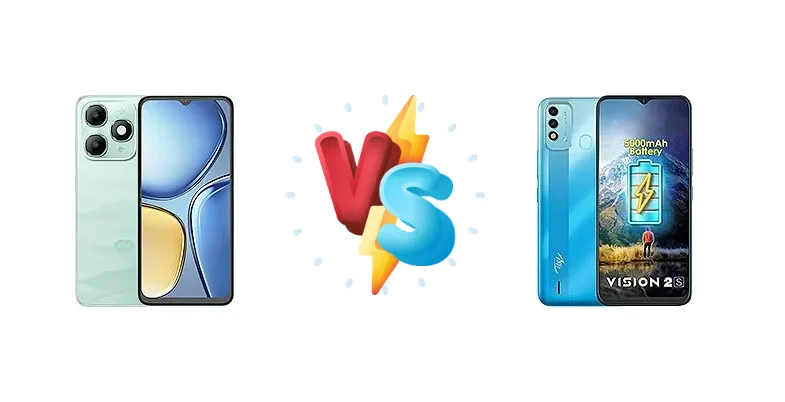
The itel A90 and Vision 2S represent itel’s commitment to the ultra-budget smartphone market. Both devices aim to deliver essential smartphone functionality at incredibly accessible price points. However, key differences in their chipsets and charging capabilities dictate which phone is better suited for specific user needs. This comparison dives deep into those differences.
🏆 Quick Verdict
For most users, the itel Vision 2S is the better choice. While the A90’s Unisoc T7100 offers a slightly higher clock speed, the Vision 2S’s 18W charging significantly reduces downtime, and its chipset is optimized for efficiency. The difference in real-world performance will be minimal for everyday tasks.
| Network |
|---|
| 2G bands | GSM 850 / 900 / 1800 / 1900 | GSM 850 / 900 / 1800 / 1900 |
| 3G bands | HSDPA 850 / 900 / 2100 | HSDPA 850 / 900 / 2100 |
| 4G bands | LTE | LTE |
| Speed | HSPA, LTE | HSPA, LTE |
| Technology | GSM / HSPA / LTE | GSM / HSPA / LTE |
| Launch |
|---|
| Announced | 2025, April 20 | 2021 |
| Status | Available. Released 2025, April | Available. Released 2021 |
| Body |
|---|
| Dimensions | 8.6 mm thickness | 166 x 76.3 x 8.9 mm (6.54 x 3.00 x 0.35 in) |
| SIM | Nano-SIM + Nano-SIM | Dual SIM |
| Weight | 187 g (6.60 oz) | - |
| Display |
|---|
| Resolution | 720 x 1612 pixels, 20:9 ratio (~267 ppi density) | 720 x 1600 pixels, 20:9 ratio (~269 ppi density) |
| Size | 6.6 inches, 104.6 cm2 | 6.52 inches, 102.6 cm2 (~81.0% screen-to-body ratio) |
| Type | IPS LCD, 90Hz, 480 nits (typ), 1500 nits (peak) | IPS LCD |
| Platform |
|---|
| CPU | Octa-core 1.8 GHz | Octa-core (4x1.6 GHz Cortex-A55 & 4x1.2 GHz Cortex-A55) |
| Chipset | Unisoc T7100 | Unisoc SC9863A (28 nm) |
| GPU | PowerVR GE8322 | IMG8322 |
| OS | Android 14, itel OS 14 | Android 11 (Go edition) |
| Memory |
|---|
| Card slot | microSDXC (dedicated slot) | microSDXC |
| Internal | 64GB 3GB RAM, 64GB 4GB RAM, 128GB 3GB RAM, 128GB 4GB RAM, 256GB 4GB RAM | 32GB 2GB RAM |
| Main Camera |
|---|
| Dual | - | 8 MP
0.3 MP |
| Features | LED flash, HDR, panorama | LED flash |
| Single | 13 MP, AF
Auxiliary lens | - |
| Video | 1080p@30fps | 1080p@30fps |
| Selfie camera |
|---|
| Single | 5 MP | 5 MP |
| Video | Yes | Yes |
| Sound |
|---|
| 35mm jack | Yes | Yes |
| Loudspeaker | Yes | Yes |
| Comms |
|---|
| Bluetooth | Yes | Yes |
| NFC | No | No |
| Positioning | GPS | GPS |
| Radio | Unspecified | Unspecified |
| USB | USB Type-C 2.0, OTG | microUSB |
| WLAN | Yes | Yes |
| Features |
|---|
| Sensors | Fingerprint (side-mounted); unspecified sensors | Fingerprint (rear-mounted), accelerometer |
| Battery |
|---|
| Charging | 15W wired | 18W wired |
| Type | 5000 mAh | 5000 mAh |
| Misc |
|---|
| Colors | Starlit Black, Space Titanium, Aurora Blue, Cosmic Green | Gradation Purple, Gradation Blue, Deep Blue |
| Models | A6610L | - |
| Price | $ 76.23 | - |
itel A90
- Slightly higher CPU clock speed (1.8 GHz)
- Potentially lower initial cost
- Unisoc T7100 chipset
- Slower 15W charging
- Likely less power-efficient chipset
- Potential for thermal throttling
itel Vision 2S
- Faster 18W charging
- More power-efficient Unisoc SC9863A chipset
- Optimized core configuration for efficiency
- Lower peak CPU clock speed (1.6 GHz)
- May be slightly more expensive
- SC9863A is an older chipset
Display Comparison
Neither itel provides display specifications beyond size, so a detailed comparison is limited. Both likely utilize IPS LCD panels, common in this price bracket. Expect 720p+ resolution on both. The absence of details like peak brightness or color gamut suggests a focus on cost reduction over display quality. Bezels are likely to be substantial on both devices, impacting the overall screen-to-body ratio.
Camera Comparison
Camera details are sparse for both devices. It’s safe to assume both feature a primary camera and potentially a secondary depth sensor. The absence of information regarding sensor size or aperture makes a direct comparison impossible. Given the price point, image quality will likely be adequate for social media sharing in good lighting conditions, but struggle in low-light scenarios. Expect limited detail and dynamic range. The inclusion of a 2MP macro camera on either device is largely a marketing tactic, offering minimal practical benefit.
Performance
The core difference lies in the chipsets. The itel A90 features the Unisoc T7100, an octa-core processor clocked at 1.8 GHz. The Vision 2S utilizes the Unisoc SC9863A, also octa-core, but with a split configuration: 4x1.6 GHz Cortex-A55 and 4x1.2 GHz Cortex-A55 cores. While the T7100 boasts a higher peak clock speed, the SC9863A’s architecture, built on a 28nm process, is likely more power-efficient. This means the Vision 2S may exhibit better sustained performance under load and less thermal throttling. The A90’s T7100, while faster on paper, may struggle to maintain peak performance for extended periods. RAM configurations are not specified, but both will likely feature 2-3GB, limiting multitasking capabilities.
Battery Life
Battery capacity is not specified for either device, but both likely house batteries in the 4000-5000 mAh range, typical for this segment. However, the charging speeds differ significantly. The itel A90 supports 15W wired charging, while the Vision 2S supports 18W. This 3W difference translates to noticeably faster charging times for the Vision 2S. Users who frequently find themselves needing to top up their battery will greatly benefit from the faster charging speed, reducing downtime and increasing usability.
Buying Guide
Buy the itel A90 if you prioritize a marginally faster CPU clock speed and are comfortable with slower charging. This phone suits users who primarily need a device for basic communication and light app usage. Buy the itel Vision 2S if you value faster charging and a more efficient chipset, making it ideal for users who rely on their phone throughout the day and need to minimize downtime. It’s the better all-rounder.
Frequently Asked Questions
❓ Will the itel Vision 2S’s 18W charging work with any USB charger, or do I need a specific adapter?
The itel Vision 2S supports standard USB Power Delivery (PD) and Quick Charge protocols. While it will charge with any USB charger, you’ll achieve the full 18W charging speed with a PD or Quick Charge compatible adapter. Using a standard 5W charger will result in significantly slower charging times.
❓ Is the Unisoc SC9863A chipset in the Vision 2S capable of running popular apps like WhatsApp and Facebook smoothly?
Yes, the Unisoc SC9863A is more than capable of running everyday apps like WhatsApp, Facebook, and web browsers without issue. While it’s not a powerhouse for demanding games, it’s optimized for efficient performance in common tasks. Expect a smooth experience for basic smartphone usage.
❓ How much storage do these phones typically come with, and can it be expanded?
Both the itel A90 and Vision 2S typically come with 32GB of internal storage. Crucially, both devices support microSD card expansion, allowing you to add up to 128GB or 256GB of additional storage for photos, videos, and apps. This is essential given the limited base storage.
❓ Which phone is better for someone who primarily uses their phone for calls and texts?
Both phones are perfectly adequate for calls and texts. However, the itel Vision 2S’s more efficient chipset and faster charging provide a slightly better overall experience, ensuring the phone is ready to go when you need it, even with infrequent charging.