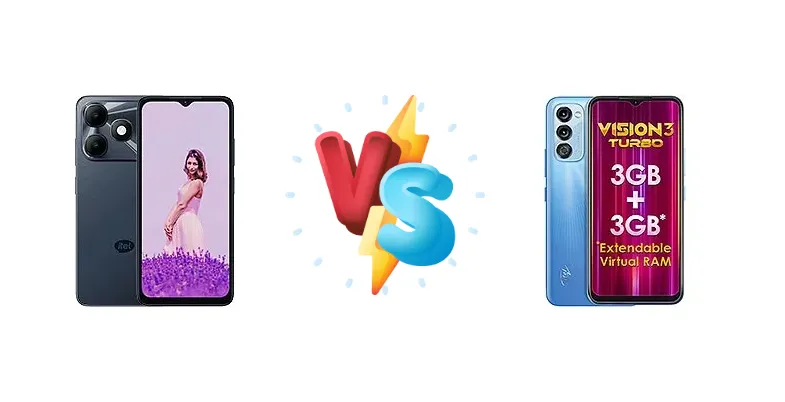
The itel A90 Limited and Vision 3 Turbo represent itel’s commitment to the ultra-budget smartphone market. Both devices aim to deliver essential smartphone functionality at incredibly accessible price points. However, they differ in their internal hardware, specifically the chipset and charging capabilities, creating a clear distinction in performance and user experience. This comparison will dissect these differences to help you determine which device best suits your needs.
🏆 Quick Verdict
For most users, the itel Vision 3 Turbo offers a slightly better experience due to its faster 18W charging and marginally more efficient chipset architecture. While the A90 Limited’s Unisoc T7100 has a higher clock speed, the Vision 3 Turbo’s SC9863A benefits from a more balanced core configuration and optimized power draw, making it the better all-rounder.
| Network |
|---|
| 2G bands | GSM 850 / 900 / 1800 / 1900 | GSM 850 / 900 / 1800 / 1900 |
| 3G bands | HSDPA 850 / 900 / 2100 | HSDPA 850 / 900 / 2100 |
| 4G bands | 1, 3, 5, 8, 38, 40, 41 | LTE |
| Speed | HSPA, LTE | HSPA, LTE |
| Technology | GSM / HSPA / LTE | GSM / HSPA / LTE |
| Launch |
|---|
| Announced | 2025, September 02 | 2022 |
| Status | Available. Released 2025, October | Available. Released 2022 |
| Body |
|---|
| Dimensions | - | - |
| SIM | Nano-SIM + Nano-SIM | Dual SIM |
| Weight | - | - |
| Display |
|---|
| Resolution | 720 x 1612 pixels, 20:9 ratio (~267 ppi density) | 720 x 1600 pixels, 20:9 ratio (~266 ppi density) |
| Size | 6.6 inches, 104.6 cm2 | 6.6 inches, 105.2 cm2 |
| Type | IPS LCD, 90Hz, 480 nits (typ), 1500 nits (peak) | IPS LCD |
| Platform |
|---|
| CPU | Octa-core 1.8 GHz | Octa-core (4x1.6 GHz Cortex-A55 & 4x1.2 GHz Cortex-A55) |
| Chipset | Unisoc T7100 | Unisoc SC9863A (28 nm) |
| GPU | PowerVR GE8322 | IMG8322 |
| OS | Android 14 (Go edition), itel OS 14 | Android 11 (Go edition) |
| Memory |
|---|
| Card slot | microSDXC (dedicated slot) | microSDXC |
| Internal | 64GB 4GB RAM, 128GB 4GB RAM | 64GB 3GB RAM |
| Main Camera |
|---|
| Features | LED flash, HDR, panorama | LED flash |
| Single | 13 MP, AF
Auxiliary lens | 8 MP (wide)
Auxiliary lens |
| Video | 1080p@30fps | 1080p@30fps |
| Selfie camera |
|---|
| Single | 5 MP | 5 MP |
| Video | Yes | Yes |
| Sound |
|---|
| 35mm jack | Yes | Yes |
| Loudspeaker | Yes | Yes |
| Comms |
|---|
| Bluetooth | Yes | Yes |
| NFC | No | No |
| Positioning | GPS | GPS |
| Radio | Unspecified | Unspecified |
| USB | USB Type-C 2.0, OTG | microUSB |
| WLAN | Yes | Yes |
| Features |
|---|
| Sensors | Fingerprint (side-mounted), accelerometer | Fingerprint (rear-mounted), accelerometer |
| Battery |
|---|
| Charging | 15W wired | 18W wired |
| Type | Li-Ion 5000 mAh | 5000 mAh |
| Misc |
|---|
| Colors | Starlit Black, Space Titanium, Aurora Blue | Blue |
| Price | About 60 EUR | - |
| SAR | 0.82 W/kg (head) 0.46 W/kg (body) | - |
itel A90 Limited
- Higher CPU clock speed (1.8 GHz)
- Potentially lower initial cost
- Simple and straightforward user experience
- Slower charging (15W)
- Less efficient chipset architecture
- Potentially more thermal throttling under sustained load
itel Vision 3 Turbo
- Faster charging (18W)
- More balanced processor core configuration
- Potentially better power efficiency
- Smoother multitasking experience
- Lower CPU clock speed (1.6 GHz)
- May be slightly more expensive
Display Comparison
Neither itel provides display specifications beyond size, so a detailed comparison is limited. Both likely utilize LCD panels, common in this price bracket. The absence of information regarding resolution, brightness, or color gamut suggests a focus on cost reduction. Bezels are expected to be substantial on both devices, maximizing screen real estate within a compact form factor. Color accuracy is likely to be standard for the segment, prioritizing visibility over fidelity.
Camera Comparison
Detailed camera specifications are unavailable for either device. However, given the price point, both are likely to feature basic camera setups. It’s safe to assume both will include a primary camera and potentially a secondary depth sensor. Image processing will be limited, and low-light performance will likely be subpar. The absence of OIS (Optical Image Stabilization) on either device means image stabilization will rely solely on software algorithms. Focusing on megapixel counts alone would be misleading; the quality of the image sensor and image processing pipeline are far more critical.
Performance
The core difference lies in the chipsets. The itel A90 Limited features the Unisoc T7100, an octa-core processor clocked at 1.8 GHz. While the clock speed is higher, the Unisoc SC9863A in the Vision 3 Turbo employs a more nuanced approach with a cluster of 4x1.6 GHz Cortex-A55 cores and 4x1.2 GHz Cortex-A55 cores. This configuration allows the SC9863A to dynamically allocate resources, potentially leading to smoother multitasking and better sustained performance. The SC9863A’s 28nm process node, while older, is optimized for power efficiency, potentially offsetting the T7100’s higher clock speed. Users engaging in more than basic tasks will likely notice a smoother experience on the Vision 3 Turbo.
Battery Life
Both devices feature modest battery capacities, typical for their price range. The itel A90 Limited supports 15W wired charging, while the Vision 3 Turbo steps up to 18W. This 3W difference, while seemingly small, translates to a noticeable reduction in charging time. The Vision 3 Turbo will likely reach a full charge faster, offering a more convenient user experience. While battery life will depend heavily on usage patterns, the SC9863A’s potentially better power efficiency could contribute to slightly longer runtimes on the Vision 3 Turbo.
Buying Guide
Buy the itel A90 Limited if you prioritize raw CPU clock speed and are comfortable with potentially slower charging times. This phone is ideal for users who primarily need a device for basic communication and light app usage. Buy the itel Vision 3 Turbo if you value faster charging, a more balanced processor configuration for smoother multitasking, and a slightly more efficient overall experience. This is the better choice for users who consume media or engage in light social media browsing.
Frequently Asked Questions
❓ Will the itel Vision 3 Turbo handle popular social media apps like Facebook and WhatsApp smoothly?
Yes, the Unisoc SC9863A’s octa-core configuration and balanced core speeds are well-suited for running common social media applications like Facebook, WhatsApp, and Instagram. The processor should provide a reasonably smooth experience for browsing feeds, sending messages, and sharing content.
❓ How long will it take to fully charge the itel A90 Limited from 0%?
With its 15W charging, the itel A90 Limited will likely take around 2.5 to 3.5 hours to fully charge from 0% to 100%, depending on usage during charging. This is considerably slower than the Vision 3 Turbo’s 18W charging.
❓ Are either of these phones suitable for playing demanding mobile games?
Neither the itel A90 Limited nor the Vision 3 Turbo are designed for demanding mobile gaming. While they can handle simpler games, graphically intensive titles will likely experience significant lag and frame rate drops. These phones are best suited for casual gaming.
❓ Do either of these phones support dual SIM functionality?
While not explicitly stated in the provided specifications, itel phones in this price range typically *do* support dual SIM functionality. However, it's best to confirm this with the retailer or official product documentation before purchasing.