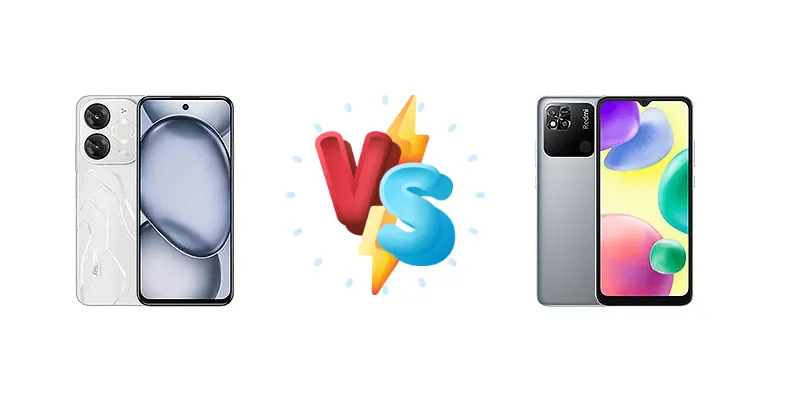
The itel A80 and Xiaomi Redmi 10A represent the extreme end of the smartphone market, targeting first-time buyers and those seeking ultra-affordable connectivity. Both devices prioritize essential functionality, but diverge in their core processing power and, consequently, their user experience. This comparison dissects these differences to determine which phone delivers the best value.
🏆 Quick Verdict
For the average user prioritizing basic tasks like calls, messaging, and light social media, the Xiaomi Redmi 10A offers a slight edge. Its Mediatek Helio G25 chipset, while still entry-level, provides a more responsive experience than the Unisoc T603 in the itel A80, justifying the often minimal price difference.
| Network |
|---|
| 2G bands | GSM 850 / 900 / 1800 / 1900 | GSM 850 / 900 / 1800 / 1900 |
| 3G bands | HSDPA 850 / 900 / 2100 | HSDPA 850 / 900 / 2100 |
| 4G bands | LTE | 1, 3, 5, 8, 40, 41 - International |
| Speed | HSPA, LTE | HSPA, LTE |
| Technology | GSM / HSPA / LTE | GSM / HSPA / CDMA2000 / LTE |
| | - | 1, 3, 5, 8, 34, 38, 39, 40, 41 - China |
| Launch |
|---|
| Announced | 2024, September | 2022, March 29 |
| Status | Available. Released 2024, September | Available. Released 2022, March 31 |
| Body |
|---|
| Dimensions | 8.5 mm thickness | 164.9 x 77.1 x 9 mm (6.49 x 3.04 x 0.35 in) |
| SIM | Dual SIM | Nano-SIM + Nano-SIM |
| Weight | - | 194 g (6.84 oz) |
| Display |
|---|
| Resolution | 720 x 1600 pixels, 20:9 ratio (~262 ppi density) | 720 x 1600 pixels, 20:9 ratio (~269 ppi density) |
| Size | 6.7 inches, 108.4 cm2 | 6.53 inches, 102.9 cm2 (~81.0% screen-to-body ratio) |
| Type | IPS LCD, 120Hz, 500 nits (peak) | IPS LCD, 400 nits (typ) |
| Platform |
|---|
| CPU | Octa-core | Octa-core (4x2.0 GHz Cortex-A53 & 4x1.5 GHz Cortex-A53) |
| Chipset | Unisoc T603 | Mediatek MT6762G Helio G25 (12 nm) |
| GPU | - | PowerVR GE8320 |
| OS | Android 14, itel OS 14 | Android 11, MIUI 12.5 |
| Memory |
|---|
| Card slot | microSDXC (dedicated slot) | microSDXC |
| Internal | 128GB 3GB RAM, 128GB 4GB RAM | 32GB 2GB RAM, 32GB 3GB RAM, 64GB 3GB RAM, 64GB 4GB RAM, 128GB 4GB RAM, 128GB 6GB RAM |
| Main Camera |
|---|
| Features | Dual-LED flash, HDR | LED flash |
| Single | 50 MP
Auxiliary lens | 13 MP, f/2.2, (wide), 1.0µm, AF |
| Video | 1080p@30fps | 1080p@30fps |
| Selfie camera |
|---|
| Features | - | HDR |
| Single | 8 MP | 5 MP |
| Video | Yes | 1080p@30fps |
| Sound |
|---|
| 3.5mm jack | - | Yes |
| 35mm jack | Yes | Yes |
| Loudspeaker | Yes | Yes |
| Comms |
|---|
| Bluetooth | Yes | 5.0, A2DP, LE |
| NFC | No | No |
| Positioning | GPS | GPS, GLONASS, BDS |
| Radio | Unspecified | No |
| USB | USB Type-C 2.0 | microUSB 2.0 |
| WLAN | Yes | Wi-Fi 802.11 a/b/g/n, Wi-Fi Direct |
| Features |
|---|
| Sensors | Fingerprint (side-mounted); unspecified sensors | Fingerprint (rear-mounted), accelerometer, proximity |
| Battery |
|---|
| Charging | 10W wired | 10W wired |
| Type | 5000 mAh | Li-Ion 5000 mAh |
| Misc |
|---|
| Colors | Sandstone Black, Glacier White, Wave Blue | Charcoal Black, Sea Blue, Slate Grey |
| Models | A671L, A671LC | 220233L2C, 220233L2G, 220233L2I |
| Price | ₹ 6,499 | € 60.00 / $ 66.55 |
| SAR | - | 0.90 W/kg (head) 0.65 W/kg (body) |
| SAR EU | - | 0.40 W/kg (head) 0.99 W/kg (body) |
itel A80
- Potentially the lowest price point available.
- Simple and easy-to-use interface.
- Decent battery life for basic usage.
- Less powerful processor compared to the Redmi 10A.
- Likely slower app loading and multitasking.
- Potentially limited software updates.
Xiaomi Redmi 10A
- More responsive performance with the Helio G25.
- Slightly better camera resolution (typically 13MP).
- Potentially longer software support from Xiaomi.
- Slightly higher price than the itel A80.
- 10W charging is slow.
- Still limited by its entry-level chipset.
Display Comparison
Neither the itel A80 nor the Xiaomi Redmi 10A are display champions. Specific display specs (resolution, panel type, brightness) are not provided, but both likely feature basic LCD panels. The focus here is on functionality over fidelity. The Redmi 10A’s slightly larger screen size (typically 6.53 inches vs the A80’s 6.6 inches) may offer a marginally more immersive experience, but the difference is likely minimal. Bezels are expected to be substantial on both devices, reflecting their budget positioning.
Camera Comparison
Camera performance on both devices will be limited. Both phones likely feature a primary camera alongside basic depth or macro sensors (often 2MP, and largely irrelevant). The Redmi 10A typically features a 13MP main sensor, while the itel A80’s main sensor resolution is not specified, but is likely lower. Image processing will be basic on both, prioritizing speed over detail. Users shouldn't expect high-quality photos, especially in low-light conditions. The Redmi 10A’s higher resolution sensor offers a slight advantage in well-lit scenarios.
Performance
The core difference lies in the chipsets. The Xiaomi Redmi 10A utilizes the Mediatek Helio G25, a 12nm process chip with an octa-core configuration split into 4x2.0 GHz Cortex-A53 and 4x1.5 GHz Cortex-A53 cores. This split architecture aims to balance performance and efficiency. Conversely, the itel A80 is powered by the Unisoc T603, an octa-core processor, but lacking the specific core clock speeds, it's difficult to assess its relative performance. The Helio G25’s 12nm fabrication process generally translates to better power efficiency and sustained performance compared to older, larger-node Unisoc chips. This means the Redmi 10A is more likely to handle multiple apps and light multitasking without significant slowdowns.
Battery Life
Both the itel A80 and Xiaomi Redmi 10A feature 10W wired charging, indicating similar charging speeds (expect around 3-4 hours for a full charge). Battery capacity is a critical factor. While specific capacities aren't provided, both likely fall in the 4000-5000 mAh range. The Redmi 10A’s more efficient chipset (Helio G25) may translate to slightly better battery life in real-world usage, offsetting any potential capacity differences. Both phones are designed for all-day battery life with moderate use.
Buying Guide
Buy the itel A80 if you absolutely need the lowest possible price and are comfortable with a more basic user experience focused solely on essential communication. Buy the Xiaomi Redmi 10A if you prefer a slightly more fluid interface, a marginally better processor for app switching, and potentially longer software support, even if it means spending a little extra.
Frequently Asked Questions
❓ Will the Mediatek Helio G25 in the Redmi 10A handle popular apps like WhatsApp and Facebook smoothly?
Yes, the Helio G25 is sufficient for running common social media apps like WhatsApp and Facebook without significant lag. While it won't offer a high-end experience, it provides a usable and responsive experience for these everyday tasks.
❓ Is the 10W charging on either phone fast enough for overnight charging?
Yes, 10W charging is perfectly adequate for overnight charging. While it's slow compared to modern fast charging standards, leaving either phone plugged in overnight will ensure a full charge by morning.
❓ Can the Xiaomi Redmi 10A run PUBG Mobile, and if so, at what settings?
The Redmi 10A can *run* PUBG Mobile, but only at the lowest graphics settings and frame rates. Expect a choppy experience, and it's not recommended for extended gaming sessions. The Helio G25 simply lacks the graphical power for smooth gameplay at higher settings.
❓ Does the itel A80 support 4G LTE connectivity?
Yes, the itel A80 supports 4G LTE connectivity, ensuring access to modern mobile data networks. This allows for reliable internet access for browsing, social media, and app usage, provided you have a compatible SIM card and network coverage.