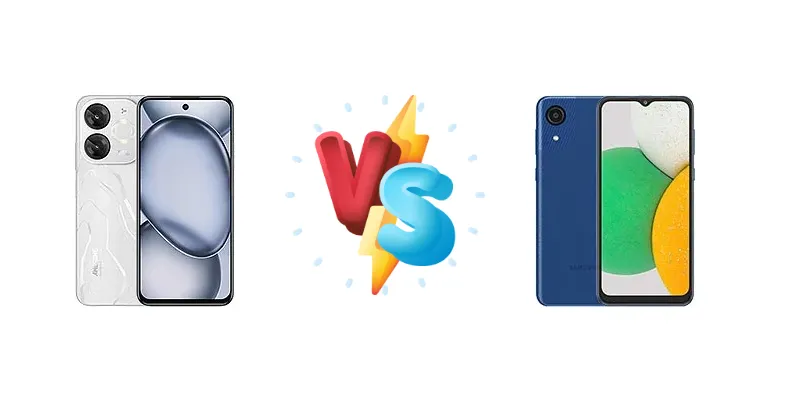
The itel A80 and Samsung Galaxy A03 Core represent the absolute entry point into smartphone ownership. Both devices target first-time smartphone buyers or those needing a reliable secondary device. This comparison dissects their core components to determine which offers the best experience for the price, focusing on real-world performance and usability.
🏆 Quick Verdict
For the average user prioritizing basic functionality and slightly better performance, the itel A80 emerges as the winner. Its Unisoc T603 chipset, while not a powerhouse, offers a more modern architecture than the A03 Core’s SC9863A, translating to a smoother user experience. However, the A03 Core benefits from Samsung’s brand recognition and software optimization.
| Network |
|---|
| 2G bands | GSM 850 / 900 / 1800 / 1900 | GSM 850 / 900 / 1800 / 1900 |
| 3G bands | HSDPA 850 / 900 / 2100 | HSDPA 850 / 900 / 2100 |
| 4G bands | LTE | 1, 3, 5, 7, 8, 20, 28, 38, 40, 41 |
| Speed | HSPA, LTE | HSPA 21.1/5.76 Mbps, LTE |
| Technology | GSM / HSPA / LTE | GSM / HSPA / LTE |
| Launch |
|---|
| Announced | 2024, September | 2021, November 15 |
| Status | Available. Released 2024, September | Available. Released 2021, December 06 |
| Body |
|---|
| Build | - | Plastic back, plastic frame |
| Dimensions | 8.5 mm thickness | 164.2 x 75.9 x 9.1 mm (6.46 x 2.99 x 0.36 in) |
| SIM | Dual SIM | · Nano-SIM· Nano-SIM + Nano-SIM |
| Weight | - | 211 g (7.44 oz) |
| Display |
|---|
| Resolution | 720 x 1600 pixels, 20:9 ratio (~262 ppi density) | 720 x 1600 pixels, 20:9 ratio (~270 ppi density) |
| Size | 6.7 inches, 108.4 cm2 | 6.5 inches, 102.0 cm2 (~81.8% screen-to-body ratio) |
| Type | IPS LCD, 120Hz, 500 nits (peak) | PLS LCD |
| Platform |
|---|
| CPU | Octa-core | Octa-core (4x1.6 GHz Cortex-A55 & 4x1.2 GHz Cortex-A55) |
| Chipset | Unisoc T603 | Unisoc SC9863A (28 nm) |
| GPU | - | IMG8322 |
| OS | Android 14, itel OS 14 | Android 11 (Go edition) |
| Memory |
|---|
| Card slot | microSDXC (dedicated slot) | microSDXC (dedicated slot) |
| Internal | 128GB 3GB RAM, 128GB 4GB RAM | 32GB 2GB RAM |
| | - | eMMC 5.1 |
| Main Camera |
|---|
| Features | Dual-LED flash, HDR | LED flash |
| Single | 50 MP
Auxiliary lens | 8 MP, f/2.0, AF |
| Video | 1080p@30fps | 1080p@30fps |
| Selfie camera |
|---|
| Single | 8 MP | 5 MP, f/2.2 |
| Video | Yes | - |
| Sound |
|---|
| 3.5mm jack | - | Yes |
| 35mm jack | Yes | Yes |
| Loudspeaker | Yes | Yes |
| Comms |
|---|
| Bluetooth | Yes | 4.2, A2DP |
| NFC | No | No |
| Positioning | GPS | GPS, GLONASS |
| Radio | Unspecified | Unspecified |
| USB | USB Type-C 2.0 | microUSB 2.0, OTG |
| WLAN | Yes | Wi-Fi 802.11 b/g/n, Wi-Fi Direct |
| Features |
|---|
| Sensors | Fingerprint (side-mounted); unspecified sensors | Accelerometer, proximity |
| Battery |
|---|
| Charging | 10W wired | - |
| Type | 5000 mAh | Li-Ion 5000 mAh |
| Misc |
|---|
| Colors | Sandstone Black, Glacier White, Wave Blue | Black, Blue |
| Models | A671L, A671LC | SM-A032F, SM-A032F/DS, SM-A032M |
| Price | ₹ 6,499 | £ 74.99 |
| SAR | - | 0.30 W/kg (head) |
| SAR EU | - | 0.24 W/kg (head) 1.39 W/kg (body) |
itel A80
- More modern chipset (Unisoc T603) for better performance.
- Potentially better battery life due to chipset efficiency.
- Likely smoother user experience for basic tasks.
- Less brand recognition than Samsung.
- Software updates may be less frequent.
Samsung Galaxy A03 Core
- Samsung brand recognition and ecosystem.
- Potentially more refined software experience.
- Wider availability in some markets.
- Older, less efficient chipset (Unisoc SC9863A).
- Potential for throttling under load.
- Likely shorter battery life.
Display Comparison
Neither device boasts a standout display. Both are likely to feature LCD panels, typical for this price segment. Specifics like resolution and brightness are not provided, but we can assume both target 720p+ resolutions. The A03 Core’s older chipset suggests it may have a less efficient display driver, potentially impacting battery life during prolonged screen-on time. Bezels are expected to be substantial on both, maximizing screen real estate within a compact form factor.
Camera Comparison
Camera performance on both devices will be limited. Details are scarce, but both likely feature a primary camera paired with basic auxiliary sensors. The focus should be on the main sensor’s megapixel count and aperture, but without that information, it’s difficult to make a direct comparison. Expect image quality to be acceptable in good lighting conditions, but struggle in low light. The inclusion of a 2MP macro camera on the A03 Core is largely a marketing gimmick, offering minimal practical benefit due to its low resolution and fixed focus.
Performance
The core difference lies in the chipsets. The itel A80’s Unisoc T603 is an octa-core processor built on a more modern architecture than the Samsung Galaxy A03 Core’s Unisoc SC9863A (28nm). The SC9863A utilizes a big.LITTLE architecture with 4x1.6 GHz Cortex-A55 cores and 4x1.2 GHz Cortex-A55 cores, while the T603’s core configuration isn’t specified, but generally offers better overall performance. The 28nm process node of the SC9863A is less efficient, meaning it will generate more heat and consume more power than a more modern node. This translates to potential throttling under sustained load and reduced battery life. Users intending to play even casual games will likely see a smoother experience on the itel A80.
Battery Life
Battery capacity isn’t specified for either device, but both likely house batteries in the 4000-5000 mAh range, typical for this segment. The itel A80’s more efficient Unisoc T603 chipset will likely result in longer battery life during typical usage. Both devices support 10W wired charging, meaning a full charge will take a considerable amount of time – likely exceeding 3 hours. The A03 Core’s less efficient chipset will offset any potential battery capacity advantage.
Buying Guide
Buy the itel A80 if you need a phone for essential tasks like calling, messaging, and light social media use, and value a slightly more responsive experience. It’s ideal for users who prioritize performance within a very tight budget. Buy the Samsung Galaxy A03 Core if you prefer the Samsung ecosystem, appreciate a potentially more refined software experience, and prioritize brand familiarity over raw processing power. It’s a good choice for those seeking a simple, reliable device with Samsung’s backing.
Frequently Asked Questions
❓ Will the Unisoc SC9863A in the Galaxy A03 Core overheat during prolonged use of apps like WhatsApp or Facebook?
The Unisoc SC9863A, being built on a 28nm process, is more prone to heat generation than newer chipsets. While it likely won't overheat catastrophically, you may experience noticeable slowdowns or throttling during extended use of demanding apps like WhatsApp or Facebook, especially in warmer environments.
❓ Is the 10W charging on either phone fast enough for daily use?
No, 10W charging is quite slow by modern standards. Expect a full charge to take over 3 hours. These phones are best charged overnight. Neither device prioritizes fast charging, focusing instead on minimizing cost.
❓ Can the itel A80 handle basic mobile games like Candy Crush or Subway Surfers?
Yes, the itel A80’s Unisoc T603 chipset should be capable of running basic mobile games like Candy Crush or Subway Surfers without significant issues. However, don’t expect high frame rates or the ability to play graphically demanding games.
❓ Does the Samsung Galaxy A03 Core receive regular software updates?
Samsung typically provides a limited number of software updates for its entry-level devices. While you can expect security patches for a period, major Android version updates are unlikely. The itel A80’s update schedule is even less predictable.