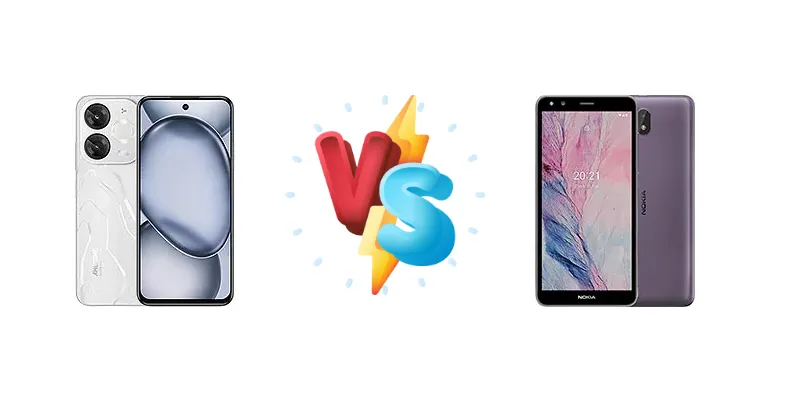
The itel A80 and Nokia C01 Plus represent the absolute bottom end of the smartphone market, targeting first-time buyers or those needing a very basic secondary device. Both rely on Unisoc chipsets to deliver functionality at an incredibly low price point, but significant differences in their silicon and overall design mean one offers a better experience for the money.
🏆 Quick Verdict
For most users, the itel A80 emerges as the stronger choice. While both phones are limited, the Unisoc T603 provides a more modern architecture and likely better sustained performance than the older SC9863A in the Nokia C01 Plus, making it more responsive for everyday tasks.
| Network |
|---|
| 2G bands | GSM 850 / 900 / 1800 / 1900 | GSM 850 / 900 / 1800 / 1900 |
| 3G bands | HSDPA 850 / 900 / 2100 | HSDPA 850 / 900 / 2100 - International |
| 4G bands | LTE | 1, 3, 5, 7, 8, 20, 28, 38, 40, 41 - International |
| Speed | HSPA, LTE | HSPA 21.1/5.76 Mbps, LTE Cat4 150/50 Mbps |
| Technology | GSM / HSPA / LTE | GSM / HSPA / LTE |
| | - | 2, 4, 5, 7, 8, 28 - LATAM |
| Launch |
|---|
| Announced | 2024, September | 2021, June 08 |
| Status | Available. Released 2024, September | Available. Released 2021, June 28 |
| Body |
|---|
| Build | - | Plastic back, plastic frame |
| Dimensions | 8.5 mm thickness | 148 x 71.8 x 9.3 mm (5.83 x 2.83 x 0.37 in) |
| SIM | Dual SIM | Nano-SIM + Nano-SIM |
| Weight | - | 157 g (5.54 oz) |
| Display |
|---|
| Resolution | 720 x 1600 pixels, 20:9 ratio (~262 ppi density) | 720 x 1440 pixels, 18:9 ratio (~295 ppi density) |
| Size | 6.7 inches, 108.4 cm2 | 5.45 inches, 76.7 cm2 (~72.1% screen-to-body ratio) |
| Type | IPS LCD, 120Hz, 500 nits (peak) | IPS LCD |
| Platform |
|---|
| CPU | Octa-core | Octa-core (4x1.6 GHz Cortex-A55 & 4x1.2 GHz Cortex-A55) |
| Chipset | Unisoc T603 | Unisoc SC9863A (28 nm) |
| GPU | - | IMG8322 |
| OS | Android 14, itel OS 14 | Android 11 (Go edition) |
| Memory |
|---|
| Card slot | microSDXC (dedicated slot) | microSDXC |
| Internal | 128GB 3GB RAM, 128GB 4GB RAM | 16GB 1GB RAM, 16GB 2GB RAM, 32GB 1GB RAM, 32GB 2GB RAM |
| | - | eMMC 5.1 |
| Main Camera |
|---|
| Features | Dual-LED flash, HDR | LED flash, HDR |
| Single | 50 MP
Auxiliary lens | 5 MP |
| Video | 1080p@30fps | 720p@30fps |
| Selfie camera |
|---|
| Features | - | LED flash, HDR |
| Single | 8 MP | 5 MP |
| Video | Yes | 720p@30fps |
| Sound |
|---|
| 3.5mm jack | - | Yes |
| 35mm jack | Yes | Yes |
| Loudspeaker | Yes | Yes |
| Comms |
|---|
| Bluetooth | Yes | 4.2, A2DP, LE |
| NFC | No | No |
| Positioning | GPS | GPS |
| Radio | Unspecified | FM radio |
| USB | USB Type-C 2.0 | microUSB 2.0 |
| WLAN | Yes | Wi-Fi 802.11 b/g/n |
| Features |
|---|
| Sensors | Fingerprint (side-mounted); unspecified sensors | Accelerometer, proximity |
| Battery |
|---|
| Charging | 10W wired | - |
| Type | 5000 mAh | Li-Ion 3000 mAh, removable |
| Misc |
|---|
| Colors | Sandstone Black, Glacier White, Wave Blue | Blue, Purple |
| Models | A671L, A671LC | TA-1383, TA-1387, TA-1391 |
| Price | ₹ 6,499 | About 90 EUR |
| SAR | - | 1.13 W/kg (head) 0.84 W/kg (body) |
| SAR EU | - | 0.59 W/kg (head) 1.41 W/kg (body) |
itel A80
- More modern Unisoc T603 chipset
- Potentially better performance for everyday tasks
- Likely better app compatibility
- Limited RAM likely restricts multitasking
- Camera performance will be basic
Nokia C01 Plus
- Nokia brand recognition
- Potentially simpler software experience (regional variations)
- Compact and lightweight design
- Older and less efficient Unisoc SC9863A chipset
- Likely slower performance compared to itel A80
- Limited RAM
Display Comparison
Neither device boasts a standout display. Details regarding panel type, resolution, and brightness are scarce, typical for this segment. However, the focus should be on usability, and the lack of detailed specs suggests both will offer basic viewing experiences. Bezels are likely substantial on both, maximizing screen real estate within a compact form factor. Color accuracy is unlikely to be a priority on either device.
Camera Comparison
Camera performance on both devices will be extremely limited. Details are sparse, but it's safe to assume both feature basic sensors. Focusing on megapixel counts alone is misleading at this price point; sensor size and image processing are far more critical. Expect washed-out colors, limited dynamic range, and poor low-light performance from both. Any included 'macro' cameras are likely to be 2MP sensors offering minimal usable detail.
Performance
The core difference lies in the chipsets. The itel A80’s Unisoc T603 is an octa-core processor, offering a more modern design than the Nokia C01 Plus’s Unisoc SC9863A, fabricated on a larger 28nm process. The SC9863A’s octa-core configuration is split into two clusters – 4x1.6 GHz Cortex-A55 and 4x1.2 GHz Cortex-A55 – indicating a big.LITTLE architecture designed for power efficiency, but the older process node and lower clock speeds suggest it will struggle with demanding tasks. The T603, while not a powerhouse, benefits from a more recent architecture, potentially offering better single-core and multi-core performance, translating to snappier app launches and smoother multitasking. Both phones will likely be paired with limited RAM, further impacting performance.
Battery Life
Both phones feature modest battery capacities, and 10W wired charging is standard. The actual battery life will depend heavily on usage patterns. The more efficient Unisoc T603 in the itel A80 *could* translate to slightly longer battery life, offsetting any potential capacity differences. Expect a full charge to take several hours with the included chargers, and battery life to be measured in hours, not days, with moderate use.
Buying Guide
Buy the itel A80 if you prioritize a slightly smoother user experience and potentially better app compatibility, even within the Android Go ecosystem. It's the better option for those who occasionally browse the web or use basic social media apps. Buy the Nokia C01 Plus if brand recognition and a potentially simpler software experience (depending on regional variations) are paramount, and your usage is *extremely* light – primarily calls and texts.
Frequently Asked Questions
❓ Will the itel A80 handle popular apps like WhatsApp and Facebook smoothly?
The Unisoc T603 should provide a reasonably smooth experience with apps like WhatsApp and Facebook, but expect some lag when multitasking or loading heavier content. The Android Go edition, likely pre-installed, is optimized for low-RAM devices, helping to mitigate performance issues.
❓ Is the Nokia C01 Plus a good choice for someone who primarily uses their phone for calls and texts?
Yes, the Nokia C01 Plus is a viable option for basic communication. Its simpler software and focus on core functionality make it suitable for users who primarily need a phone for calls and texts, but the itel A80 offers a slightly better overall experience even for these basic tasks.
❓ Can either of these phones play modern mobile games?
Playing modern, graphically demanding mobile games on either the itel A80 or Nokia C01 Plus will be a frustrating experience. The chipsets lack the processing power and graphics capabilities to run these games smoothly, even at the lowest settings. Simple, older games may be playable, but don't expect a high-quality gaming experience.