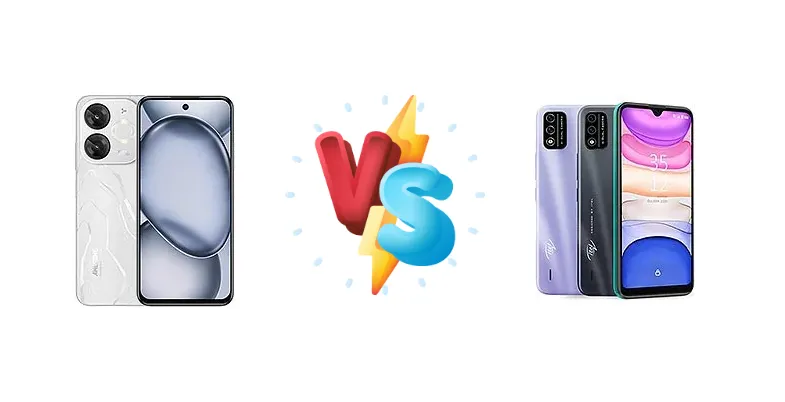
The itel A80 and A48 represent itel’s commitment to the ultra-budget smartphone market. While both aim to deliver essential smartphone functionality at a low price point, they differ significantly in their internal hardware. This comparison dissects those differences, focusing on how the chipset choices impact real-world performance and user experience.
🏆 Quick Verdict
For most users, the itel A80 is the superior choice. Its Unisoc T603 chipset, featuring an octa-core CPU, provides a noticeably smoother experience for multitasking and app usage compared to the quad-core Unisoc SC9832E in the A48. While both offer basic functionality, the A80’s processing power justifies the potential slight price difference.
| Network |
|---|
| 2G bands | GSM 850 / 900 / 1800 / 1900 | GSM 850 / 900 / 1800 / 1900 |
| 3G bands | HSDPA 850 / 900 / 2100 | HSDPA 850 / 900 / 2100 |
| 4G bands | LTE | LTE |
| Speed | HSPA, LTE | HSPA, LTE |
| Technology | GSM / HSPA / LTE | GSM / HSPA / LTE |
| Launch |
|---|
| Announced | 2024, September | 2021 |
| Status | Available. Released 2024, September | Available. Released 2021 |
| Body |
|---|
| Dimensions | 8.5 mm thickness | - |
| SIM | Dual SIM | Dual SIM |
| Weight | - | - |
| Display |
|---|
| Resolution | 720 x 1600 pixels, 20:9 ratio (~262 ppi density) | 720 x 1600 pixels, 20:9 ratio (~288 ppi density) |
| Size | 6.7 inches, 108.4 cm2 | 6.1 inches, 89.8 cm2 |
| Type | IPS LCD, 120Hz, 500 nits (peak) | IPS LCD |
| Platform |
|---|
| CPU | Octa-core | Quad-core 1.4 GHz |
| Chipset | Unisoc T603 | Unisoc SC9832E (28 nm) |
| GPU | - | Mali-T820 MP1 |
| OS | Android 14, itel OS 14 | Android 10 (Go edition) |
| Memory |
|---|
| Card slot | microSDXC (dedicated slot) | microSDXC |
| Internal | 128GB 3GB RAM, 128GB 4GB RAM | 32GB 2GB RAM |
| Main Camera |
|---|
| Features | Dual-LED flash, HDR | LED flash |
| Single | 50 MP
Auxiliary lens | 5 MP (wide)
Auxiliary lens |
| Video | 1080p@30fps | Yes |
| Selfie camera |
|---|
| Single | 8 MP | 5 MP |
| Video | Yes | Yes |
| Sound |
|---|
| 35mm jack | Yes | Yes |
| Loudspeaker | Yes | Yes |
| Comms |
|---|
| Bluetooth | Yes | Yes |
| NFC | No | No |
| Positioning | GPS | GPS |
| Radio | Unspecified | Unspecified |
| USB | USB Type-C 2.0 | microUSB |
| WLAN | Yes | Yes |
| Features |
|---|
| Sensors | Fingerprint (side-mounted); unspecified sensors | Fingerprint (rear-mounted), accelerometer |
| Battery |
|---|
| Charging | 10W wired | - |
| Type | 5000 mAh | 3000 mAh |
| Misc |
|---|
| Colors | Sandstone Black, Glacier White, Wave Blue | Black, Purple, Green |
| Models | A671L, A671LC | - |
| Price | ₹ 6,499 | - |
itel A80
- Faster octa-core processor for smoother performance
- More efficient chipset potentially leading to better battery life
- Likely better ISP for improved image processing
- May be slightly more expensive than the A48
- Still limited by budget components in other areas (display, camera)
itel A48
- Extremely affordable price point
- Functional for basic communication needs
- Simple and easy-to-use interface
- Slow quad-core processor resulting in sluggish performance
- Less efficient chipset potentially impacting battery life
- Limited multitasking capabilities
Display Comparison
Neither itel provides display specifications beyond size, suggesting both utilize basic LCD panels. Given the price bracket, expect 60Hz refresh rates and modest brightness levels on both. The absence of details like peak brightness or color gamut coverage indicates a focus on cost reduction, meaning color accuracy and outdoor visibility will likely be limited on both devices. Bezels are expected to be substantial on both models.
Camera Comparison
Both phones likely feature basic camera setups, and detailed specifications are scarce. It's safe to assume both will include a primary rear camera and potentially a secondary depth sensor. Given the target market, image quality will be adequate for social media sharing in good lighting conditions, but expect significant noise and limited detail in low light. The absence of OIS (Optical Image Stabilization) on either device means shaky hands will result in blurry photos. Focusing on megapixel counts alone is misleading; the image signal processor (ISP) within the chipset plays a larger role in image quality, and the T603 in the A80 likely has a more capable ISP.
Performance
The core difference lies in the chipsets. The itel A80’s Unisoc T603 is an octa-core processor, offering significantly more processing power than the itel A48’s Unisoc SC9832E, a quad-core chip built on a 28nm process. This translates to faster app launch times, smoother multitasking, and a more responsive user interface on the A80. The 28nm node of the SC9832E also implies lower power efficiency compared to a more modern node, potentially impacting battery life under load. While neither chipset is designed for demanding gaming, the A80 will handle casual games more comfortably.
Battery Life
While battery capacity isn't specified, both phones likely house batteries in the 4000-5000 mAh range, typical for this price segment. The A80’s more efficient Unisoc T603 chipset, despite its higher core count, may offer slightly better battery life under moderate usage due to its more modern architecture. Both phones support 10W wired charging, meaning a full charge will take several hours. The difference in charging time will likely be minimal, as the bottleneck is the charging wattage, not the battery capacity.
Buying Guide
Buy the itel A80 if you need a phone capable of handling more than just basic calls and messaging. It’s ideal for users who occasionally browse the web, use social media, or play light mobile games. Buy the itel A48 if your primary needs are limited to essential communication – calls, texts, and perhaps a simple radio – and you prioritize absolute affordability above all else. The A48 is a functional device for those with minimal smartphone requirements.
Frequently Asked Questions
❓ Will the itel A80 handle popular apps like WhatsApp and Facebook smoothly?
Yes, the Unisoc T603’s octa-core processor in the A80 provides sufficient power to run apps like WhatsApp and Facebook without significant lag. While it won’t offer a flagship-level experience, it will be a noticeable improvement over the A48’s quad-core processor for these common tasks.
❓ Is the itel A48 suitable for someone who primarily uses a phone for calls and texts?
Absolutely. The itel A48 is perfectly adequate for basic communication. Its quad-core processor is sufficient for making calls, sending texts, and using the phone’s core functions. If your smartphone needs are minimal, the A48 offers a functional and affordable solution.
❓ Can I play games on either of these phones?
Casual games are playable on both, but don't expect a high-performance experience. The itel A80 will handle simpler games better due to its more powerful processor. Demanding games will likely experience significant lag and frame rate drops on both devices.
❓ What kind of storage options are available on these phones?
Storage details are not explicitly provided. However, given the price point, expect both phones to offer limited internal storage (likely 32GB or 64GB) with support for microSD card expansion. This is crucial for storing photos, videos, and apps.