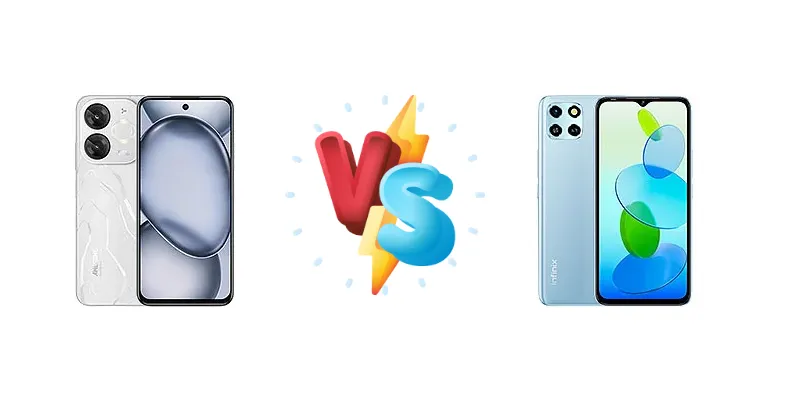
The itel A80 and Infinix Smart 6 HD represent the extreme end of the smartphone price spectrum. Both aim to deliver essential smartphone functionality at a price point accessible to almost anyone. This comparison dissects their core components to determine which device offers the best value for users prioritizing affordability and basic functionality.
🏆 Quick Verdict
For the average user seeking a functional, no-frills smartphone, the itel A80 edges out the Infinix Smart 6 HD. While both utilize Unisoc chipsets, the T603 in the A80 offers a slightly more modern architecture, potentially translating to smoother multitasking and app performance, despite the similar core count.
| Network |
|---|
| 2G bands | GSM 850 / 900 / 1800 / 1900 | GSM 850 / 900 / 1800 / 1900 |
| 3G bands | HSDPA 850 / 900 / 2100 | HSDPA 850 / 900 / 2100 |
| 4G bands | LTE | 1, 3, 5, 8, 38, 40, 41 |
| Speed | HSPA, LTE | HSPA, LTE |
| Technology | GSM / HSPA / LTE | GSM / HSPA / LTE |
| | - | 1, 3, 7, 8, 20 |
| Launch |
|---|
| Announced | 2024, September | 2022, April 26 |
| Status | Available. Released 2024, September | Available. Released 2022, April 26 |
| Body |
|---|
| Build | - | Glass front, plastic back, plastic frame |
| Dimensions | 8.5 mm thickness | 165.6 x 76.4 x 9.1 mm (6.52 x 3.01 x 0.36 in) |
| SIM | Dual SIM | Nano-SIM + Nano-SIM |
| Weight | - | - |
| Display |
|---|
| Resolution | 720 x 1600 pixels, 20:9 ratio (~262 ppi density) | 720 x 1600 pixels, 20:9 ratio (~266 ppi density) |
| Size | 6.7 inches, 108.4 cm2 | 6.6 inches, 105.2 cm2 (~83.1% screen-to-body ratio) |
| Type | IPS LCD, 120Hz, 500 nits (peak) | IPS LCD, 500 nits (peak) |
| Platform |
|---|
| CPU | Octa-core | Octa-core (4x1.6 GHz Cortex-A55 & 4x1.2 GHz Cortex-A55) |
| Chipset | Unisoc T603 | Unisoc SC9863A (28 nm) |
| GPU | - | IMG8322 |
| OS | Android 14, itel OS 14 | Android 11 (Go edition), XOS 7.6 |
| Memory |
|---|
| Card slot | microSDXC (dedicated slot) | microSDXC (dedicated slot) |
| Internal | 128GB 3GB RAM, 128GB 4GB RAM | 32GB 2GB RAM, 64GB 3GB RAM |
| | - | eMMC 5.1 |
| Main Camera |
|---|
| Dual | - | 8 MP, AF
Auxiliary lens |
| Features | Dual-LED flash, HDR | Dual-LED flash |
| Single | 50 MP
Auxiliary lens | 5 MP |
| Video | 1080p@30fps | 1080p@30fps |
| Selfie camera |
|---|
| Features | - | LED flash |
| Single | 8 MP | 5 MP |
| Video | Yes | 720p@30fps |
| Sound |
|---|
| 3.5mm jack | - | Yes |
| 35mm jack | Yes | Yes |
| Loudspeaker | Yes | Yes |
| Comms |
|---|
| Bluetooth | Yes | Yes |
| NFC | No | No |
| Positioning | GPS | GPS |
| Radio | Unspecified | FM radio |
| USB | USB Type-C 2.0 | microUSB 2.0, OTG |
| WLAN | Yes | Wi-Fi 802.11 b/g/n |
| Features |
|---|
| Sensors | Fingerprint (side-mounted); unspecified sensors | Accelerometer, proximity |
| Battery |
|---|
| Charging | 10W wired | 10W wired |
| Type | 5000 mAh | 5000 mAh |
| Misc |
|---|
| Colors | Sandstone Black, Glacier White, Wave Blue | Force Black, Origin Blue, Aqua Sky |
| Models | A671L, A671LC | X6512 |
| Price | ₹ 6,499 | About 80 EUR |
itel A80
- Slightly more modern chipset (Unisoc T603)
- Potentially smoother multitasking
- Likely better power efficiency
- Limited brand recognition
- Basic camera capabilities
Infinix Smart 6 HD
- Potentially wider availability
- Established brand (Infinix)
- Similar core functionality
- Older chipset (Unisoc SC9863A)
- Less efficient 28nm process
- Potentially slower app performance
Display Comparison
Neither itel nor Infinix provide detailed display specifications beyond resolution. Given the price bracket, both likely employ LCD panels with standard 60Hz refresh rates. The focus here isn't on visual fidelity, but rather basic readability. Bezels are expected to be substantial on both devices, maximizing screen real estate within a compact form factor. Color accuracy and brightness are likely to be similar, prioritizing power efficiency over vibrant visuals.
Camera Comparison
Camera performance on both devices will be limited. Details are scarce, but both are likely to feature a primary sensor paired with basic auxiliary lenses (often 2MP depth or macro sensors of limited utility). Image quality will be acceptable in well-lit conditions, but expect significant noise and a lack of detail in low light. The aperture of the main sensor will be the key determinant of low-light performance, but this information isn't available. Image processing will likely be minimal, relying on basic algorithms to enhance contrast and sharpness.
Performance
Both the itel A80 and Infinix Smart 6 HD are powered by octa-core Unisoc chipsets, but the underlying architecture differs significantly. The itel A80 utilizes the Unisoc T603, a more recent design. The Infinix Smart 6 HD employs the older Unisoc SC9863A, fabricated on a 28nm process. While both feature eight cores, the SC9863A splits its cores into two clusters – 4x1.6 GHz Cortex-A55 and 4x1.2 GHz Cortex-A55 – suggesting a more conservative power profile. The T603’s unified core configuration, while not specified, likely offers a more consistent performance level. This translates to potentially smoother app launches and multitasking on the itel A80, even if the peak performance difference isn't dramatic.
Battery Life
Both devices feature 10W wired charging, indicating a similar charging experience – expect approximately 2-3 hours for a full charge. Battery capacity isn't specified, but given the target market and device size, both likely house batteries in the 4000-5000 mAh range. Real-world battery life will depend heavily on usage patterns, but both should comfortably last a full day with moderate use (calls, messaging, light browsing). The more efficient Unisoc T603 in the itel A80 *could* translate to slightly longer battery life, but the difference will likely be marginal.
Buying Guide
Buy the itel A80 if you need a slightly more responsive experience for everyday tasks like calling, messaging, and light social media browsing. Its newer Unisoc T603 chipset provides a marginal performance advantage. Buy the Infinix Smart 6 HD if you prioritize a potentially wider availability or find it at a significantly lower price point; the core functionality remains similar, and the difference in performance will be minimal for basic usage.
Frequently Asked Questions
❓ Will the Unisoc SC9863A in the Infinix Smart 6 HD struggle with popular apps like WhatsApp and Facebook?
While the SC9863A can handle basic apps like WhatsApp and Facebook, expect some lag when switching between them or loading media-heavy content. It's designed for light usage, and demanding apps may experience slowdowns. The itel A80's T603 chipset should offer a slightly smoother experience.
❓ Are either of these phones suitable for mobile gaming?
Neither the itel A80 nor the Infinix Smart 6 HD are designed for gaming. While simple 2D games may be playable at low settings, demanding 3D titles will likely experience significant frame rate drops and lag. These phones prioritize battery life and basic functionality over gaming performance.
❓ How much storage do these phones typically offer, and can it be expanded?
Both phones typically come with 32GB of internal storage, which is quite limited. Fortunately, both support microSD card expansion, allowing you to add up to 128GB or 256GB of additional storage for photos, videos, and apps. This is highly recommended for both devices.
❓ What version of Android do these phones run?
Both devices likely ship with Android 11 or 12 (Go Edition), a lightweight version of Android designed for devices with limited processing power and RAM. This ensures a smoother experience on these entry-level smartphones.