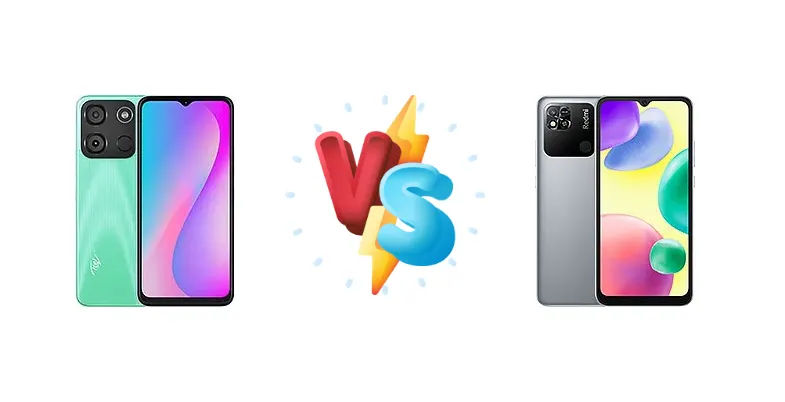
The itel A60 and Xiaomi Redmi 10A represent the absolute entry point into smartphone ownership. Both aim to deliver essential functionality at an incredibly low price. However, significant differences in their underlying hardware mean one offers a noticeably smoother experience, particularly for multitasking and app responsiveness. This comparison dives deep into those differences to help you choose the best option for your needs.
🏆 Quick Verdict
For most users, the Xiaomi Redmi 10A is the better choice. Its MediaTek Helio G25 chipset, featuring an octa-core CPU, provides a substantial performance advantage over the itel A60’s quad-core Unisoc SC9832E. While both offer similar battery life and charging speeds, the Redmi 10A’s extra processing power makes it more capable for everyday tasks.
| Network |
|---|
| 2G bands | GSM 850 / 900 / 1800 / 1900 | GSM 850 / 900 / 1800 / 1900 |
| 3G bands | HSDPA 850 / 900 / 2100 | HSDPA 850 / 900 / 2100 |
| 4G bands | 1, 3, 5, 8, 40, 41 | 1, 3, 5, 8, 40, 41 - International |
| Speed | HSPA, LTE | HSPA, LTE |
| Technology | GSM / HSPA / LTE | GSM / HSPA / CDMA2000 / LTE |
| | - | 1, 3, 5, 8, 34, 38, 39, 40, 41 - China |
| Launch |
|---|
| Announced | 2022 | 2022, March 29 |
| Status | Available. Released 2022 | Available. Released 2022, March 31 |
| Body |
|---|
| Dimensions | - | 164.9 x 77.1 x 9 mm (6.49 x 3.04 x 0.35 in) |
| SIM | Dual SIM | Nano-SIM + Nano-SIM |
| Weight | - | 194 g (6.84 oz) |
| Display |
|---|
| Resolution | 720 x 1612 pixels, 20:9 ratio (~267 ppi density) | 720 x 1600 pixels, 20:9 ratio (~269 ppi density) |
| Size | 6.6 inches, 104.6 cm2 | 6.53 inches, 102.9 cm2 (~81.0% screen-to-body ratio) |
| Type | IPS LCD | IPS LCD, 400 nits (typ) |
| Platform |
|---|
| CPU | Quad-core 1.4 GHz | Octa-core (4x2.0 GHz Cortex-A53 & 4x1.5 GHz Cortex-A53) |
| Chipset | Unisoc SC9832E (28 nm) | Mediatek MT6762G Helio G25 (12 nm) |
| GPU | Mali-T820 MP1 | PowerVR GE8320 |
| OS | Android 11 or 12 (Go edition) | Android 11, MIUI 12.5 |
| Memory |
|---|
| Card slot | microSDXC | microSDXC |
| Internal | 32GB 2GB RAM | 32GB 2GB RAM, 32GB 3GB RAM, 64GB 3GB RAM, 64GB 4GB RAM, 128GB 4GB RAM, 128GB 6GB RAM |
| Main Camera |
|---|
| Dual | 8 MP
0.3 MP | - |
| Features | LED flash | LED flash |
| Single | - | 13 MP, f/2.2, (wide), 1.0µm, AF |
| Video | Yes | 1080p@30fps |
| Selfie camera |
|---|
| Features | - | HDR |
| Single | 5 MP | 5 MP |
| Video | Yes | 1080p@30fps |
| Sound |
|---|
| 3.5mm jack | - | Yes |
| 35mm jack | Yes | Yes |
| Loudspeaker | Yes | Yes |
| Comms |
|---|
| Bluetooth | Yes | 5.0, A2DP, LE |
| NFC | No | No |
| Positioning | GPS | GPS, GLONASS, BDS |
| Radio | Unspecified | No |
| USB | microUSB, OTG | microUSB 2.0 |
| WLAN | Yes | Wi-Fi 802.11 a/b/g/n, Wi-Fi Direct |
| Features |
|---|
| Sensors | Fingerprint (rear-mounted), accelerometer, proximity | Fingerprint (rear-mounted), accelerometer, proximity |
| Battery |
|---|
| Charging | 10W wired | 10W wired |
| Type | 5000 mAh | Li-Ion 5000 mAh |
| Misc |
|---|
| Colors | Dawn Blue, Vert Menthe, Sapphire Black | Charcoal Black, Sea Blue, Slate Grey |
| Models | - | 220233L2C, 220233L2G, 220233L2I |
| Price | - | € 60.00 / $ 66.55 |
| SAR | - | 0.90 W/kg (head) 0.65 W/kg (body) |
| SAR EU | - | 0.40 W/kg (head) 0.99 W/kg (body) |
itel A60
- Lowest possible price point
- Functional for basic tasks
- Lightweight and portable
- Significantly slower performance
- Less responsive user interface
- Limited multitasking capabilities
Xiaomi Redmi 10A
- Faster and more responsive performance
- Better multitasking capabilities
- Slightly improved camera processing
- Slightly higher price
- Still a basic smartphone experience
- Limited storage options
Display Comparison
Neither device boasts a particularly impressive display. Both are likely to feature LCD panels, typical for this price bracket. However, detailed specifications regarding resolution, brightness, and color gamut are unavailable. Given itel’s market positioning, the A60 likely prioritizes cost savings over display quality. The Redmi 10A, while still basic, benefits from Xiaomi’s broader manufacturing scale and potentially tighter quality control, potentially resulting in slightly better color accuracy and viewing angles.
Camera Comparison
Camera performance on both devices will be basic. Detailed sensor information is lacking, but it’s safe to assume both feature low-resolution primary sensors. Focusing on megapixel counts alone is misleading at this price point; image processing and software optimization play a larger role. However, the Redmi 10A’s more powerful chipset allows for slightly more sophisticated image processing algorithms, potentially resulting in better dynamic range and noise reduction. Expect both to struggle in low-light conditions. Any secondary cameras (often 2MP macro lenses) on either device are largely marketing features and offer limited practical benefit.
Performance
This is where the Redmi 10A truly shines. The MediaTek Helio G25, built on a more efficient 12nm process compared to the itel A60’s 28nm Unisoc SC9832E, offers a significant performance leap. The octa-core configuration (4x2.0 GHz Cortex-A53 & 4x1.5 GHz Cortex-A53) versus the A60’s quad-core 1.4 GHz CPU translates to faster app loading times, smoother multitasking, and a more responsive user interface. The Helio G25 also includes a slightly more capable GPU, making the Redmi 10A the better choice for light gaming. The larger process node of the Unisoc chip in the itel A60 will likely result in lower sustained performance under load due to thermal throttling.
Battery Life
Both the itel A60 and Xiaomi Redmi 10A feature 10W wired charging, indicating similar charging speeds. While battery capacity isn’t specified, both likely house batteries in the 4000-5000 mAh range, typical for this segment. The more efficient MediaTek Helio G25 in the Redmi 10A may contribute to slightly better battery life in real-world usage, as it consumes less power during typical tasks. However, the difference is unlikely to be dramatic, and both phones should comfortably last a full day with moderate use.
Buying Guide
Buy the itel A60 if you absolutely need the lowest possible price and your smartphone usage is limited to basic calling, texting, and very light app use. It’s a functional device for first-time smartphone owners or as a simple backup phone. Buy the Xiaomi Redmi 10A if you want a more responsive experience, plan to use multiple apps simultaneously, or occasionally enjoy casual gaming. The extra processing power justifies the slightly higher cost for most users.
Frequently Asked Questions
❓ Will the Unisoc SC9832E in the itel A60 struggle with popular apps like WhatsApp and Facebook?
While the itel A60 can run these apps, expect slower loading times and occasional lag, especially when switching between them. The quad-core processor and limited RAM are a bottleneck for multitasking. The Redmi 10A will handle these apps much more smoothly.
❓ Is the Redmi 10A suitable for playing games like PUBG Mobile or Call of Duty Mobile?
The Redmi 10A can run these games at the lowest graphics settings and frame rates. However, expect significant frame drops and a less-than-ideal gaming experience. It's suitable for very casual gaming, but not for serious mobile gamers.
❓ Does either phone support fast charging, or will a full charge take a long time?
Both phones support only 10W charging, which is relatively slow. Expect a full charge to take around 2.5 to 3.5 hours from 0%.
❓ What version of Android do these phones run, and will they receive software updates?
Both likely run Android Go Edition, a lightweight version of Android designed for low-end hardware. Software update support is limited on both devices; don't expect frequent or long-term updates.