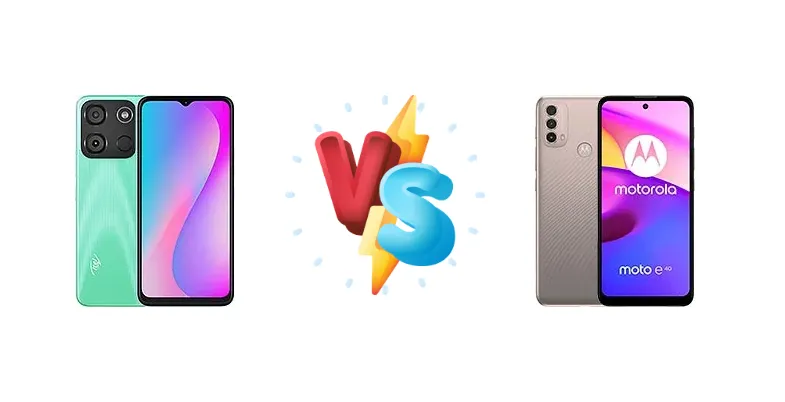
The itel A60 and Motorola Moto E40 represent the extreme end of the smartphone price spectrum. Both aim to deliver essential smartphone functionality at a remarkably low cost, but they achieve this with different approaches to processing power and overall design. This comparison dissects their key specifications to determine which device offers the best value for users prioritizing affordability.
🏆 Quick Verdict
For most users, the Motorola Moto E40 emerges as the better choice. Its Unisoc T700 chipset, featuring an octa-core CPU clocked at 1.8 GHz, provides a significantly more responsive experience than the itel A60’s quad-core 1.4 GHz Unisoc SC9832E. While both offer basic functionality, the E40’s performance edge justifies the potentially slight price difference.
| Network |
|---|
| 2G bands | GSM 850 / 900 / 1800 / 1900 | GSM 850 / 900 / 1800 / 1900 |
| 3G bands | HSDPA 850 / 900 / 2100 | HSDPA 850 / 900 / 1700(AWS) / 1900 / 2100 |
| 4G bands | 1, 3, 5, 8, 40, 41 | 1, 2, 3, 4, 5, 7, 8, 19, 28, 40, 66 - Brazil |
| Speed | HSPA, LTE | HSPA 42.2/5.76 Mbps, LTE Cat4 150/50 Mbps |
| Technology | GSM / HSPA / LTE | GSM / HSPA / LTE |
| Launch |
|---|
| Announced | 2022 | 2021, October 07 |
| Status | Available. Released 2022 | Available. Released 2021, October 11 |
| Body |
|---|
| Build | - | Glass front, plastic frame, plastic back |
| Dimensions | - | 165.1 x 75.7 x 9.1 mm (6.5 x 2.98 x 0.36 in) |
| SIM | Dual SIM | · Nano-SIM· Nano-SIM + Nano-SIM |
| Weight | - | 198 g (6.98 oz) |
| Display |
|---|
| Resolution | 720 x 1612 pixels, 20:9 ratio (~267 ppi density) | 720 x 1600 pixels, 20:9 ratio (~270 ppi density) |
| Size | 6.6 inches, 104.6 cm2 | 6.5 inches, 102.0 cm2 (~81.6% screen-to-body ratio) |
| Type | IPS LCD | IPS LCD, 90Hz |
| Platform |
|---|
| CPU | Quad-core 1.4 GHz | Octa-core 1.8 GHz |
| Chipset | Unisoc SC9832E (28 nm) | Unisoc T700 |
| GPU | Mali-T820 MP1 | Mali G52 |
| OS | Android 11 or 12 (Go edition) | Android 11 |
| Memory |
|---|
| Card slot | microSDXC | microSDXC (dedicated slot) |
| Internal | 32GB 2GB RAM | 64GB 4GB RAM |
| | - | eMMC 5.1 |
| Main Camera |
|---|
| Dual | 8 MP
0.3 MP | - |
| Features | LED flash | LED flash, HDR, panorama |
| Triple | - | 48 MP, f/2.0, 26mm (wide), PDAF
2 MP (macro)
Auxiliary lens |
| Video | Yes | 1080p@30fps |
| Selfie camera |
|---|
| Features | - | HDR |
| Single | 5 MP | 8 MP, f/2.0 |
| Video | Yes | 1080p@30fps |
| Sound |
|---|
| 3.5mm jack | - | Yes |
| 35mm jack | Yes | Yes |
| Loudspeaker | Yes | Yes |
| Comms |
|---|
| Bluetooth | Yes | 5.0, A2DP, LE |
| NFC | No | No |
| Positioning | GPS | GPS, GLONASS, GALILEO |
| Radio | Unspecified | FM radio |
| USB | microUSB, OTG | USB Type-C 2.0 |
| WLAN | Yes | Wi-Fi 802.11 b/g/n |
| Features |
|---|
| Sensors | Fingerprint (rear-mounted), accelerometer, proximity | Fingerprint (rear-mounted), accelerometer, proximity |
| Battery |
|---|
| Charging | 10W wired | 10W wired |
| Type | 5000 mAh | Li-Po 5000 mAh |
| Misc |
|---|
| Colors | Dawn Blue, Vert Menthe, Sapphire Black | Carbon Gray, Pink Clay |
| Price | - | About 90 EUR |
itel A60
- Potentially lower price point
- May offer slightly longer battery life due to less powerful processor
- Simple and easy-to-use interface
- Significantly slower performance
- Limited multitasking capabilities
- Likely to struggle with modern apps
Motorola Moto E40
- Faster and more responsive performance
- Better multitasking capabilities
- More versatile for everyday tasks
- Potentially slightly higher price
- May have slightly shorter battery life
- Still limited by budget components
Display Comparison
Neither device boasts a standout display. Both are likely to feature LCD panels, typical for this price bracket. However, specifics like resolution and brightness are not provided. The focus here is on usability, and the lack of detailed display specs suggests both prioritize cost savings over visual fidelity. Expect adequate, but not impressive, viewing experiences.
Camera Comparison
Camera performance is likely to be similar on both devices, meaning basic functionality. Without sensor size or aperture information, it’s safe to assume both rely on low-resolution sensors and limited image processing capabilities. The presence of a 2MP macro camera on either device is largely a marketing tactic, offering minimal practical benefit. Expect acceptable photos in good lighting conditions, but significant noise and lack of detail in low light.
Performance
The core difference lies in the chipsets. The Motorola Moto E40’s Unisoc T700, with its octa-core configuration and 1.8 GHz clock speed, represents a substantial upgrade over the itel A60’s Unisoc SC9832E. The T700’s higher core count and clock speed translate to faster app loading times, smoother multitasking, and a more responsive overall user interface. The SC9832E, built on a 28nm process, will likely struggle with even moderately demanding applications. The E40’s architecture is more efficient, offering a better balance between performance and power consumption.
Battery Life
Both phones feature 10W wired charging, indicating similar charging speeds. While battery capacity isn’t specified, the less powerful chipset in the itel A60 may result in slightly better battery life due to lower power consumption. However, the performance difference offered by the Moto E40 likely outweighs the potential battery life advantage of the itel A60 for most users. Expect a full charge to take over 2 hours in both cases.
Buying Guide
Buy the itel A60 if you absolutely need the lowest possible price and are primarily focused on basic communication tasks like calls, texts, and light WhatsApp usage. It’s a suitable option for first-time smartphone users or as a simple backup device. Buy the Motorola Moto E40 if you prioritize a smoother, more capable user experience, even for moderately demanding tasks like browsing, social media, and occasional light gaming. The E40’s superior processing power makes it a more versatile and future-proof option.
Frequently Asked Questions
❓ Will the Motorola Moto E40 struggle with popular apps like Facebook or WhatsApp?
While the Moto E40 won't offer a flagship-level experience, its Unisoc T700 chipset is capable of running Facebook and WhatsApp smoothly. You might experience occasional slowdowns with multiple apps open simultaneously, but for typical usage, it should be adequate. The itel A60 will likely struggle more with these apps, especially with multiple tasks running.
❓ Is the 10W charging on either phone fast enough for daily use?
10W charging is relatively slow by modern standards. Expect a full charge to take over two hours on both the itel A60 and Motorola Moto E40. This is typical for phones in this price range, and it's unlikely to be a major inconvenience for most users who charge their phones overnight.
❓ Can the Motorola Moto E40 handle basic mobile games?
The Motorola Moto E40 can handle basic mobile games, but don't expect high frame rates or detailed graphics. Games like Candy Crush or simple puzzle games will run fine. More demanding titles may require reduced graphics settings and may still experience occasional lag. The itel A60 will struggle even with less demanding games.