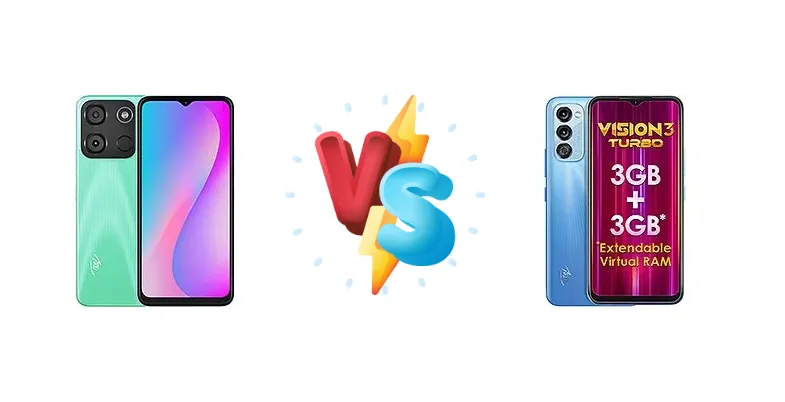
The itel A60 and Vision 3 Turbo represent itel’s commitment to the ultra-budget smartphone market. While both aim to deliver essential smartphone functionality at a low price point, they differ significantly in their internal hardware, particularly in their chipsets and charging capabilities. This comparison will dissect these differences to determine which device offers the best value for users prioritizing performance and convenience.
🏆 Quick Verdict
For most users, the itel Vision 3 Turbo is the superior choice. Its octa-core Unisoc SC9863A chipset provides a noticeable performance boost over the A60’s quad-core SC9832E, making it better suited for multitasking and moderately demanding apps. The faster 18W charging is also a significant advantage, reducing downtime.
| Network |
|---|
| 2G bands | GSM 850 / 900 / 1800 / 1900 | GSM 850 / 900 / 1800 / 1900 |
| 3G bands | HSDPA 850 / 900 / 2100 | HSDPA 850 / 900 / 2100 |
| 4G bands | 1, 3, 5, 8, 40, 41 | LTE |
| Speed | HSPA, LTE | HSPA, LTE |
| Technology | GSM / HSPA / LTE | GSM / HSPA / LTE |
| Launch |
|---|
| Announced | 2022 | 2022 |
| Status | Available. Released 2022 | Available. Released 2022 |
| Body |
|---|
| Dimensions | - | - |
| SIM | Dual SIM | Dual SIM |
| Weight | - | - |
| Display |
|---|
| Resolution | 720 x 1612 pixels, 20:9 ratio (~267 ppi density) | 720 x 1600 pixels, 20:9 ratio (~266 ppi density) |
| Size | 6.6 inches, 104.6 cm2 | 6.6 inches, 105.2 cm2 |
| Type | IPS LCD | IPS LCD |
| Platform |
|---|
| CPU | Quad-core 1.4 GHz | Octa-core (4x1.6 GHz Cortex-A55 & 4x1.2 GHz Cortex-A55) |
| Chipset | Unisoc SC9832E (28 nm) | Unisoc SC9863A (28 nm) |
| GPU | Mali-T820 MP1 | IMG8322 |
| OS | Android 11 or 12 (Go edition) | Android 11 (Go edition) |
| Memory |
|---|
| Card slot | microSDXC | microSDXC |
| Internal | 32GB 2GB RAM | 64GB 3GB RAM |
| Main Camera |
|---|
| Dual | 8 MP
0.3 MP | - |
| Features | LED flash | LED flash |
| Single | - | 8 MP (wide)
Auxiliary lens |
| Video | Yes | 1080p@30fps |
| Selfie camera |
|---|
| Single | 5 MP | 5 MP |
| Video | Yes | Yes |
| Sound |
|---|
| 35mm jack | Yes | Yes |
| Loudspeaker | Yes | Yes |
| Comms |
|---|
| Bluetooth | Yes | Yes |
| NFC | No | No |
| Positioning | GPS | GPS |
| Radio | Unspecified | Unspecified |
| USB | microUSB, OTG | microUSB |
| WLAN | Yes | Yes |
| Features |
|---|
| Sensors | Fingerprint (rear-mounted), accelerometer, proximity | Fingerprint (rear-mounted), accelerometer |
| Battery |
|---|
| Charging | 10W wired | 18W wired |
| Type | 5000 mAh | 5000 mAh |
| Misc |
|---|
| Colors | Dawn Blue, Vert Menthe, Sapphire Black | Blue |
itel A60
- Extremely affordable price point
- Potentially longer battery life due to less powerful chipset
- Simple and easy-to-use interface
- Slow processor struggles with multitasking
- Slow 10W charging
- Limited performance for modern apps
itel Vision 3 Turbo
- Faster octa-core processor for smoother performance
- 18W fast charging reduces downtime
- More responsive user experience
- Potentially shorter battery life compared to A60
- Slightly higher price point
- May still struggle with graphically intensive games
Display Comparison
Both devices utilize 28nm chipsets, suggesting similar display capabilities are likely. Given the price bracket, expect basic LCD panels with resolutions around 720p+. While specific details like peak brightness and color accuracy are unavailable, the focus is likely on affordability rather than display fidelity. Bezels are expected to be relatively thick on both models, maximizing screen real estate within a compact form factor.
Camera Comparison
Without detailed camera specifications, it's safe to assume both phones feature basic camera setups geared towards casual photography. The market segment suggests primary sensors will likely be in the 8-13MP range. Any additional sensors (often 2MP macro or depth sensors) are unlikely to offer substantial image quality improvements. Image processing will likely be minimal, focusing on basic scene detection and auto-enhancement. The Vision 3 Turbo *may* benefit from slightly improved image signal processing capabilities due to its more powerful chipset, but this is speculative.
Performance
The core difference lies in the chipsets. The itel A60’s Unisoc SC9832E is a quad-core processor clocked at 1.4 GHz. This is adequate for very basic tasks, but will struggle with multitasking or demanding applications. The Vision 3 Turbo, however, boasts the Unisoc SC9863A, an octa-core chip featuring four Cortex-A55 cores at 1.6 GHz and four at 1.2 GHz. This configuration provides a significant performance advantage, particularly in multi-threaded workloads. The higher clock speeds and additional cores translate to smoother app switching, faster web browsing, and a more responsive user experience. While both use the same 28nm process, the architectural improvements of the SC9863A are key.
Battery Life
Battery capacity is not specified, but both devices likely house batteries in the 4000-5000 mAh range, typical for this price point. However, the Vision 3 Turbo’s 18W wired charging is a significant advantage over the A60’s 10W charging. This translates to considerably faster charging times, reducing the time spent tethered to a power outlet. While a larger battery capacity on the A60 *could* offset the slower charging, the convenience of faster charging on the Vision 3 Turbo is a compelling benefit for many users.
Buying Guide
Buy the itel A60 if you need a basic, extremely affordable smartphone for essential tasks like calls, texts, and light social media use, and battery life is paramount. You're willing to accept slower performance for extended usage. Buy the itel Vision 3 Turbo if you prefer a smoother, more responsive experience, even with slightly reduced battery longevity, and value faster charging to minimize downtime. This is the better option for users who occasionally browse the web or use multiple apps simultaneously.
Frequently Asked Questions
❓ Will the itel Vision 3 Turbo handle popular social media apps like Facebook and Instagram smoothly?
Yes, the Vision 3 Turbo’s octa-core processor and increased processing power should provide a significantly smoother experience when using social media apps compared to the A60. While it won’t be a flagship-level experience, it will handle scrolling, image loading, and video playback without significant lag.
❓ Is the 18W charging on the Vision 3 Turbo a significant improvement over the A60’s 10W charging in real-world use?
Absolutely. 18W charging will noticeably reduce the time it takes to charge the Vision 3 Turbo from 0% to 100%. Expect a charge time reduction of at least 30-45 minutes compared to the A60, making it much more convenient for users who need to quickly top up their battery.
❓ Can the itel A60 handle basic mobile gaming?
The itel A60 can handle very basic 2D games, but it will struggle with more demanding 3D titles. Expect low frame rates and potential lag, even on low graphics settings. The Vision 3 Turbo, while not a gaming phone, will offer a slightly better gaming experience due to its more powerful processor.
❓ What type of storage does each phone use, and is it expandable?
While not explicitly stated, both phones likely utilize eMMC storage, common in this price range. Expandability via microSD card is highly probable on both models, allowing users to increase storage capacity for photos, videos, and other files. Check the product specifications for the maximum supported microSD card size.