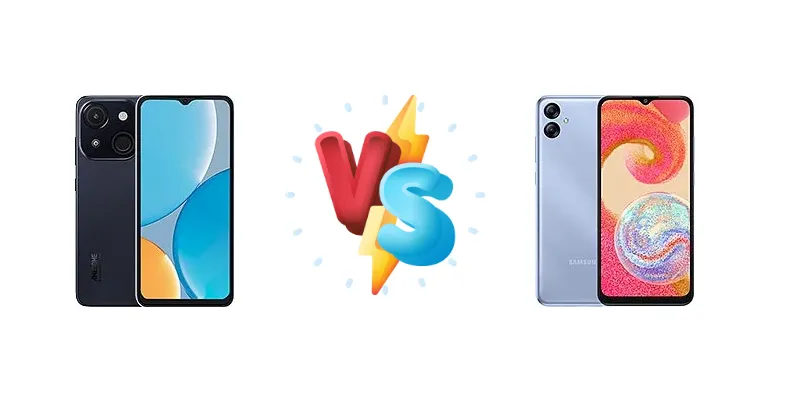
The itel A50C and Samsung Galaxy A04e represent the extreme end of the smartphone price spectrum. Both aim to deliver essential smartphone functionality at a minimal cost, but they achieve this with different approaches to chipset selection and overall design. This comparison dissects their key specifications to determine which device offers the best value for users prioritizing affordability.
🏆 Quick Verdict
For the average user seeking a slightly more responsive experience, the itel A50C edges out the Samsung Galaxy A04e thanks to the newer Unisoc T603 chipset. While the A04e benefits from Samsung’s brand recognition, the A50C provides a more modern architecture for a similar price point.
| Network |
|---|
| 2G bands | GSM 850 / 900 / 1800 / 1900 | GSM 850 / 900 / 1800 / 1900 |
| 3G bands | HSDPA 850 / 900 / 2100 | HSDPA 850 / 900 / 2100 |
| 4G bands | LTE | 1, 3, 5, 7, 8, 20, 28, 38, 40, 41 |
| Speed | HSPA | HSPA, LTE |
| Technology | GSM / HSPA / LTE | GSM / HSPA / LTE |
| Launch |
|---|
| Announced | 2024, August 12 | 2022, October 21 |
| Status | Available. Released 2024, August 12 | Available. Released 2022, November 07 |
| Body |
|---|
| Build | - | Glass front, plastic back, plastic frame |
| Dimensions | 163.9 x 75.7 x 9.4 mm (6.45 x 2.98 x 0.37 in) | 164.2 x 75.9 x 9.1 mm (6.46 x 2.99 x 0.36 in) |
| SIM | Dual SIM | · Nano-SIM· Nano-SIM + Nano-SIM |
| Weight | 192.6 g (6.81 oz) | 188 g (6.63 oz) |
| Display |
|---|
| Resolution | 540 x 1208 pixels, 20:9 ratio (~202 ppi density) | 720 x 1600 pixels, 20:9 ratio (~270 ppi density) |
| Size | 6.56 inches, 103.4 cm2 (~83.4% screen-to-body ratio) | 6.5 inches, 102.0 cm2 (~81.8% screen-to-body ratio) |
| Type | IPS LCD | PLS LCD |
| Platform |
|---|
| CPU | Octa-core | Octa-core (4x2.3 GHz Cortex-A53 & 4x1.8 GHz Cortex-A53) |
| Chipset | Unisoc T603 | Mediatek MT6765 Helio P35 (12 nm) |
| GPU | - | PowerVR GE8320 |
| OS | Android 14 (Go edition) | Android 12, One UI Core 4.1 |
| Memory |
|---|
| Card slot | microSDXC | microSDXC (dedicated slot) |
| Internal | 32GB 2GB RAM | 32GB 2GB RAM, 32GB 3GB RAM, 32GB 4GB RAM, 64GB 2GB RAM, 64GB 3GB RAM, 64GB 4GB RAM, 128GB 4GB RAM |
| Main Camera |
|---|
| Dual | - | 13 MP, f/2.2, (wide), AF
Auxiliary lens |
| Features | LED flash | LED flash |
| Single | 8 MP, AF | 5 MP, f/2.2 |
| Video | Yes | 1080p@30fps |
| Selfie camera |
|---|
| Single | 5 MP | 5 MP, f/2.2 |
| Video | Yes | Yes |
| Sound |
|---|
| 3.5mm jack | - | Yes |
| 35mm jack | Yes | Yes |
| Loudspeaker | Yes | Yes |
| Comms |
|---|
| Bluetooth | Yes | 5.0, A2DP, LE |
| NFC | No | No |
| Positioning | GPS | GPS, GLONASS, GALILEO, BDS |
| Radio | Unspecified | Unspecified |
| USB | USB Type-C | USB Type-C 2.0, OTG |
| WLAN | Yes | Wi-Fi 802.11 b/g/n, Wi-Fi Direct |
| Features |
|---|
| Sensors | Fingerprint (rear-mounted); unspecified sensors | Accelerometer, proximity |
| Battery |
|---|
| Type | 4000 mAh | Li-Po 5000 mAh |
| Misc |
|---|
| Colors | Dawn Blue, Sapphire Black, Misty Aqua | Black, Copper, Light Blue |
| Models | - | SM-A042F, SM-A042F/DS, SM-A042M, SM-A042M/DS |
| Price | - | ₹ 7,999 |
| SAR EU | - | 0.29 W/kg (head) 1.11 W/kg (body) |
itel A50C
- More modern chipset architecture (Unisoc T603)
- Potentially better sustained performance
- Likely better power efficiency
- Less brand recognition than Samsung
- Limited software update support
Samsung Galaxy A04e
- Samsung brand reputation
- Potentially wider availability of accessories
- Established support network
- Older chipset (Helio P35)
- Likely lower sustained performance
- Potentially higher power consumption
Display Comparison
Neither device boasts a standout display. Both are likely to feature LCD panels, typical for this price bracket. The A04e’s display specifications are largely unavailable, but given its market positioning, it’s unlikely to surpass the A50C in terms of brightness or color accuracy. The focus here is on functionality over fidelity; expect adequate viewing angles and readability in indoor environments, but struggles in direct sunlight.
Camera Comparison
Camera performance on both devices will be basic. Details are scarce, but both are expected to feature a primary camera alongside auxiliary lenses of limited utility. The A04e’s camera specifications are unavailable, but it’s reasonable to assume a similar sensor size to the A50C. Image processing will likely prioritize speed over quality, resulting in acceptable photos in good lighting conditions but struggles in low light. Don't expect detailed images or advanced features like optical image stabilization (OIS) on either device.
Performance
The core difference lies in the chipsets. The itel A50C utilizes the Unisoc T603, an octa-core processor built on a less-defined process node. The Samsung Galaxy A04e employs the MediaTek Helio P35 (12nm). While both are octa-core, the Helio P35’s architecture is older, utilizing four Cortex-A53 cores clocked at 2.3 GHz and another four at 1.8 GHz. The Unisoc T603, while lacking detailed clock speed information, benefits from a more modern design, potentially offering better efficiency and sustained performance. This translates to a smoother experience when multitasking or running multiple apps on the itel A50C. The 12nm process of the Helio P35 suggests it will likely run warmer under sustained load.
Battery Life
Battery life will be a key consideration for budget smartphone buyers. While specific mAh ratings are unavailable for both devices, the efficiency gains of the Unisoc T603 in the itel A50C could translate to slightly longer battery life despite potentially having a similar capacity to the A04e. Charging speeds are also likely to be slow on both, with neither device expected to support fast charging technologies. Expect a full charge to take several hours.
Buying Guide
Buy the itel A50C if you need a phone that feels a bit snappier for everyday tasks like browsing and social media, and if you appreciate a more recent chipset design. Buy the Samsung Galaxy A04e if you prioritize brand familiarity and a potentially wider availability of support and accessories, even if it means sacrificing some processing power.
Frequently Asked Questions
❓ Will the MediaTek Helio P35 in the Galaxy A04e struggle with demanding apps?
Yes, the Helio P35 is an older chipset designed for basic tasks. While it can handle social media and web browsing, it will likely exhibit noticeable lag when running more demanding applications or multitasking heavily. The Unisoc T603 in the itel A50C offers a more modern architecture and should provide a smoother experience.
❓ How does the software experience differ between the itel A50C and Samsung Galaxy A04e?
The Samsung Galaxy A04e likely runs Samsung’s One UI, a feature-rich but potentially resource-intensive skin on top of Android. The itel A50C may run a lighter version of Android, potentially Android Go Edition, designed for devices with limited RAM and processing power. This could result in a cleaner, faster experience on the itel A50C, but with fewer pre-installed features.
❓ Is the itel A50C a good choice for mobile gaming?
Neither phone is ideal for serious mobile gaming. The Unisoc T603 and Helio P35 are entry-level chipsets. While they can run some less demanding games, expect low frame rates and graphical settings. The itel A50C’s newer architecture might offer a slightly better experience, but don’t expect to play PUBG or Call of Duty Mobile at high settings.