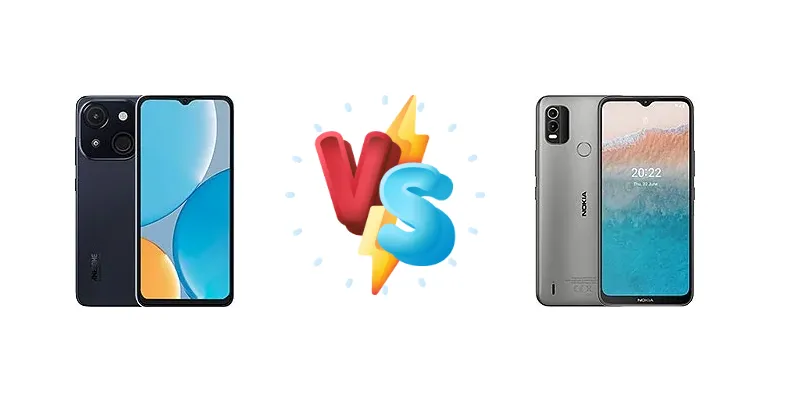
The itel A50C and Nokia C21 Plus represent the extreme end of the smartphone price spectrum, targeting first-time buyers or those needing a reliable secondary device. Both rely on Unisoc chipsets to deliver basic functionality, but significant differences in their architecture and features create a clear distinction in real-world performance and user experience. This comparison dissects these differences to determine which phone offers the best value.
🏆 Quick Verdict
For most users, the itel A50C emerges as the stronger choice. Its Unisoc T603 chipset, while still entry-level, offers a more modern architecture than the Nokia C21 Plus’s SC9863A, resulting in noticeably smoother performance for everyday tasks. While the Nokia C21 Plus benefits from 10W charging, the performance gap justifies the trade-off for the average user.
| Network |
|---|
| 2G bands | GSM 850 / 900 / 1800 / 1900 | GSM 850 / 900 / 1800 / 1900 |
| 3G bands | HSDPA 850 / 900 / 2100 | HSDPA 850 / 900 / 2100 |
| 4G bands | LTE | LTE |
| Speed | HSPA | HSPA 42.2/5.76 Mbps, LTE Cat4 150/50 Mbps |
| Technology | GSM / HSPA / LTE | GSM / HSPA / LTE |
| | - | HSDPA 850 / 900 / 1700(AWS) / 1900 / 2100 |
| Launch |
|---|
| Announced | 2024, August 12 | 2022, February 28 |
| Status | Available. Released 2024, August 12 | Available. Released 2022, April 29 |
| Body |
|---|
| Build | - | Glass front, aluminum frame, plastic back |
| Dimensions | 163.9 x 75.7 x 9.4 mm (6.45 x 2.98 x 0.37 in) | 164.8 x 75.9 x 8.6 mm (6.49 x 2.99 x 0.34 in) |
| SIM | Dual SIM | · Nano-SIM· Nano-SIM + Nano-SIM |
| Weight | 192.6 g (6.81 oz) | 178 g or 191 g (6.28 oz) |
| | - | Splash protection |
| Display |
|---|
| Protection | - | Scratch-resistant glass |
| Resolution | 540 x 1208 pixels, 20:9 ratio (~202 ppi density) | 720 x 1600 pixels, 20:9 ratio (~269 ppi density) |
| Size | 6.56 inches, 103.4 cm2 (~83.4% screen-to-body ratio) | 6.52 inches, 102.6 cm2 (~82.1% screen-to-body ratio) |
| Type | IPS LCD | IPS LCD |
| Platform |
|---|
| CPU | Octa-core | Octa-core (4x1.6 GHz Cortex-A55 & 4x1.2 GHz Cortex-A55) |
| Chipset | Unisoc T603 | Unisoc SC9863A (28 nm) |
| GPU | - | IMG8322 |
| OS | Android 14 (Go edition) | Android 11 (Go edition) |
| Memory |
|---|
| Card slot | microSDXC | microSDXC (dedicated slot) |
| Internal | 32GB 2GB RAM | 32GB 2GB RAM, 32GB 3GB RAM, 64GB 2GB RAM, 64GB 3GB RAM, 64GB 4GB RAM |
| | - | eMMC 5.1 |
| Main Camera |
|---|
| Dual | - | 13 MP, (wide), AF
Auxiliary lens |
| Features | LED flash | LED flash, HDR, panorama |
| Single | 8 MP, AF | 5 MP |
| Video | Yes | 1080p@30fps |
| Selfie camera |
|---|
| Features | - | LED flash |
| Single | 5 MP | 5 MP |
| Video | Yes | 720p |
| Sound |
|---|
| 3.5mm jack | - | Yes |
| 35mm jack | Yes | Yes |
| Loudspeaker | Yes | Yes |
| Comms |
|---|
| Bluetooth | Yes | 4.2, A2DP |
| NFC | No | No |
| Positioning | GPS | GPS |
| Radio | Unspecified | FM radio |
| USB | USB Type-C | microUSB 2.0 |
| WLAN | Yes | Wi-Fi 802.11 b/g/n |
| Features |
|---|
| Sensors | Fingerprint (rear-mounted); unspecified sensors | Fingerprint (rear-mounted), accelerometer, proximity |
| Battery |
|---|
| Charging | - | 10W wired |
| Type | 4000 mAh | Li-Ion 4000/5050 mAh |
| Misc |
|---|
| Colors | Dawn Blue, Sapphire Black, Misty Aqua | Dark Cyan, Warm Gray |
| Models | - | TA-1433, TA-1431, TA-1426, TA-1424 |
| Price | - | About 120 EUR |
| SAR | - | 0.57 W/kg (head) 0.65 W/kg (body) |
| SAR EU | - | 0.40 W/kg (head) 0.99 W/kg (body) |
itel A50C
- More modern Unisoc T603 chipset for better performance
- Potentially more efficient power consumption
- Likely smoother user experience for everyday tasks
- Charging speed likely slower than Nokia C21 Plus
- Build quality may be less refined than Nokia
Nokia C21 Plus
- 10W wired charging for faster top-ups
- Nokia’s reputation for software support
- Potentially more durable build quality
- Older and less powerful Unisoc SC9863A chipset
- Less responsive performance for multitasking
- 28nm process less power efficient
Display Comparison
Neither device boasts a standout display. Both are likely to feature LCD panels, typical for this price point. The Nokia C21 Plus’s 28nm chipset suggests a focus on power efficiency, potentially impacting display brightness. While specific nit counts are unavailable, the itel A50C’s newer chipset *could* allow for slightly better display calibration and color reproduction, though expectations should remain modest. Bezels are expected to be substantial on both devices, maximizing screen real estate within their budget constraints.
Camera Comparison
Camera performance on both devices will be limited. Details on sensor sizes and apertures are unavailable, but given the price point, expect basic 5-8MP main sensors. The Nokia C21 Plus may include a secondary depth sensor, but its utility is questionable. Image processing will be minimal on both, relying heavily on software algorithms to enhance photos. The itel A50C’s slightly more powerful chipset *could* offer marginally faster image processing, but don’t expect flagship-level results from either device. Focusing on the main sensor’s capabilities is crucial, as any additional sensors are likely to be of limited value.
Performance
The core difference lies in the chipsets. The itel A50C’s Unisoc T603 is an octa-core processor built on a more modern node (likely 12nm, though unconfirmed), offering a performance advantage over the Nokia C21 Plus’s Unisoc SC9863A (28nm). The SC9863A utilizes a big.LITTLE architecture with 4x1.6 GHz Cortex-A55 cores and 4x1.2 GHz Cortex-A55 cores, designed for efficiency. However, the older 28nm process and the split core configuration will likely result in slower overall performance compared to the T603’s homogenous octa-core design. This translates to faster app loading times and smoother multitasking on the itel A50C.
Battery Life
Both phones likely house batteries in the 3000-4000 mAh range, typical for entry-level smartphones. The Nokia C21 Plus supports 10W wired charging, a slight advantage over the itel A50C, which likely relies on 5W or 7.5W charging. However, the Unisoc T603 in the itel A50C is potentially more power-efficient, potentially offsetting the slower charging speed with longer battery life during typical usage. Real-world battery performance will depend heavily on usage patterns, but the Nokia C21 Plus will offer quicker top-ups when a charger is available.
Buying Guide
Buy the itel A50C if you prioritize responsiveness and a smoother user experience, even for basic tasks like browsing and social media. It’s ideal for users who need a phone that doesn’t feel sluggish. Buy the Nokia C21 Plus if you value a brand known for software support and a slightly more refined build quality, and if your usage is extremely light, focusing primarily on calls and messaging, and you appreciate the convenience of 10W charging.
Frequently Asked Questions
❓ Will the Unisoc T603 in the itel A50C handle basic gaming like Candy Crush or Subway Surfers?
Yes, the Unisoc T603 is capable of running casual games like Candy Crush and Subway Surfers without significant issues. However, don’t expect to play graphically demanding games smoothly. Frame rates will likely be low, and you may experience occasional lag.
❓ Does the Nokia C21 Plus receive regular software updates, including security patches?
Nokia is generally known for providing relatively good software support for its budget devices. While the C21 Plus may not receive major Android version updates, it’s likely to receive regular security patches for a reasonable period, enhancing its security and stability. However, the frequency and duration of updates are not guaranteed.
❓ Is the 10W charging on the Nokia C21 Plus a significant advantage over the likely 5W/7.5W charging on the itel A50C?
Yes, 10W charging is noticeably faster than 5W or 7.5W charging. While it won’t charge the phone as quickly as higher-wattage solutions, it will reduce the time needed to top up the battery, which is convenient for users who frequently need to recharge.
❓ How much storage do these phones typically offer, and is it expandable?
Both the itel A50C and Nokia C21 Plus typically come with 32GB of internal storage, which is quite limited. Fortunately, both devices support microSD card expansion, allowing you to add up to 512GB or 1TB of additional storage for photos, videos, and apps.