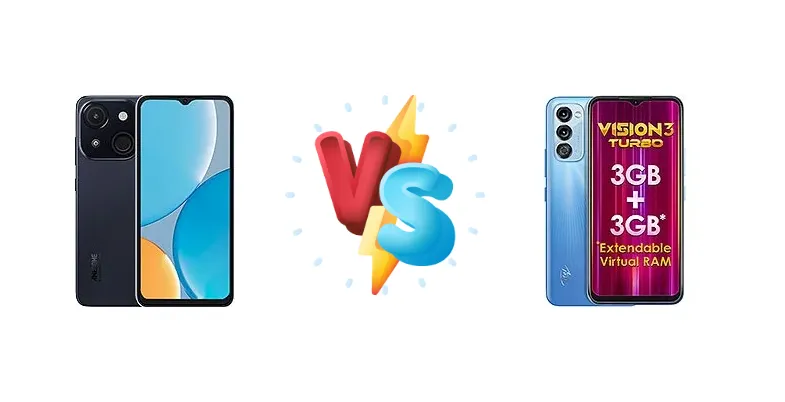
The itel A50C and Vision 3 Turbo represent itel’s commitment to the ultra-budget smartphone market. While both aim to deliver essential smartphone functionality at incredibly low price points, they differ significantly in their internal hardware. This comparison dissects those differences, focusing on how the Unisoc T603 in the A50C stacks up against the Unisoc SC9863A in the Vision 3 Turbo, and which phone offers the best experience for the money.
🏆 Quick Verdict
For most users, the itel Vision 3 Turbo is the better choice. Its 18W charging capability provides a significant convenience advantage over the A50C, and while the chipset is older, the real-world performance difference is minimal for basic tasks. The A50C is only preferable if extreme cost savings are the absolute priority.
| Network |
|---|
| 2G bands | GSM 850 / 900 / 1800 / 1900 | GSM 850 / 900 / 1800 / 1900 |
| 3G bands | HSDPA 850 / 900 / 2100 | HSDPA 850 / 900 / 2100 |
| 4G bands | LTE | LTE |
| Speed | HSPA | HSPA, LTE |
| Technology | GSM / HSPA / LTE | GSM / HSPA / LTE |
| Launch |
|---|
| Announced | 2024, August 12 | 2022 |
| Status | Available. Released 2024, August 12 | Available. Released 2022 |
| Body |
|---|
| Dimensions | 163.9 x 75.7 x 9.4 mm (6.45 x 2.98 x 0.37 in) | - |
| SIM | Dual SIM | Dual SIM |
| Weight | 192.6 g (6.81 oz) | - |
| Display |
|---|
| Resolution | 540 x 1208 pixels, 20:9 ratio (~202 ppi density) | 720 x 1600 pixels, 20:9 ratio (~266 ppi density) |
| Size | 6.56 inches, 103.4 cm2 (~83.4% screen-to-body ratio) | 6.6 inches, 105.2 cm2 |
| Type | IPS LCD | IPS LCD |
| Platform |
|---|
| CPU | Octa-core | Octa-core (4x1.6 GHz Cortex-A55 & 4x1.2 GHz Cortex-A55) |
| Chipset | Unisoc T603 | Unisoc SC9863A (28 nm) |
| GPU | - | IMG8322 |
| OS | Android 14 (Go edition) | Android 11 (Go edition) |
| Memory |
|---|
| Card slot | microSDXC | microSDXC |
| Internal | 32GB 2GB RAM | 64GB 3GB RAM |
| Main Camera |
|---|
| Features | LED flash | LED flash |
| Single | 8 MP, AF | 8 MP (wide)
Auxiliary lens |
| Video | Yes | 1080p@30fps |
| Selfie camera |
|---|
| Single | 5 MP | 5 MP |
| Video | Yes | Yes |
| Sound |
|---|
| 35mm jack | Yes | Yes |
| Loudspeaker | Yes | Yes |
| Comms |
|---|
| Bluetooth | Yes | Yes |
| NFC | No | No |
| Positioning | GPS | GPS |
| Radio | Unspecified | Unspecified |
| USB | USB Type-C | microUSB |
| WLAN | Yes | Yes |
| Features |
|---|
| Sensors | Fingerprint (rear-mounted); unspecified sensors | Fingerprint (rear-mounted), accelerometer |
| Battery |
|---|
| Charging | - | 18W wired |
| Type | 4000 mAh | 5000 mAh |
| Misc |
|---|
| Colors | Dawn Blue, Sapphire Black, Misty Aqua | Blue |
itel A50C
- Potentially lower price point
- Unisoc T603 offers newer architecture
- Adequate for basic smartphone tasks
- Slow charging speeds
- Likely limited software support
- Lower overall user experience
itel Vision 3 Turbo
- 18W fast charging
- Slightly more refined experience
- Better value for the money
- Older Unisoc SC9863A chipset
- Potentially higher price
- Still limited in demanding tasks
Display Comparison
Neither itel provides detailed display specifications. Given the price point, both likely utilize LCD panels with 720p+ resolutions. The Vision 3 Turbo’s slightly higher price suggests a potentially better-quality panel, but without specific brightness (nits) or color gamut data, it’s difficult to quantify. Bezels are expected to be substantial on both devices, prioritizing cost reduction over a premium aesthetic. Color accuracy is likely to be standard for this segment.
Camera Comparison
Camera performance on both devices will be limited. Neither phone is expected to excel in photography. Details on sensor sizes and apertures are unavailable, but it’s safe to assume both feature basic sensors. The presence of a 2MP macro camera on either device is largely a marketing tactic, offering minimal practical benefit due to the low resolution and lack of optical image stabilization (OIS). Image processing will likely be basic, prioritizing speed over quality. Expect acceptable results in well-lit conditions, but poor performance in low light.
Performance
The itel Vision 3 Turbo utilizes the Unisoc SC9863A, a 28nm octa-core processor with a split core configuration of 4x1.6 GHz Cortex-A55 and 4x1.2 GHz Cortex-A55 cores. The itel A50C, conversely, features the Unisoc T603, an octa-core processor built on a more modern node (though the specific node size isn't provided). While the T603 lacks detailed core clock information, its newer architecture *generally* implies better efficiency and potentially slightly improved single-core performance. However, the SC9863A’s higher clocked cores might offer a marginal advantage in multi-threaded tasks. Both phones will struggle with demanding applications, but are adequate for basic tasks. RAM configurations are not specified, but will heavily influence multitasking performance.
Battery Life
Battery capacity is not specified for either device. However, given the target market, both likely house batteries in the 4000-5000 mAh range. The key differentiator is the Vision 3 Turbo’s 18W wired charging support. This significantly reduces charging times compared to the A50C, which likely supports only 5W or 10W charging. While a larger battery capacity on the A50C might offer slightly longer runtime, the convenience of faster charging on the Vision 3 Turbo is a substantial advantage for many users.
Buying Guide
Buy the itel A50C if you need the absolute cheapest possible smartphone for basic communication – calls, texts, and light app usage – and are willing to sacrifice charging speed and potentially long-term software support. Buy the itel Vision 3 Turbo if you prefer a slightly more refined experience with faster charging, even if it means spending a little more. This phone is better suited for users who occasionally browse the web, use social media, or play casual games.
Frequently Asked Questions
❓ Will the itel Vision 3 Turbo overheat during prolonged use of apps like WhatsApp or Facebook?
The Unisoc SC9863A is a relatively low-power chipset. While it may experience some warmth during extended use, it's unlikely to overheat significantly under typical social media usage. The 28nm process node isn't the most efficient, but the chipset's overall power draw is low.
❓ Is the performance difference between the Unisoc T603 and SC9863A noticeable for everyday tasks like calling and browsing?
For basic tasks like making calls, sending texts, and browsing the web, the performance difference between the two chipsets will be minimal. Both are capable of handling these tasks adequately. The T603 might feel slightly snappier when opening apps, but the difference won't be dramatic.
❓ How long does it take to fully charge the itel Vision 3 Turbo with the 18W charger?
While the exact 0-100% charging time isn't specified, the 18W charging support on the Vision 3 Turbo will significantly reduce charging times compared to the A50C. Expect a full charge in approximately 2-3 hours, depending on usage during charging.