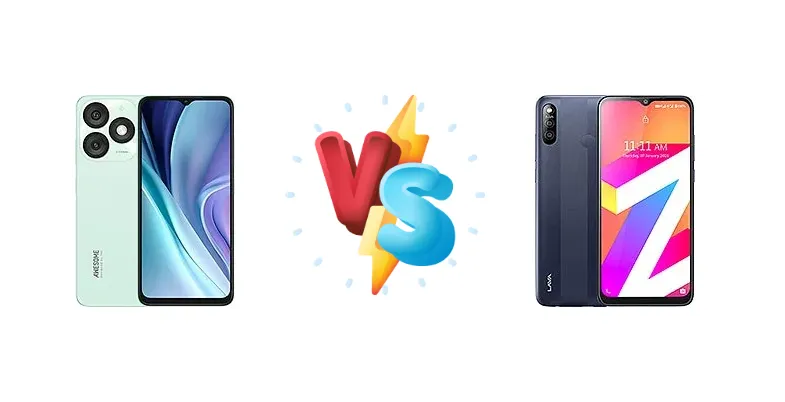
The itel A50 and Lava Z3 Pro represent the fiercely competitive sub-$150 smartphone market. Both aim to deliver essential smartphone functionality at an incredibly accessible price point. However, they achieve this with different chipsets and approaches. This comparison dissects their key specifications to determine which device offers the best value for users prioritizing performance and everyday usability.
🏆 Quick Verdict
For the average user needing a reliable, if basic, smartphone experience, the itel A50 edges out the Lava Z3 Pro. The Unisoc T603, while not a powerhouse, generally offers a smoother experience than the older Helio A25, particularly in multitasking, making it a better choice for everyday tasks.
| Network |
|---|
| 2G bands | GSM 850 / 900 / 1800 / 1900 | GSM 900 / 1800 |
| 3G bands | HSDPA 850 / 900 / 2100 | HSDPA 900 / 2100 |
| 4G bands | LTE | 1, 3, 5, 8, 40, 41 |
| Speed | HSPA, LTE | HSPA 42.2/5.76 Mbps, LTE Cat4 150/50 Mbps |
| Technology | GSM / HSPA / LTE | GSM / HSPA / LTE |
| Launch |
|---|
| Announced | 2024, May | 2022, May 18 |
| Status | Available. Released 2024, May | Available. Released 2022, May 18 |
| Body |
|---|
| Build | - | Glass front, plastic back, plastic frame |
| Dimensions | 163.9 x 75.7 x 8.7 mm (6.45 x 2.98 x 0.34 in) | 164.5 x 75.8 x 8.9 mm (6.48 x 2.98 x 0.35 in) |
| SIM | Dual SIM | Nano-SIM + Nano-SIM |
| Weight | - | 192 g (6.77 oz) |
| Display |
|---|
| Resolution | 720 x 1612 pixels, 20:9 ratio (~267 ppi density) | 720 x 1600 pixels, 20:9 ratio (~269 ppi density) |
| Size | 6.6 inches, 104.6 cm2 (~84.3% screen-to-body ratio) | 6.52 inches, 102.6 cm2 (~82.3% screen-to-body ratio) |
| Type | IPS LCD, 480 nits (peak) | IPS LCD |
| Platform |
|---|
| CPU | Octa-core | Octa-core (4x1.8 GHz Cortex-A53 & 4x1.5 GHz Cortex-A53) |
| Chipset | Unisoc T603 | Mediatek MT6762D Helio A25 (12 nm) |
| GPU | - | PowerVR GE8320 |
| OS | Android 14 (Go edition) | Android 11 |
| Memory |
|---|
| Card slot | microSDXC | microSDXC (dedicated slot) |
| Internal | 64GB 2GB RAM, 64GB 3GB RAM, 64GB 4GB RAM, 128GB 3GB RAM | 32GB 3GB RAM |
| Main Camera |
|---|
| Dual | - | 8 MP, f/2.0, (wide), 1.12µm, AF
Auxiliary lens |
| Features | LED flash | LED flash |
| Single | 8 MP
auxiliary lens | - |
| Video | Yes | 1080p@30fps |
| Selfie camera |
|---|
| Single | 5 MP | 5 MP, f/2.2, (wide) |
| Video | Yes | - |
| Sound |
|---|
| 35mm jack | Yes | Yes |
| Loudspeaker | Yes | Yes |
| Comms |
|---|
| Bluetooth | Yes | 5.0, A2DP, LE |
| NFC | No | No |
| Positioning | GPS | GPS |
| Radio | Unspecified | FM radio |
| USB | USB Type-C 2.0 | USB Type-C 2.0, OTG |
| WLAN | Yes | Wi-Fi 802.11 b/g/n/ac, Wi-Fi Direct |
| Features |
|---|
| Sensors | Fingerprint (side-mounted); unspecified sensors | Fingerprint (rear-mounted), accelerometer, proximity |
| Battery |
|---|
| Charging | 10W wired | - |
| Type | 5000 mAh | Li-Po 5000 mAh |
| Misc |
|---|
| Colors | Shimmer Gold, Суаn Blue, Lime Green, Misty Black | Blue, Dark Blue |
| Models | A507LXU | - |
| Price | - | About 80 EUR |
itel A50
- Potentially smoother performance with Unisoc T603
- More modern ISP for potentially better image quality
- Likely better multitasking capabilities
- Charging speed is slow at 10W
- Display quality likely basic
Lava Z3 Pro
- Established brand presence in India
- Potentially longer battery life due to lower power chipset
- Affordable price point
- Older and less efficient Helio A25 chipset
- Potentially slower app loading and multitasking
- Less capable ISP for camera performance
Display Comparison
Neither device boasts a standout display. Both are likely to feature LCD panels, typical for this price bracket. The critical difference lies under the hood. While specific display specs are unavailable, the Lava Z3 Pro’s Helio A25 chipset includes a basic image signal processor (ISP) which may impact color reproduction and sharpness. The itel A50’s Unisoc T603, while also entry-level, offers a more modern ISP, potentially leading to slightly better image quality on the display, even with similar panel characteristics. Bezels are expected to be substantial on both devices.
Camera Comparison
Camera performance on both devices will be limited. Details on sensor sizes and apertures are unavailable, but given the price point, expectations should be tempered. Both are likely to feature a primary camera alongside basic depth or macro sensors. The Helio A25’s ISP, while functional, is less capable than the one found in the Unisoc T603. This means the itel A50 may produce slightly more detailed and accurate images, particularly in good lighting conditions. The Lava Z3 Pro may rely more heavily on software processing to compensate, potentially leading to over-sharpened or artificial-looking photos. The usefulness of any 2MP macro lens on either device is questionable.
Performance
The core of the difference lies in the chipsets. The itel A50 utilizes the Unisoc T603, an octa-core processor. The Lava Z3 Pro employs the MediaTek Helio A25. While both are octa-core, the Helio A25’s architecture is older and less efficient. Specifically, the Helio A25 uses a split core configuration (4x1.8 GHz Cortex-A53 & 4x1.5 GHz Cortex-A53), indicating a focus on power saving over raw performance. The Unisoc T603’s core configuration is not specified, but generally offers a more balanced approach. This translates to potentially smoother app switching and faster loading times on the itel A50. The Helio A25’s 12nm process node is also less efficient than what Unisoc likely uses for the T603, potentially leading to more heat generation under load.
Battery Life
Battery capacity is not specified for either device. However, both are likely to house batteries in the 3000-4000 mAh range. The Lava Z3 Pro, with its less powerful Helio A25, may exhibit slightly longer battery life due to its lower power consumption. However, the itel A50’s more efficient Unisoc T603 could offset this with optimized power management. Both devices feature 10W wired charging, meaning charging times will be relatively slow – expect several hours to reach a full charge from empty.
Buying Guide
Buy the itel A50 if you need a phone for consistent, everyday tasks like calling, messaging, and light social media browsing, and value a slightly more responsive user experience. Buy the Lava Z3 Pro if you prioritize a known brand within the Indian market and are comfortable with a potentially more constrained performance profile, focusing on basic functionality and extended battery life due to potentially more aggressive power management.
Frequently Asked Questions
❓ Will the Helio A25 in the Lava Z3 Pro struggle with popular apps like WhatsApp and Facebook?
While the Helio A25 can run these apps, users may experience noticeable lag when switching between them or when the phone is running other processes in the background. The itel A50’s Unisoc T603 is better equipped to handle these common tasks smoothly.
❓ Is the 10W charging on either phone sufficient for daily use?
10W charging is quite slow by modern standards. Expect to spend several hours fully charging either device. It's best to charge overnight to ensure you have sufficient battery life for the next day. Neither phone is suited for quick top-ups.
❓ Can either of these phones handle basic mobile gaming?
Both phones can handle very basic 2D games. However, demanding 3D games will likely be unplayable or experience significant frame rate drops. The Helio A25 in the Lava Z3 Pro will struggle more with even moderately demanding titles.
❓ Do either of these phones support VoWiFi (WiFi Calling)?
Support for VoWiFi is highly dependent on the carrier and software implementation. Given the budget nature of these devices, it's unlikely that VoWiFi is consistently supported. Check with your mobile carrier for compatibility.