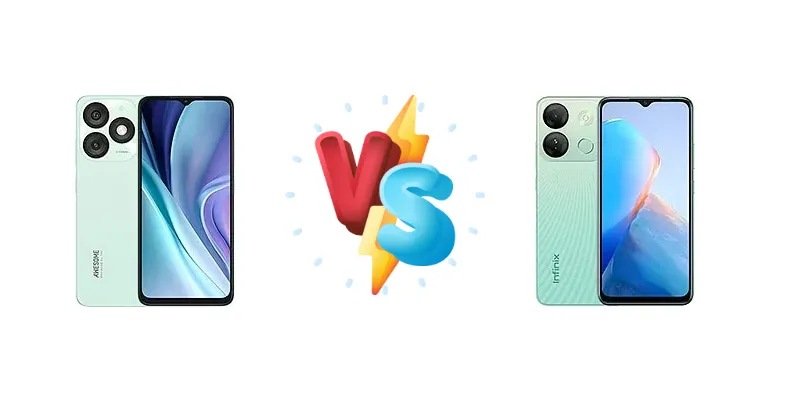
The itel A50 and Infinix Smart 7 HD represent the fiercely competitive entry-level smartphone market. Both aim to deliver essential smartphone functionality at an incredibly affordable price point. This comparison dissects their core specifications to determine which device offers the best balance of performance and value for users prioritizing basic connectivity and everyday tasks.
🏆 Quick Verdict
For the average user seeking a reliable, basic smartphone, the Infinix Smart 7 HD edges out the itel A50. While both share a 10W charging rate, the slightly higher clocked CPU in the Smart 7 HD suggests a marginally smoother user experience, particularly when multitasking. However, the A50 remains a viable option for those on the tightest of budgets.
| Network |
|---|
| 2G bands | GSM 850 / 900 / 1800 / 1900 | GSM 850 / 900 / 1800 / 1900 |
| 3G bands | HSDPA 850 / 900 / 2100 | HSDPA 850 / 900 / 2100 |
| 4G bands | LTE | 1, 3, 5, 8, 38, 40, 41 |
| Speed | HSPA, LTE | HSPA, LTE |
| Technology | GSM / HSPA / LTE | GSM / HSPA / LTE |
| | - | 1, 2, 3, 4, 5, 7, 8, 20, 28, 38, 40, 41 |
| Launch |
|---|
| Announced | 2024, May | 2023, April 14 |
| Status | Available. Released 2024, May | Available. Released 2023, April 14 |
| Body |
|---|
| Build | - | Glass front, plastic back, plastic frame |
| Dimensions | 163.9 x 75.7 x 8.7 mm (6.45 x 2.98 x 0.34 in) | 163.9 x 75.5 x 8.7 mm (6.45 x 2.97 x 0.34 in) |
| SIM | Dual SIM | Nano-SIM + Nano-SIM |
| Weight | - | 196.5 g (6.95 oz) |
| Display |
|---|
| Resolution | 720 x 1612 pixels, 20:9 ratio (~267 ppi density) | 720 x 1612 pixels, 20:9 ratio (~267 ppi density) |
| Size | 6.6 inches, 104.6 cm2 (~84.3% screen-to-body ratio) | 6.6 inches, 104.6 cm2 (~84.6% screen-to-body ratio) |
| Type | IPS LCD, 480 nits (peak) | IPS LCD, 500 nits |
| Platform |
|---|
| CPU | Octa-core | Octa-core 1.6 GHz |
| Chipset | Unisoc T603 | - |
| OS | Android 14 (Go edition) | Android 12 (Go edition) |
| Memory |
|---|
| Card slot | microSDXC | microSDXC (dedicated slot) |
| Internal | 64GB 2GB RAM, 64GB 3GB RAM, 64GB 4GB RAM, 128GB 3GB RAM | 64GB 2GB RAM |
| | - | UFS 2.1 |
| Main Camera |
|---|
| Dual | - | 8 MP, f/2.0
0.08 MP, (depth) |
| Features | LED flash | Dual-LED flash, HDR, panorama |
| Single | 8 MP
auxiliary lens | 8 MP, f/2.0
Auxiliary lens |
| Video | Yes | 1080p@30fps |
| Selfie camera |
|---|
| Features | - | LED flash |
| Single | 5 MP | 5 MP, f/2.0 |
| Video | Yes | 720p@30fps |
| Sound |
|---|
| 3.5mm jack | - | Yes |
| 35mm jack | Yes | Yes |
| Loudspeaker | Yes | Yes |
| Comms |
|---|
| Bluetooth | Yes | 5.0, A2DP, LE |
| NFC | No | No |
| Positioning | GPS | GPS |
| Radio | Unspecified | FM radio |
| USB | USB Type-C 2.0 | microUSB 2.0, OTG |
| WLAN | Yes | Wi-Fi 802.11 b/g/n |
| Features |
|---|
| Sensors | Fingerprint (side-mounted); unspecified sensors | Fingerprint (rear-mounted), accelerometer, proximity |
| Battery |
|---|
| Charging | 10W wired | 10W wired |
| Type | 5000 mAh | 5000 mAh |
| Misc |
|---|
| Colors | Shimmer Gold, Суаn Blue, Lime Green, Misty Black | Ink Black, Silk Blue, Jade White, Green Apple |
| Models | A507LXU | X6516 |
| Price | - | About 110 EUR |
itel A50
- Potentially lower price point
- Reliable Unisoc T603 chipset
- Simple and easy-to-use interface
- Slightly slower CPU clock speed
- Limited performance for demanding tasks
- Basic camera capabilities
Infinix Smart 7 HD
- Marginally faster CPU clock speed (1.6 GHz)
- Slightly improved multitasking performance
- Competitive pricing
- Still limited by the Unisoc T603 chipset
- Basic camera system
- 10W charging is relatively slow
Display Comparison
Neither itel nor Infinix provide display specifications beyond size in their marketing materials. Given the price point, both likely utilize IPS LCD panels with 720p+ resolution. Expect similar color accuracy and viewing angles. The absence of higher refresh rates or advanced features like PWM dimming control is standard for this segment. Bezels are likely to be substantial on both devices, maximizing screen real estate within a compact form factor.
Camera Comparison
Camera details are sparse for both devices. Both will likely feature a primary rear camera alongside auxiliary lenses (often 2MP depth or macro sensors). The image processing capabilities will be basic, prioritizing speed over detail. Expect acceptable results in well-lit conditions, but significant noise and softness in low light. The absence of Optical Image Stabilization (OIS) is expected. The primary sensor resolution is not specified, making a direct comparison difficult, but image quality will likely be similar given the shared chipset and price bracket.
Performance
Both the itel A50 and Infinix Smart 7 HD feature octa-core CPUs, but the key difference lies in the clock speed. The Infinix Smart 7 HD’s CPU is clocked at 1.6 GHz, a slight increase over the itel A50’s unspecified clock speed (but still based on the Unisoc T603). This suggests the Smart 7 HD will offer a marginally faster response time when launching apps or switching between them. Both rely on the Unisoc T603 chipset, which is designed for efficient power consumption rather than raw performance. RAM configurations are not specified, but both will likely ship with 2GB or 3GB, impacting multitasking capabilities. Thermal management will be passive, relying on the chassis to dissipate heat, meaning sustained heavy workloads will likely result in performance throttling.
Battery Life
Both the itel A50 and Infinix Smart 7 HD utilize 10W wired charging, indicating similar charging speeds. A full 0-100% charge will likely take around 2.5 to 3.5 hours. Battery capacity is not specified for either device, but both will likely house a 4000mAh to 5000mAh battery. Given the power-efficient Unisoc T603 chipset and basic display technology, both phones should comfortably last a full day with moderate usage, focusing on calls, messaging, and light social media browsing.
Buying Guide
Buy the itel A50 if you need a functional smartphone for the absolute lowest possible price and prioritize simplicity. It's ideal for first-time smartphone users or as a backup device. Buy the Infinix Smart 7 HD if you prefer a slightly more responsive experience for everyday tasks like browsing and social media, and are willing to spend a little more for that incremental performance boost. The Smart 7 HD is better suited for users who anticipate light multitasking.
Frequently Asked Questions
❓ Will the Infinix Smart 7 HD struggle with popular apps like WhatsApp and Facebook?
The Infinix Smart 7 HD, powered by the Unisoc T603, should handle WhatsApp and Facebook without significant issues. However, running multiple apps simultaneously or using resource-intensive features within these apps may lead to some slowdown. It's designed for basic connectivity and social media, not heavy multitasking.
❓ Is the Unisoc T603 chipset capable of playing mobile games?
The Unisoc T603 can handle casual mobile games, but it's not designed for graphically demanding titles. Expect low frame rates and reduced graphics settings in games like PUBG Mobile or Call of Duty Mobile. It's best suited for simpler games and puzzle titles.
❓ How long will the battery last on a single charge with typical usage?
With typical usage – including calls, messaging, and light social media browsing – both the itel A50 and Infinix Smart 7 HD should last a full day on a single charge. The efficient Unisoc T603 chipset and basic display technology contribute to good battery life.
❓ Can I expand the storage on either the itel A50 or Infinix Smart 7 HD?
While not explicitly stated in the provided specifications, most smartphones in this price range include a dedicated microSD card slot for storage expansion. It's highly likely that both the itel A50 and Infinix Smart 7 HD support microSD cards, allowing you to increase the available storage for photos, videos, and other files.