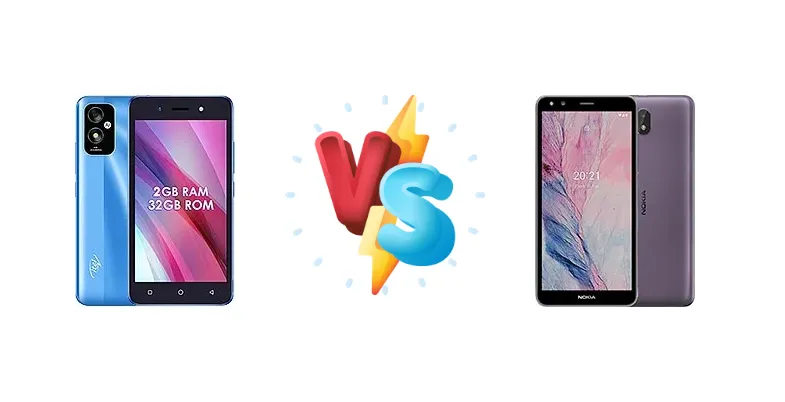
The itel A23S and Nokia C01 Plus represent the absolute bottom end of the smartphone market, targeting first-time buyers or those needing a very basic, reliable device. Both rely on Unisoc chipsets to deliver functionality at an incredibly low price point, but significant architectural differences exist that impact real-world performance. This comparison dissects those differences to determine which phone offers the best value.
🏆 Quick Verdict
For the average user prioritizing responsiveness and multitasking, the Nokia C01 Plus is the better choice. Its octa-core processor, despite sharing the same 28nm process as the itel A23S, provides a noticeable performance advantage for everyday tasks like browsing and social media. However, the itel A23S remains a viable option for extremely basic use cases.
| Network |
|---|
| 2G bands | GSM 850 / 900 / 1800 / 1900 | GSM 850 / 900 / 1800 / 1900 |
| 3G bands | HSDPA 850 / 900 / 2100 | HSDPA 850 / 900 / 2100 - International |
| 4G bands | LTE | 1, 3, 5, 7, 8, 20, 28, 38, 40, 41 - International |
| Speed | HSPA, LTE | HSPA 21.1/5.76 Mbps, LTE Cat4 150/50 Mbps |
| Technology | GSM / HSPA / LTE | GSM / HSPA / LTE |
| | - | 2, 4, 5, 7, 8, 28 - LATAM |
| Launch |
|---|
| Announced | 2022 | 2021, June 08 |
| Status | Available. Released 2022 | Available. Released 2021, June 28 |
| Body |
|---|
| Build | - | Plastic back, plastic frame |
| Dimensions | - | 148 x 71.8 x 9.3 mm (5.83 x 2.83 x 0.37 in) |
| SIM | Dual SIM | Nano-SIM + Nano-SIM |
| Weight | - | 157 g (5.54 oz) |
| Display |
|---|
| Resolution | 480 x 854 pixels, 16:9 ratio (~196 ppi density) | 720 x 1440 pixels, 18:9 ratio (~295 ppi density) |
| Size | 5.0 inches, 68.9 cm2 | 5.45 inches, 76.7 cm2 (~72.1% screen-to-body ratio) |
| Type | IPS LCD | IPS LCD |
| Platform |
|---|
| CPU | Quad-core 1.4 GHz | Octa-core (4x1.6 GHz Cortex-A55 & 4x1.2 GHz Cortex-A55) |
| Chipset | Unisoc SC9832E (28 nm) | Unisoc SC9863A (28 nm) |
| GPU | Mali-T820 MP1 | IMG8322 |
| OS | Android 11 (Go edition) | Android 11 (Go edition) |
| Memory |
|---|
| Card slot | microSDXC | microSDXC |
| Internal | 32GB 2GB RAM | 16GB 1GB RAM, 16GB 2GB RAM, 32GB 1GB RAM, 32GB 2GB RAM |
| | - | eMMC 5.1 |
| Main Camera |
|---|
| Features | LED flash | LED flash, HDR |
| Single | 2 MP | 5 MP |
| Video | Yes | 720p@30fps |
| Selfie camera |
|---|
| Features | LED flash | LED flash, HDR |
| Single | 0.3 MP | 5 MP |
| Video | Yes | 720p@30fps |
| Sound |
|---|
| 3.5mm jack | - | Yes |
| 35mm jack | Yes | Yes |
| Loudspeaker | Yes | Yes |
| Comms |
|---|
| Bluetooth | Yes | 4.2, A2DP, LE |
| NFC | No | No |
| Positioning | Unspecified | GPS |
| Radio | Unspecified | FM radio |
| USB | microUSB | microUSB 2.0 |
| WLAN | Yes | Wi-Fi 802.11 b/g/n |
| Features |
|---|
| Sensors | Accelerometer | Accelerometer, proximity |
| Battery |
|---|
| Type | 3020 mAh | Li-Ion 3000 mAh, removable |
| Misc |
|---|
| Colors | Sky Cyan, Sky Black, Ocean Blue | Blue, Purple |
| Models | - | TA-1383, TA-1387, TA-1391 |
| Price | - | About 90 EUR |
| SAR | - | 1.13 W/kg (head) 0.84 W/kg (body) |
| SAR EU | - | 0.59 W/kg (head) 1.41 W/kg (body) |
itel A23S
- Potentially lower price point
- Simpler user interface (likely)
- Compact and lightweight
- Significantly slower performance
- Limited multitasking capabilities
- May struggle with modern apps
Nokia C01 Plus
- Faster and more responsive performance
- Better multitasking capabilities
- More future-proofed processor
- Potentially slightly higher price
- May not offer significantly better camera quality
- Similar battery life to itel A23S
Display Comparison
Neither device boasts a standout display. Both likely utilize LCD panels, typical for this price bracket. Specifics like resolution and brightness are not provided, but we can assume they are basic. The focus here isn't on visual fidelity, but on basic readability. Bezels are likely substantial on both, maximizing screen real estate within a compact form factor. Color accuracy is expected to be standard for budget displays, prioritizing power efficiency over color science.
Camera Comparison
Camera performance on both devices will be limited. Details are scarce, but it's safe to assume both feature basic sensors. Focusing on megapixel counts alone is misleading at this price point. Image quality will heavily rely on software processing, and we expect limited dynamic range and detail in challenging lighting conditions. Any secondary cameras (likely 2MP macro lenses) are largely marketing features and offer minimal practical benefit. The Nokia C01 Plus *may* have a slight edge due to potentially better software optimization, but don't expect flagship-level results from either.
Performance
The core difference lies in the chipset. The itel A23S uses the Unisoc SC9832E, a quad-core processor clocked at 1.4 GHz. The Nokia C01 Plus, however, features the Unisoc SC9863A, an octa-core chip with a heterogeneous core configuration: four Cortex-A55 cores at 1.6 GHz and four at 1.2 GHz. This octa-core setup provides a significant advantage in multitasking and handling more complex applications. While both are built on a 28nm process, the architectural advantage of the SC9863A translates to a smoother user experience. The Nokia C01 Plus will handle app switching and basic gaming more effectively, while the itel A23S may struggle with even moderate workloads.
Battery Life
Battery capacity is not specified for either device. However, given their target market and hardware, we can expect capacities around 3000-4000 mAh. Charging wattage is also likely to be low (5W-10W), resulting in relatively slow charging times. The more efficient octa-core processor in the Nokia C01 Plus *could* translate to slightly better battery life under moderate use, but real-world performance will depend heavily on usage patterns and software optimization. Expect a full charge to take several hours on both devices.
Buying Guide
Buy the itel A23S if you need a phone solely for calls, texts, and very light app usage – think WhatsApp and a basic radio. It’s ideal for those who prioritize simplicity and minimal cost. Buy the Nokia C01 Plus if you prefer a smoother experience with slightly more demanding apps, occasional multitasking, and a more future-proofed platform thanks to its more capable processor. It’s a better fit for users who want a bit more versatility.
Frequently Asked Questions
❓ Will the Nokia C01 Plus handle popular social media apps like Facebook and WhatsApp smoothly?
Yes, the octa-core Unisoc SC9863A processor in the Nokia C01 Plus is sufficiently capable of running Facebook, WhatsApp, and similar social media applications without significant lag. While it won't offer a high-end experience, it will provide a usable and responsive experience for these common tasks.
❓ Is the itel A23S suitable for a first-time smartphone user or an elderly person?
The itel A23S is a reasonable choice for a first-time smartphone user or someone needing a very simple device. Its basic functionality and likely simplified user interface make it easy to learn. However, its limited performance may be frustrating for users who want to explore more demanding apps.
❓ Can either of these phones run multiple apps at the same time without slowing down?
The Nokia C01 Plus handles multitasking significantly better than the itel A23S. The octa-core processor allows for smoother switching between a few apps. The itel A23S, with its quad-core processor, will struggle with even moderate multitasking, leading to noticeable slowdowns.
❓ What kind of storage options are available on these phones, and can it be expanded?
Storage details are not provided. However, both phones likely come with limited internal storage (around 16GB or 32GB). Crucially, both are expected to support microSD card expansion, allowing users to add more storage for photos, videos, and apps. This is essential given the limited internal capacity.