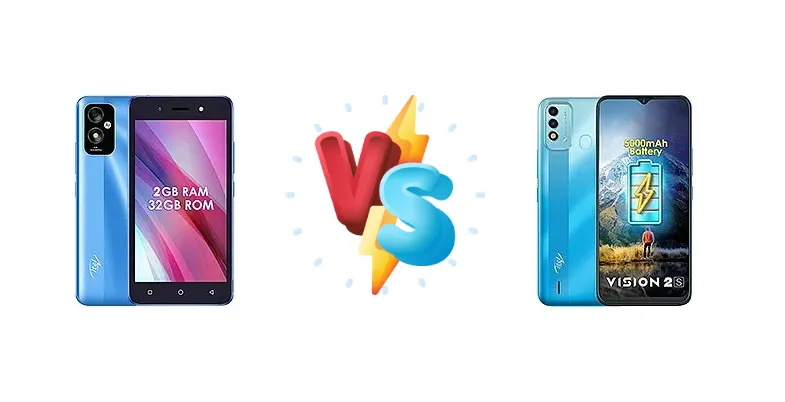
The itel A23S and Vision 2S represent itel’s commitment to the ultra-budget smartphone market. While both devices aim to deliver essential smartphone functionality at a low price point, they differ significantly in their internal hardware, particularly in their chipsets. This comparison will dissect those differences to determine which device offers the best experience for users prioritizing performance and features.
🏆 Quick Verdict
For most users, the itel Vision 2S is the superior choice. Its Unisoc SC9863A octa-core processor provides a substantial performance uplift over the A23S’s quad-core SC9832E, making it noticeably smoother for multitasking and app usage. The inclusion of 18W charging is also a significant advantage, offsetting the likely similar battery capacities.
| Network |
|---|
| 2G bands | GSM 850 / 900 / 1800 / 1900 | GSM 850 / 900 / 1800 / 1900 |
| 3G bands | HSDPA 850 / 900 / 2100 | HSDPA 850 / 900 / 2100 |
| 4G bands | LTE | LTE |
| Speed | HSPA, LTE | HSPA, LTE |
| Technology | GSM / HSPA / LTE | GSM / HSPA / LTE |
| Launch |
|---|
| Announced | 2022 | 2021 |
| Status | Available. Released 2022 | Available. Released 2021 |
| Body |
|---|
| Dimensions | - | 166 x 76.3 x 8.9 mm (6.54 x 3.00 x 0.35 in) |
| SIM | Dual SIM | Dual SIM |
| Weight | - | - |
| Display |
|---|
| Resolution | 480 x 854 pixels, 16:9 ratio (~196 ppi density) | 720 x 1600 pixels, 20:9 ratio (~269 ppi density) |
| Size | 5.0 inches, 68.9 cm2 | 6.52 inches, 102.6 cm2 (~81.0% screen-to-body ratio) |
| Type | IPS LCD | IPS LCD |
| Platform |
|---|
| CPU | Quad-core 1.4 GHz | Octa-core (4x1.6 GHz Cortex-A55 & 4x1.2 GHz Cortex-A55) |
| Chipset | Unisoc SC9832E (28 nm) | Unisoc SC9863A (28 nm) |
| GPU | Mali-T820 MP1 | IMG8322 |
| OS | Android 11 (Go edition) | Android 11 (Go edition) |
| Memory |
|---|
| Card slot | microSDXC | microSDXC |
| Internal | 32GB 2GB RAM | 32GB 2GB RAM |
| Main Camera |
|---|
| Dual | - | 8 MP
0.3 MP |
| Features | LED flash | LED flash |
| Single | 2 MP | - |
| Video | Yes | 1080p@30fps |
| Selfie camera |
|---|
| Features | LED flash | - |
| Single | 0.3 MP | 5 MP |
| Video | Yes | Yes |
| Sound |
|---|
| 35mm jack | Yes | Yes |
| Loudspeaker | Yes | Yes |
| Comms |
|---|
| Bluetooth | Yes | Yes |
| NFC | No | No |
| Positioning | Unspecified | GPS |
| Radio | Unspecified | Unspecified |
| USB | microUSB | microUSB |
| WLAN | Yes | Yes |
| Features |
|---|
| Sensors | Accelerometer | Fingerprint (rear-mounted), accelerometer |
| Battery |
|---|
| Charging | - | 18W wired |
| Type | 3020 mAh | 5000 mAh |
| Misc |
|---|
| Colors | Sky Cyan, Sky Black, Ocean Blue | Gradation Purple, Gradation Blue, Deep Blue |
itel A23S
- Extremely affordable
- Simple and easy to use
- Lightweight and portable
- Slow performance
- Limited multitasking capabilities
- Basic camera quality
itel Vision 2S
- Faster octa-core processor
- 18W fast charging
- Improved multitasking
- Slightly higher price
- Still limited by budget components
- Camera quality remains basic
Display Comparison
Both devices likely feature similar LCD panels given their price bracket, and specific details like resolution and brightness are not provided. However, the display is less of a differentiating factor than the internal hardware. Expect basic viewing experiences on both, suitable for everyday tasks but not ideal for media consumption in bright sunlight. Bezels are likely to be substantial on both models, reflecting their cost-conscious design.
Camera Comparison
Without specific camera sensor details, it’s difficult to make a definitive comparison. However, given the price point, both phones likely feature basic camera setups. The focus should be on the image processing capabilities of the respective chipsets. The SC9863A in the Vision 2S likely offers slightly better image processing, resulting in marginally improved photo quality. Any claims of advanced features like HDR or scene recognition should be viewed with skepticism. The presence of a 2MP macro camera on either device is largely a marketing gimmick and unlikely to deliver significant improvements in image quality.
Performance
The core difference lies in the chipsets. The itel A23S utilizes the Unisoc SC9832E, a quad-core processor built on a 28nm process. This is a basic chipset designed for minimal tasks. Conversely, the itel Vision 2S boasts the Unisoc SC9863A, an octa-core processor (4x1.6 GHz Cortex-A55 & 4x1.2 GHz Cortex-A55) also on a 28nm process. The octa-core configuration, with its combination of faster and slower cores, allows for significantly better multitasking and app responsiveness. The Cortex-A55 cores, while not high-end, represent a more modern architecture than what’s typically found in quad-core budget chips. This translates to a smoother user experience, especially when switching between apps or browsing the web. The Vision 2S will handle light gaming far better than the A23S.
Battery Life
Battery capacity details are missing for both devices. However, given their similar target market, they likely feature comparable battery sizes (around 3000-4000 mAh). The key differentiator is the Vision 2S’s 18W wired charging support. This allows for significantly faster charging times compared to the A23S, which likely supports only 5W or 10W charging. This means less downtime and more time using the device. While a larger battery capacity is always preferable, faster charging can mitigate the impact of a slightly smaller battery.
Buying Guide
Buy the itel A23S if you need a truly basic smartphone for essential tasks like calls, texts, and light social media use, and prioritize absolute affordability above all else. It’s a suitable option for first-time smartphone users or as a backup device. Buy the itel Vision 2S if you prefer a more responsive experience, enjoy occasional gaming, or value faster charging speeds. The extra processing power and convenience make it a worthwhile upgrade for those willing to spend slightly more.
Frequently Asked Questions
❓ Will the itel Vision 2S handle popular games like PUBG Mobile?
While the Vision 2S won't deliver a high-end gaming experience, the octa-core processor will allow for playable frame rates at low settings. Expect some lag and frame drops, but it's significantly better than the A23S, which would struggle even with basic games.
❓ Is the difference in performance between the two chipsets noticeable in everyday use?
Yes, the difference is quite noticeable. The A23S will exhibit lag when opening multiple apps or switching between them. The Vision 2S provides a smoother, more responsive experience, making everyday tasks like browsing, social media, and messaging feel less frustrating.
❓ Does the itel Vision 2S support Android Go edition?
It's likely the Vision 2S runs a full version of Android, rather than Android Go. The SC9863A chipset has enough processing power to handle the standard Android OS without significant performance issues. The A23S, with its weaker chipset, may benefit more from the streamlined Android Go experience.
❓ How long does it take to fully charge the itel Vision 2S with the 18W charger?
While a precise charging time is unavailable, the 18W charger should fully charge the Vision 2S in approximately 2-3 hours, depending on battery capacity. This is significantly faster than the A23S, which could take 4-5 hours with a standard 5W charger.