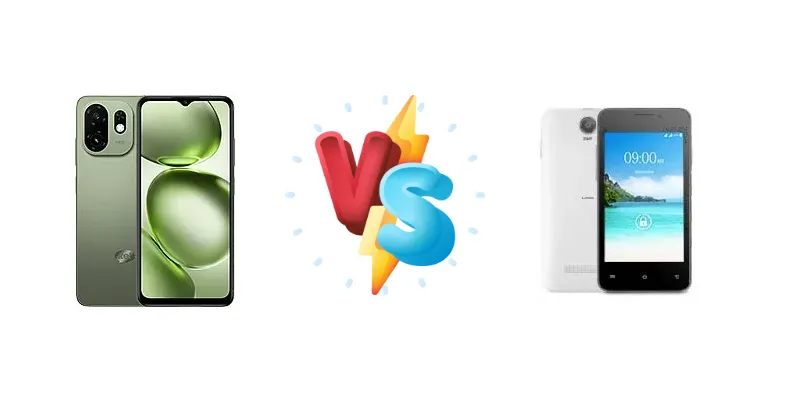
The itel A100C and Lava A32 represent the extreme end of the smartphone price spectrum, targeting first-time buyers or those needing a reliable secondary device. While both aim for affordability, they differ significantly in their internal hardware, particularly in processing power. This comparison dissects these differences to determine which phone offers the best experience for the price.
🏆 Quick Verdict
For the average user prioritizing responsiveness and multitasking, the itel A100C is the clear winner. Its Unisoc T7100 octa-core processor provides a substantial performance advantage over the Lava A32’s 1 GHz CPU, making it better suited for running apps and handling daily tasks smoothly.
| Network |
|---|
| 2G bands | GSM 850 / 900 / 1800 / 1900 | GSM 900 / 1800 - SIM 1 & SIM 2 |
| 3G bands | HSDPA 850 / 900 / 2100 | HSDPA 2100 |
| 4G bands | LTE | - |
| Speed | HSPA, LTE | HSPA |
| Technology | GSM / HSPA / LTE | GSM / HSPA |
| Launch |
|---|
| Announced | 2025, October 06 | 2016, July. Released 2016, July |
| Status | Available. Released 2025, October | Discontinued |
| Body |
|---|
| Dimensions | 8.5 mm thickness | 124.4 x 64.6 x 10.8 mm (4.90 x 2.54 x 0.43 in) |
| SIM | Nano-SIM + Nano-SIM | Dual SIM |
| Weight | - | 92 g (3.25 oz) |
| Display |
|---|
| Resolution | 720 x 1612 pixels, 20:9 ratio (~267 ppi density) | 480 x 800 pixels, 5:3 ratio (~233 ppi density) |
| Size | 6.6 inches, 104.6 cm2 | 4.0 inches, 45.5 cm2 (~56.7% screen-to-body ratio) |
| Type | IPS LCD, 90Hz, 400 nits | TFT, 256K colors |
| Platform |
|---|
| CPU | Octa-core 1.8 GHz | 1 GHz |
| Chipset | Unisoc T7100 | - |
| GPU | PowerVR GE8322 | - |
| OS | Android 15 (Go edition), itel OS 15 | Android OS |
| Memory |
|---|
| Card slot | microSDXC | microSDHC |
| Internal | 64GB 2GB RAM, 64GB 3GB RAM, 64GB 4GB RAM, 128GB 4GB RAM | 512MB 256MB RAM |
| Main Camera |
|---|
| Features | LED flash | LED flash |
| Single | 8 MP | 2 MP |
| Video | 1080p@30fps | Yes |
| Selfie camera |
|---|
| Single | 5 MP | VGA |
| Video | Yes | - |
| Sound |
|---|
| 3.5mm jack | - | Yes |
| 35mm jack | Yes | Yes |
| Loudspeaker | Yes | Yes |
| Comms |
|---|
| Bluetooth | Yes | 2.1 |
| Infrared port | Yes | - |
| NFC | No | No |
| Positioning | GPS | GPS |
| Radio | Unspecified | FM radio |
| USB | USB Type-C | microUSB 2.0 |
| WLAN | Yes | Wi-Fi 802.11 b/g/n, hotspot |
| Features |
|---|
| Sensors | Fingerprint (side-mounted), accelerometer | Accelerometer |
| Battery |
|---|
| Type | 5000 mAh | Li-Ion 1500 mAh, removable |
| Misc |
|---|
| Colors | Pure Black, Titanium Gold, Blaze Blue, Silk Green | Black, White |
itel A100C
- Significantly faster processor for smoother performance
- Octa-core CPU enables better multitasking
- More responsive user experience
- Display specifications are unknown
- Camera quality likely basic
Lava A32
- Potentially longer battery life due to lower power consumption
- Simpler user experience for basic tasks
- Extremely affordable
- Very slow processor limits functionality
- Struggles with multitasking and app performance
- Limited future-proofing
Display Comparison
Neither itel nor Lava provide display specifications beyond size. Given the price point, both likely utilize LCD panels with modest resolutions (likely 720p+). The absence of details like peak brightness or color gamut suggests neither phone is geared towards media consumption. Bezels are expected to be substantial on both devices, maximizing screen real estate within a compact form factor. Color accuracy will likely be standard for this segment.
Camera Comparison
Camera details are sparse for both phones. It's safe to assume both feature basic rear and front cameras, likely with resolutions around 5MP or 8MP. Image quality will be adequate for casual snapshots in good lighting conditions, but expect significant noise and limited detail in low light. The absence of features like Optical Image Stabilization (OIS) or advanced image processing algorithms means the cameras are primarily functional rather than feature-rich. Any mention of a 2MP macro lens on either device should be viewed with skepticism – its utility is minimal.
Performance
The core difference lies in the chipset. The itel A100C’s Unisoc T7100 is an octa-core processor clocked at 1.8 GHz, offering significantly more processing power than the Lava A32’s single-core 1 GHz CPU. This translates to faster app launch times, smoother multitasking, and a more responsive user experience on the itel. While RAM details are missing for both, the A100C’s processor will better manage memory allocation. The Lava A32 will struggle with even moderately demanding applications. Thermal management is unlikely to be a concern on either device given the low-power chipsets.
Battery Life
Battery capacity is not specified for either device. However, given the low-power processors, both phones should offer at least a full day of battery life with moderate usage. The Lava A32, with its less powerful CPU, *may* exhibit slightly longer battery life, but the difference is unlikely to be substantial. Charging wattage is also unknown; expect slow charging speeds via micro-USB, typical for this price range. The A100C’s more powerful processor will consume more power, but the difference will likely be offset by similar battery capacities.
Buying Guide
Buy the itel A100C if you need a smartphone capable of handling more than just basic calling and texting – apps like WhatsApp, light social media browsing, and even some casual gaming will be noticeably smoother. Buy the Lava A32 if your primary need is a very basic, reliable phone for calls and texts, and you prioritize simplicity and potentially longer battery life due to the less demanding processor.
Frequently Asked Questions
❓ Will the itel A100C handle popular apps like WhatsApp and Facebook smoothly?
Yes, the Unisoc T7100 processor in the itel A100C is capable of running apps like WhatsApp and Facebook without significant lag. It offers a much smoother experience compared to the Lava A32, which may struggle with these applications.
❓ Is the Lava A32 suitable for someone who primarily needs a phone for making calls and sending texts?
Absolutely. The Lava A32’s simple interface and low-power processor make it an excellent choice for users who only require basic communication features. It prioritizes reliability and ease of use over advanced functionality.
❓ Can I play games on either of these phones?
Casual games with simple graphics are playable on both, but the experience will be limited. The itel A100C will handle them better due to its more powerful processor, but don't expect to play demanding titles smoothly. The Lava A32 will struggle even with basic games.
❓ What type of charging port do these phones use?
Both the itel A100C and Lava A32 are expected to use a micro-USB port for charging, which is standard for phones in this price range. Charging speeds will likely be slow.