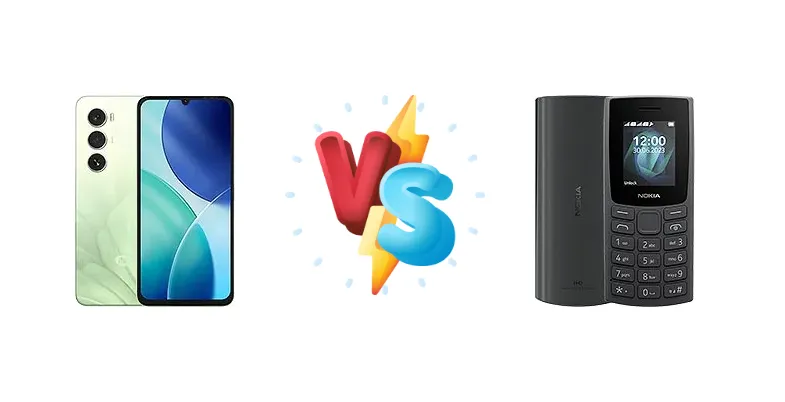
The itel A100 and Nokia 105 4G 2nd Edition represent opposite ends of the mobile spectrum. The itel A100 aims to deliver smartphone functionality at an incredibly accessible price point, while the Nokia 105 4G 2nd Edition focuses on providing reliable call and text capabilities with the added benefit of 4G connectivity. This comparison dissects their core differences to help you determine which device best fits your needs.
🏆 Quick Verdict
For users needing smartphone features like app access and internet browsing, the itel A100 is the clear winner, thanks to its Unisoc T7250 chipset. However, if you prioritize extreme simplicity, long battery life, and a durable, no-frills experience, the Nokia 105 4G 2nd Edition remains a compelling option.
| Network |
|---|
| 2G bands | GSM 850 / 900 / 1800 / 1900 | GSM 900 / 1800 |
| 3G bands | HSDPA 850 / 900 / 2100 | HSDPA 850 / 900 / 1700(AWS) / 1900 / 2100 |
| 4G bands | LTE | LTE |
| Speed | HSPA, LTE | HSPA, LTE |
| Technology | GSM / HSPA / LTE | GSM / HSPA / LTE |
| Launch |
|---|
| Announced | 2025, September 25 | 2024, December |
| Status | Available. Released 2025, October | Available. Released 2024, December |
| Body |
|---|
| Dimensions | 8.1 mm thickness | 121.5 x 50 x 14.4 mm (4.78 x 1.97 x 0.57 in) |
| SIM | Nano-SIM + Nano-SIM | · Nano-SIM· Nano-SIM + Nano-SIM |
| Weight | - | 93 g (3.28 oz) |
| Display |
|---|
| Resolution | 720 x 1600 pixels, 20:9 ratio (~260 ppi density) | 120 x 160 pixels, 4:3 ratio (~111 ppi density) |
| Size | 6.75 inches, 110.0 cm2 | 1.8 inches, 10.0 cm2 (~16.5% screen-to-body ratio) |
| Type | IPS LCD, 90Hz, 700 nits | IPS LCD |
| Platform |
|---|
| CPU | Octa-core (2x1.8 GHz Cortex-A75 & 6x1.6 GHz Cortex-A55) | - |
| Chipset | Unisoc T7250 (12 nm) | - |
| GPU | Mali-G57 MP1 | - |
| OS | Android 15 (Go edition), itel OS 15 | - |
| Memory |
|---|
| Call records | - | Yes |
| Card slot | microSDXC | microSDHC |
| Internal | 128GB 3GB RAM, 128GB 4GB RAM, 128GB 8GB RAM | 48MB 128MB RAM |
| Phonebook | - | Yes |
| Main Camera |
|---|
| Features | LED flash | - |
| Single | 8 MP | - |
| Video | 1080p@30fps | - |
| Selfie camera |
|---|
| Single | 8 MP | - |
| Video | Yes | - |
| Sound |
|---|
| 35mm jack | Yes | Yes |
| Loudspeaker | Yes | Yes |
| Comms |
|---|
| Bluetooth | Yes | 5.0, A2DP |
| Infrared port | Yes | - |
| NFC | No | No |
| Positioning | GPS | No |
| Radio | Unspecified | Wireless FM radio |
| USB | USB Type-C 2.0, OTG | USB Type-C |
| WLAN | Yes | No |
| Features |
|---|
| Games | - | Yes |
| Java | - | No |
| Messaging | - | SMS |
| Sensors | Fingerprint (side-mounted), accelerometer | - |
| Battery |
|---|
| Charging | 15W wired | - |
| Type | 5000 mAh | Li-Ion 1450 mAh, removable |
| Misc |
|---|
| Colors | Fresh Green, Star Titanium, Shadow Titanium | Charcoal |
| Price | - | About 50 EUR |
itel A100
- Smartphone functionality with app access
- Faster processor for smoother performance
- 15W fast charging
- Shorter battery life compared to feature phones
- Likely lower build quality than Nokia
Nokia 105 4G 2nd Edition
- Exceptional battery life (days on a single charge)
- Extreme durability and simplicity
- Affordable price point
- Limited functionality – no app support
- Basic features only (calls and texts)
Display Comparison
Given the Nokia 105 4G 2nd Edition's positioning as a feature phone, detailed display specifications are unavailable. The itel A100, being a smartphone, will undoubtedly feature a larger, color display, though its resolution and panel technology are not specified. This difference alone caters to different user needs; the itel A100 allows for visual content consumption, while the Nokia 105 4G 2nd Edition prioritizes readability and power efficiency.
Camera Comparison
Camera specifications for the Nokia 105 4G 2nd Edition are not available, and it likely features a very basic camera, if any. The itel A100, while likely not boasting a high-end camera system, will offer photographic capabilities absent in the Nokia 105 4G 2nd Edition. The quality will be limited, but it provides the option to capture photos and videos.
Performance
The itel A100's Unisoc T7250 (12 nm) chipset, with its octa-core configuration (2x1.8 GHz Cortex-A75 & 6x1.6 GHz Cortex-A55), represents a significant performance leap over what's expected in the Nokia 105 4G 2nd Edition. The Cortex-A75 cores provide a boost in single-core performance, beneficial for app loading and responsiveness, while the A55 cores handle background tasks efficiently. The Nokia 105 4G 2nd Edition is designed for basic communication and will lack the processing power for anything beyond that. The 12nm process node of the Unisoc chip suggests a reasonable balance between performance and power consumption, though it won't compete with flagship-level efficiency.
Battery Life
The Nokia 105 4G 2nd Edition is renowned for its exceptional battery life, typical of feature phones. While the exact capacity isn't specified, it will likely last for days on a single charge. The itel A100, with its smartphone functionality and Unisoc T7250 chipset, will have a shorter battery life, requiring daily charging. The itel A100's 15W wired charging offers a faster recharge time compared to the Nokia 105 4G 2nd Edition's likely slower charging method, but this is offset by the need to charge it more frequently.
Buying Guide
Buy the itel A100 if you need a device capable of running apps, accessing the internet, and handling basic multimedia tasks. It's ideal for first-time smartphone users or those on a very tight budget. Buy the Nokia 105 4G 2nd Edition if you primarily need a phone for calls and texts, value exceptional battery life, and prefer a device that's incredibly easy to use and durable – a perfect secondary or emergency phone.
Frequently Asked Questions
❓ How does the Unisoc T7250 in the itel A100 handle multitasking compared to the Nokia 105 4G 2nd Edition?
The Unisoc T7250 is designed for basic multitasking, allowing you to switch between apps like messaging, web browsing, and music playback. The Nokia 105 4G 2nd Edition is not designed for multitasking; it can only handle one task at a time – typically a phone call or sending a text message.
❓ Is the itel A100 a good option for someone upgrading from a traditional feature phone like the Nokia 105 4G 2nd Edition?
Yes, the itel A100 is an excellent entry point for users transitioning from a feature phone. It offers a familiar form factor with the added benefits of smartphone functionality, such as app access and internet connectivity, at a very affordable price.
❓ What kind of 4G speeds can I expect on the Nokia 105 4G 2nd Edition?
The Nokia 105 4G 2nd Edition supports 4G LTE, providing faster data speeds than 2G or 3G networks. However, speeds will vary depending on network coverage and congestion. It's suitable for basic web browsing and occasional social media use, but don't expect flagship-level download speeds.