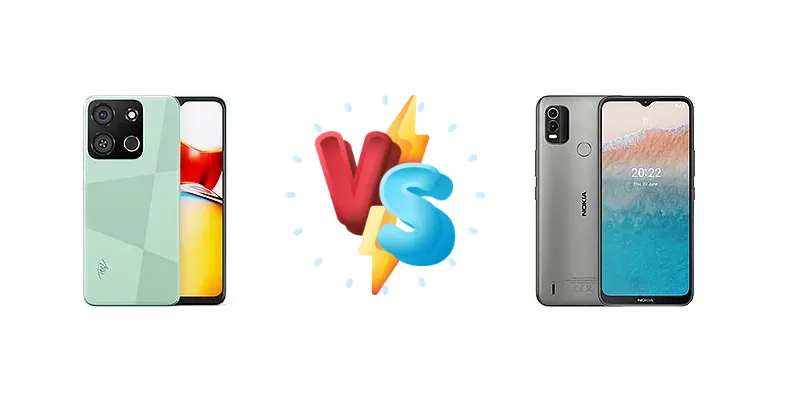
The itel A05s and Nokia C21 Plus represent the extreme end of the smartphone price spectrum, targeting first-time buyers or those needing a reliable secondary device. Both rely on Unisoc chipsets, but subtle differences in fabrication and features create a noticeable gap in efficiency and overall user experience. This comparison dissects those differences to determine which phone offers the best value.
🏆 Quick Verdict
For the average user prioritizing efficiency and slightly better performance, the itel A05s is the superior choice. Its Unisoc SC9863A1, built on a 22nm process, offers a marginal but measurable advantage over the Nokia C21 Plus’s 28nm SC9863A, translating to potentially longer battery life and smoother multitasking.
| Network |
|---|
| 2G bands | GSM 850 / 900 / 1800 / 1900 | GSM 850 / 900 / 1800 / 1900 |
| 3G bands | HSDPA 850 / 900 / 2100 | HSDPA 850 / 900 / 2100 |
| 4G bands | LTE | LTE |
| Speed | HSPA, LTE | HSPA 42.2/5.76 Mbps, LTE Cat4 150/50 Mbps |
| Technology | GSM / HSPA / LTE | GSM / HSPA / LTE |
| | - | HSDPA 850 / 900 / 1700(AWS) / 1900 / 2100 |
| Launch |
|---|
| Announced | 2023 | 2022, February 28 |
| Status | Available. Released 2023 | Available. Released 2022, April 29 |
| Body |
|---|
| Build | - | Glass front, aluminum frame, plastic back |
| Dimensions | - | 164.8 x 75.9 x 8.6 mm (6.49 x 2.99 x 0.34 in) |
| SIM | Dual SIM | · Nano-SIM· Nano-SIM + Nano-SIM |
| Weight | - | 178 g or 191 g (6.28 oz) |
| | - | Splash protection |
| Display |
|---|
| Protection | - | Scratch-resistant glass |
| Resolution | 720 x 1612 pixels, 20:9 ratio (~267 ppi density) | 720 x 1600 pixels, 20:9 ratio (~269 ppi density) |
| Size | 6.6 inches, 104.6 cm2 | 6.52 inches, 102.6 cm2 (~82.1% screen-to-body ratio) |
| Type | IPS LCD | IPS LCD |
| Platform |
|---|
| CPU | Octa-core (4x1.6 GHz Cortex-A55 & 4x1.2 GHz Cortex-A55) | Octa-core (4x1.6 GHz Cortex-A55 & 4x1.2 GHz Cortex-A55) |
| Chipset | Unisoc SC9863A1 (22 nm) | Unisoc SC9863A (28 nm) |
| GPU | IMG8322 | IMG8322 |
| OS | Android 12 (Go edition) | Android 11 (Go edition) |
| Memory |
|---|
| Card slot | microSDXC | microSDXC (dedicated slot) |
| Internal | 32GB 2GB RAM | 32GB 2GB RAM, 32GB 3GB RAM, 64GB 2GB RAM, 64GB 3GB RAM, 64GB 4GB RAM |
| | - | eMMC 5.1 |
| Main Camera |
|---|
| Dual | - | 13 MP, (wide), AF
Auxiliary lens |
| Features | LED flash | LED flash, HDR, panorama |
| Single | 8 MP | 5 MP |
| Video | Yes | 1080p@30fps |
| Selfie camera |
|---|
| Features | - | LED flash |
| Single | 5 MP | 5 MP |
| Video | Yes | 720p |
| Sound |
|---|
| 3.5mm jack | - | Yes |
| 35mm jack | Yes | Yes |
| Loudspeaker | Yes | Yes |
| Comms |
|---|
| Bluetooth | Yes | 4.2, A2DP |
| NFC | No | No |
| Positioning | GPS | GPS |
| Radio | Unspecified | FM radio |
| USB | USB Type-C | microUSB 2.0 |
| WLAN | Yes | Wi-Fi 802.11 b/g/n |
| Features |
|---|
| Sensors | Fingerprint (rear-mounted), accelerometer, compass | Fingerprint (rear-mounted), accelerometer, proximity |
| Battery |
|---|
| Charging | - | 10W wired |
| Type | 4000 mAh | Li-Ion 4000/5050 mAh |
| Misc |
|---|
| Colors | Meadow Green, Nebula Black | Dark Cyan, Warm Gray |
| Models | A663LC | TA-1433, TA-1431, TA-1426, TA-1424 |
| Price | About 70 EUR | About 120 EUR |
| SAR | - | 0.57 W/kg (head) 0.65 W/kg (body) |
| SAR EU | - | 0.40 W/kg (head) 0.99 W/kg (body) |
itel A05s
- More efficient processor (22nm)
- Potentially longer battery life
- Slightly smoother multitasking
- Brand recognition is lower than Nokia
- Software updates may be less frequent
Nokia C21 Plus
- Established brand reputation (Nokia)
- 10W wired charging
- Potentially more refined software experience
- Less efficient processor (28nm)
- Shorter battery life under load
- Potentially slower app performance
Display Comparison
Neither device boasts a standout display. Both are likely to feature LCD panels with resolutions around 720x1600, typical for this price point. Without specific brightness data, it's difficult to declare a winner, but the Nokia C21 Plus’s inclusion of 10W charging suggests a focus on usability, potentially extending screen-on time. Bezels are expected to be substantial on both, minimizing immersive viewing experiences.
Camera Comparison
Camera performance is likely to be similar and underwhelming on both devices. Details on sensor size and aperture are unavailable, but given the price bracket, expect basic 8MP or 5MP main sensors. The Nokia C21 Plus may benefit from slightly more refined image processing algorithms, a hallmark of Nokia’s software optimization. However, the impact will be minimal. Any 2MP macro or depth sensors present on either device should be considered marketing features rather than genuine photographic tools.
Performance
The core difference lies in the chipsets. The itel A05s utilizes the Unisoc SC9863A1, fabricated on a 22nm process, while the Nokia C21 Plus uses the SC9863A on a 28nm process. A smaller fabrication node generally equates to improved power efficiency and potentially higher clock speeds for the same architecture. Both CPUs share the same octa-core configuration (4x1.6 GHz Cortex-A55 & 4x1.2 GHz Cortex-A55), meaning raw clock speed isn’t the differentiator. The 22nm node of the A05s’ chipset will result in lower power consumption under load, leading to less thermal throttling and sustained performance. While both are adequate for basic tasks, the A05s will handle multitasking and app switching slightly more smoothly.
Battery Life
Battery capacity is not specified for either device, but both likely house batteries in the 3000-4000 mAh range. The Nokia C21 Plus’s 10W wired charging is a notable feature, offering a standardized charging solution. The itel A05s’ charging speed is unknown, but given the focus on efficiency with its chipset, it may achieve comparable real-world charge times despite potentially lower wattage. The A05s’ more efficient processor will contribute to longer battery life between charges, even with a similar capacity battery.
Buying Guide
Buy the itel A05s if you need a phone that maximizes battery life for basic tasks like calling, texting, and light social media use. Its more efficient processor will stretch every milliampere-hour further. Buy the Nokia C21 Plus if you prioritize brand recognition and the slightly more polished software experience Nokia typically provides, understanding that you'll trade a small amount of performance and efficiency for it.
Frequently Asked Questions
❓ Will the Unisoc SC9863A1 in the itel A05s struggle with popular apps like WhatsApp and Facebook?
While not a powerhouse, the Unisoc SC9863A1 is sufficient for running lightweight apps like WhatsApp and Facebook. Expect some loading times and occasional lag when switching between apps, but it should handle basic social media usage without major issues. The 22nm process helps maintain stability during these tasks.
❓ Does the Nokia C21 Plus support any fast charging standards beyond 10W?
No, the Nokia C21 Plus is limited to 10W wired charging. This is a standard charging speed for devices in this price range, but it means a full charge will take several hours. The focus is on reliable, albeit slow, charging rather than speed.
❓ Is the difference between the 22nm and 28nm process significant in real-world usage?
Yes, while seemingly small, the difference between 22nm and 28nm fabrication processes is noticeable. The 22nm process used in the itel A05s’ chipset allows for lower power consumption and reduced heat generation, resulting in longer battery life and potentially less performance throttling during sustained use.