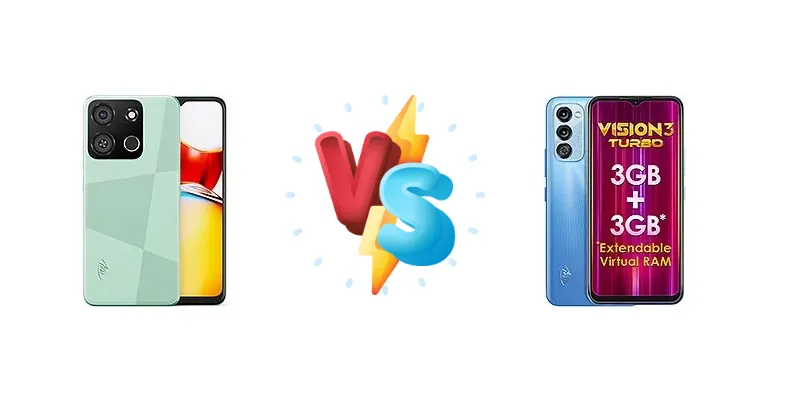
The itel A05s and Vision 3 Turbo represent itel’s commitment to the ultra-budget smartphone market. While both aim to deliver essential smartphone functionality at a low price point, they differ in key areas, most notably chipset fabrication and charging capabilities. This comparison dissects these differences to determine which device offers the best value for users prioritizing performance and convenience.
🏆 Quick Verdict
For the average user seeking the most responsive experience, the itel A05s emerges as the slightly better choice. Its Unisoc SC9863A1 chipset, built on a 22nm process, offers a marginal performance advantage over the 28nm SC9863A in the Vision 3 Turbo, despite the latter’s 18W charging. However, the Vision 3 Turbo’s faster charging is a significant benefit for those prioritizing convenience.
| Network |
|---|
| 2G bands | GSM 850 / 900 / 1800 / 1900 | GSM 850 / 900 / 1800 / 1900 |
| 3G bands | HSDPA 850 / 900 / 2100 | HSDPA 850 / 900 / 2100 |
| 4G bands | LTE | LTE |
| Speed | HSPA, LTE | HSPA, LTE |
| Technology | GSM / HSPA / LTE | GSM / HSPA / LTE |
| Launch |
|---|
| Announced | 2023 | 2022 |
| Status | Available. Released 2023 | Available. Released 2022 |
| Body |
|---|
| Dimensions | - | - |
| SIM | Dual SIM | Dual SIM |
| Weight | - | - |
| Display |
|---|
| Resolution | 720 x 1612 pixels, 20:9 ratio (~267 ppi density) | 720 x 1600 pixels, 20:9 ratio (~266 ppi density) |
| Size | 6.6 inches, 104.6 cm2 | 6.6 inches, 105.2 cm2 |
| Type | IPS LCD | IPS LCD |
| Platform |
|---|
| CPU | Octa-core (4x1.6 GHz Cortex-A55 & 4x1.2 GHz Cortex-A55) | Octa-core (4x1.6 GHz Cortex-A55 & 4x1.2 GHz Cortex-A55) |
| Chipset | Unisoc SC9863A1 (22 nm) | Unisoc SC9863A (28 nm) |
| GPU | IMG8322 | IMG8322 |
| OS | Android 12 (Go edition) | Android 11 (Go edition) |
| Memory |
|---|
| Card slot | microSDXC | microSDXC |
| Internal | 32GB 2GB RAM | 64GB 3GB RAM |
| Main Camera |
|---|
| Features | LED flash | LED flash |
| Single | 8 MP | 8 MP (wide)
Auxiliary lens |
| Video | Yes | 1080p@30fps |
| Selfie camera |
|---|
| Single | 5 MP | 5 MP |
| Video | Yes | Yes |
| Sound |
|---|
| 35mm jack | Yes | Yes |
| Loudspeaker | Yes | Yes |
| Comms |
|---|
| Bluetooth | Yes | Yes |
| NFC | No | No |
| Positioning | GPS | GPS |
| Radio | Unspecified | Unspecified |
| USB | USB Type-C | microUSB |
| WLAN | Yes | Yes |
| Features |
|---|
| Sensors | Fingerprint (rear-mounted), accelerometer, compass | Fingerprint (rear-mounted), accelerometer |
| Battery |
|---|
| Charging | - | 18W wired |
| Type | 4000 mAh | 5000 mAh |
| Misc |
|---|
| Colors | Meadow Green, Nebula Black | Blue |
| Models | A663LC | - |
| Price | About 70 EUR | - |
itel A05s
- Slightly more efficient chipset (22nm)
- Potentially better sustained performance
- Lower price (likely)
- Slower charging speeds (likely)
- No fast charging support
itel Vision 3 Turbo
- 18W fast charging support
- Faster charging times
- Convenient for quick top-ups
- Less efficient chipset (28nm)
- Potentially more thermal throttling
- May be slightly more expensive
Display Comparison
Both devices likely feature similar LCD panels, typical for this price segment. Specifics like resolution and brightness are not provided, but we can assume they are optimized for power efficiency rather than visual fidelity. The absence of features like high refresh rates or PWM dimming control suggests a focus on cost reduction. Bezels are expected to be substantial on both models, maximizing screen real estate within a compact form factor.
Camera Comparison
Camera performance is likely to be similar on both devices, relying on basic image sensors and software processing. Details regarding sensor size and aperture are unavailable, but given the price point, expectations should be tempered. The inclusion of a 2MP macro camera on either device is largely a marketing tactic, offering limited practical benefit due to the low resolution and fixed focus. Image quality will be acceptable for casual snapshots in good lighting conditions, but struggles in low-light scenarios are anticipated.
Performance
The core difference lies in the chipsets. The itel A05s utilizes the Unisoc SC9863A1, fabricated on a 22nm process, while the Vision 3 Turbo uses the SC9863A on a 28nm process. A smaller fabrication node generally translates to improved power efficiency and potentially higher clock speeds for the same architecture. Both feature the same octa-core CPU configuration (4x1.6 GHz Cortex-A55 & 4x1.2 GHz Cortex-A55), meaning the A05s’ advantage will be subtle, manifesting in slightly better sustained performance and potentially less thermal throttling during prolonged use. The RAM configuration is not specified, but likely sits around 2-3GB in both cases, impacting multitasking capabilities.
Battery Life
Battery capacity is not specified for either device, but both likely house batteries in the 3000-4000 mAh range, typical for entry-level smartphones. The itel Vision 3 Turbo’s key advantage is its 18W wired charging support. This significantly reduces charging times compared to the standard 5W or 10W charging likely found on the A05s. While a larger battery capacity is always preferable, the faster charging of the Vision 3 Turbo can mitigate the impact of a slightly smaller battery, offering more convenient top-ups throughout the day.
Buying Guide
Buy the itel A05s if you need a phone that feels slightly more responsive for everyday tasks like browsing and social media, and if you prioritize a marginally more efficient chipset. Buy the itel Vision 3 Turbo if you frequently find yourself needing to quickly top up your battery and value the convenience of 18W fast charging, even if it means a slight trade-off in raw processing power.
Frequently Asked Questions
❓ Will the Unisoc SC9863A chipset in the Vision 3 Turbo struggle with multitasking?
The SC9863A, paired with a likely 2-3GB of RAM, will exhibit limitations when multitasking. Running several apps simultaneously may lead to slowdowns and app reloading. The A05s, with the SC9863A1, will perform marginally better, but neither device is designed for heavy multitasking.
❓ How long will it take to fully charge the itel Vision 3 Turbo with the 18W charger?
While the exact 0-100% charging time isn't specified, the 18W charging support on the Vision 3 Turbo will likely take between 2-3 hours for a full charge, significantly faster than the A05s which likely supports only 5W or 10W charging, potentially taking 4+ hours.
❓ Are either of these phones suitable for playing demanding mobile games like PUBG Mobile?
Neither the itel A05s nor the Vision 3 Turbo are well-suited for demanding games like PUBG Mobile. The Unisoc chipsets and limited RAM will struggle to deliver a smooth gaming experience, even at low settings. Expect significant frame rate drops and potential overheating.
❓ Do either of these phones support VoLTE or Wi-Fi calling?
Support for VoLTE and Wi-Fi calling will depend on the carrier and region. Itel does not consistently advertise these features on its entry-level devices, so it's best to check with your mobile carrier to confirm compatibility before purchasing.