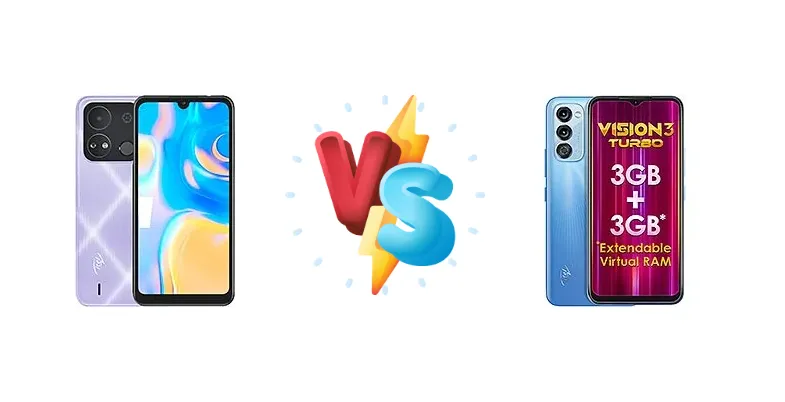
The itel A04 and Vision 3 Turbo represent itel’s commitment to the ultra-budget smartphone market. While both aim to deliver essential smartphone functionality at a low price point, they differ significantly in internal hardware. This comparison dissects these differences, focusing on how the Vision 3 Turbo’s Unisoc chipset impacts real-world performance compared to the A04’s unknown configuration.
🏆 Quick Verdict
For users prioritizing basic functionality like calls and light messaging, the itel A04 may suffice. However, the itel Vision 3 Turbo is the clear winner for anyone needing a more responsive experience, thanks to its Unisoc SC9863A chipset. The 18W charging also provides a significant convenience advantage.
| Network |
|---|
| 2G bands | GSM 850 / 900 / 1800 / 1900 | GSM 850 / 900 / 1800 / 1900 |
| 3G bands | HSDPA 850 / 900 / 2100 | HSDPA 850 / 900 / 2100 |
| 4G bands | LTE | LTE |
| Speed | HSPA, LTE | HSPA, LTE |
| Technology | GSM / HSPA / LTE | GSM / HSPA / LTE |
| Launch |
|---|
| Announced | 2023 | 2022 |
| Status | Available. Released 2023 | Available. Released 2022 |
| Body |
|---|
| Dimensions | - | - |
| SIM | Dual SIM | Dual SIM |
| Weight | - | - |
| Display |
|---|
| Resolution | 480 x 960 pixels, 18:9 ratio (~170 ppi density) | 720 x 1600 pixels, 20:9 ratio (~266 ppi density) |
| Size | 6.3 inches, 102.4 cm2 | 6.6 inches, 105.2 cm2 |
| Type | IPS LCD | IPS LCD |
| Platform |
|---|
| CPU | - | Octa-core (4x1.6 GHz Cortex-A55 & 4x1.2 GHz Cortex-A55) |
| Chipset | - | Unisoc SC9863A (28 nm) |
| GPU | - | IMG8322 |
| OS | Android (Go edition) | Android 11 (Go edition) |
| Memory |
|---|
| Card slot | microSDXC | microSDXC |
| Internal | 32GB 2GB RAM | 64GB 3GB RAM |
| Main Camera |
|---|
| Features | LED flash | LED flash |
| Single | 5 MP (wide)
Auxiliary lens | 8 MP (wide)
Auxiliary lens |
| Video | Yes | 1080p@30fps |
| Selfie camera |
|---|
| Single | 5 MP | 5 MP |
| Video | Yes | Yes |
| Sound |
|---|
| 35mm jack | Yes | Yes |
| Loudspeaker | Yes | Yes |
| Comms |
|---|
| Bluetooth | Yes | Yes |
| NFC | No | No |
| Positioning | GPS | GPS |
| Radio | Unspecified | Unspecified |
| USB | microUSB | microUSB |
| WLAN | Yes | Yes |
| Features |
|---|
| Sensors | Fingerprint (rear-mounted), accelerometer | Fingerprint (rear-mounted), accelerometer |
| Battery |
|---|
| Charging | - | 18W wired |
| Type | 4000 mAh | 5000 mAh |
| Misc |
|---|
| Colors | Lake Cyan, Violet, Sandstone Black | Blue |
| Price | About 50 EUR | - |
itel A04
- Potentially lower price point
- Simple and easy to use
- Suitable for basic communication
- Likely very limited performance
- Unknown display quality
- Slow charging (assumed)
itel Vision 3 Turbo
- Unisoc SC9863A chipset for improved performance
- 18W fast charging
- More responsive user experience
- Display details are limited
- Camera quality likely basic
- May be slightly more expensive than the A04
Display Comparison
Specific display details for the itel A04 are unavailable. The itel Vision 3 Turbo’s display specifications are also not detailed, but given the price point, it likely utilizes an IPS LCD panel. The absence of information regarding resolution, brightness, or refresh rate on either device suggests a focus on cost reduction. Users should expect basic viewing experiences, prioritizing visibility over color accuracy or high refresh rates. The A04, lacking any known display features, likely offers a more basic experience.
Camera Comparison
Camera specifications for both devices are limited. The itel Vision 3 Turbo likely features a primary camera, but details regarding its sensor size and aperture are unavailable. The itel A04’s camera details are entirely unknown. Given the market segment, both phones likely rely on basic image processing and may struggle in low-light conditions. The presence of a chipset in the Vision 3 Turbo suggests some level of image signal processing capability, potentially offering slightly better image quality than the A04, but expectations should remain low.
Performance
The itel Vision 3 Turbo’s Unisoc SC9863A chipset, built on a 28nm process, is the defining performance differentiator. Its octa-core configuration – featuring four Cortex-A55 cores clocked at 1.6 GHz and four at 1.2 GHz – provides a significant advantage over the itel A04, which lacks any published processor information. The A04 likely utilizes a less powerful, potentially quad-core chipset. The SC9863A allows for smoother multitasking and a more responsive user interface on the Vision 3 Turbo. While not a gaming powerhouse, the Vision 3 Turbo can handle less demanding titles. The 28nm node, while older, is common in this price segment and balances performance with power efficiency.
Battery Life
Battery capacity for both devices is unspecified. However, the itel Vision 3 Turbo’s 18W wired charging is a notable advantage. This faster charging speed significantly reduces the time required to replenish the battery compared to the A04, which likely supports slower charging rates. While a larger battery capacity is always preferable, the 18W charging on the Vision 3 Turbo mitigates the impact of a potentially smaller battery, offering greater convenience for users who frequently need to recharge.
Buying Guide
Buy the itel A04 if you need a phone solely for essential communication – calls, texts, and perhaps WhatsApp – and are on an extremely tight budget. It’s a viable option for first-time smartphone users or as a backup device. Buy the itel Vision 3 Turbo if you prefer a smoother, more capable experience for social media, light gaming, and multitasking. The performance boost from the Unisoc chipset justifies the likely price difference.
Frequently Asked Questions
❓ Will the itel Vision 3 Turbo be able to run popular social media apps like Facebook and Instagram smoothly?
Yes, the Unisoc SC9863A chipset in the Vision 3 Turbo provides sufficient processing power to run social media apps like Facebook and Instagram without significant lag. While it won't offer the same performance as flagship devices, it will deliver a usable and reasonably smooth experience.
❓ Is the itel A04 a good choice for someone who primarily uses their phone for making calls and sending texts?
The itel A04 is a viable option for users who primarily need a phone for basic communication. Its simplicity and potentially lower price point make it suitable for those who don't require advanced features or high performance. However, be prepared for a potentially slower and less responsive experience compared to more modern smartphones.
❓ What type of charging port does the itel Vision 3 Turbo use?
While the exact port type isn't specified, most smartphones in this price range utilize a Micro-USB port. The 18W charging capability is supported through this port, offering faster charging compared to standard 5W charging.