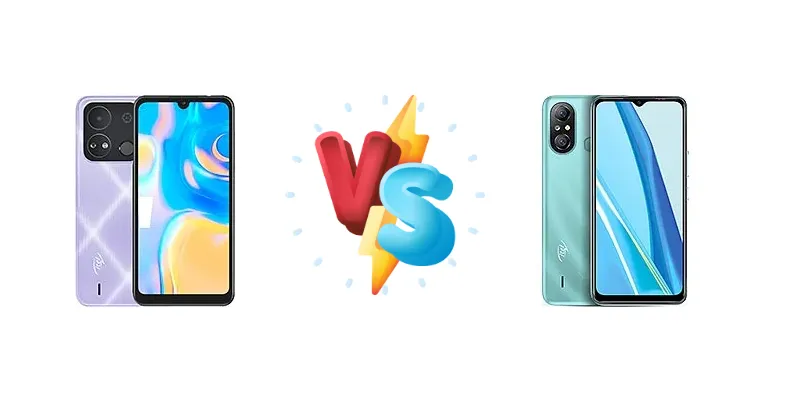
The itel A04 and A49 represent the extreme end of the smartphone price spectrum. Both aim to deliver basic smartphone functionality at an incredibly low cost. However, a key difference emerges with the A49’s inclusion of a Unisoc chipset, while the A04’s specifications remain largely unknown, making a direct comparison a challenge focused on understanding the implications of that core hardware difference.
🏆 Quick Verdict
For the average user prioritizing even a minimal level of responsiveness for apps and multitasking, the itel A49 is the better choice. Its Unisoc SC9832E chipset provides a tangible performance advantage over the likely even more basic hardware within the A04, despite both phones being firmly in the entry-level category.
| Network |
|---|
| 2G bands | GSM 850 / 900 / 1800 / 1900 | GSM 850 / 900 / 1800 / 1900 |
| 3G bands | HSDPA 850 / 900 / 2100 | HSDPA 850 / 900 / 2100 |
| 4G bands | LTE | LTE |
| Speed | HSPA, LTE | HSPA, LTE |
| Technology | GSM / HSPA / LTE | GSM / HSPA / LTE |
| Launch |
|---|
| Announced | 2023 | 2022 |
| Status | Available. Released 2023 | Available. Released 2022 |
| Body |
|---|
| Dimensions | - | - |
| SIM | Dual SIM | Dual SIM |
| Weight | - | - |
| Display |
|---|
| Resolution | 480 x 960 pixels, 18:9 ratio (~170 ppi density) | 720 x 1600 pixels, 20:9 ratio (~266 ppi density) |
| Size | 6.3 inches, 102.4 cm2 | 6.6 inches, 105.2 cm2 |
| Type | IPS LCD | IPS LCD |
| Platform |
|---|
| CPU | - | Quad-core 1.4 GHz |
| Chipset | - | Unisoc SC9832E (28 nm) |
| GPU | - | Mali-T820 MP1 |
| OS | Android (Go edition) | Android 11 (Go edition) |
| Memory |
|---|
| Card slot | microSDXC | microSDXC |
| Internal | 32GB 2GB RAM | 32GB 2GB RAM |
| Main Camera |
|---|
| Features | LED flash | LED flash |
| Single | 5 MP (wide)
Auxiliary lens | 5 MP |
| Video | Yes | Yes |
| Selfie camera |
|---|
| Single | 5 MP | 5 MP |
| Video | Yes | Yes |
| Sound |
|---|
| 35mm jack | Yes | Yes |
| Loudspeaker | Yes | Yes |
| Comms |
|---|
| Bluetooth | Yes | Yes |
| NFC | No | No |
| Positioning | GPS | GPS |
| Radio | Unspecified | Unspecified |
| USB | microUSB | microUSB |
| WLAN | Yes | Yes |
| Features |
|---|
| Sensors | Fingerprint (rear-mounted), accelerometer | Fingerprint (rear-mounted), accelerometer |
| Battery |
|---|
| Type | 4000 mAh | 4000 mAh |
| Misc |
|---|
| Colors | Lake Cyan, Violet, Sandstone Black | Blue |
| Price | About 50 EUR | - |
itel A04
- Likely the most affordable option
- Suitable for basic calling and texting
- Simple and easy to use
- Significantly lower performance
- Limited functionality
- Poor camera quality (likely)
itel A49
- Better performance with Unisoc SC9832E
- More responsive user experience
- Slightly improved camera processing
- Still limited in overall capabilities
- Low-resolution display
- Slow charging speeds
Display Comparison
Without specific display details for the itel A04, a comparison is limited. The itel A49 likely features a standard LCD panel common in this price bracket. Both devices will likely have resolutions around 720x1440 pixels. The absence of any mention of features like high refresh rates or improved color accuracy suggests both displays prioritize cost over visual fidelity. Users should expect limited viewing angles and moderate brightness levels on both.
Camera Comparison
Given the price point, camera performance will be limited on both devices. It's highly probable both phones feature a primary camera with a low megapixel count (likely 5MP or 8MP) and a secondary depth sensor. The A49 may have a slight advantage due to the processing capabilities of the Unisoc chipset, allowing for basic image enhancements. However, users should not expect high-quality photos or videos from either device. Any additional camera sensors on either phone (like a 2MP macro) are unlikely to provide significant value.
Performance
The core differentiator lies in the chipset. The itel A49’s Unisoc SC9832E, fabricated on a 28nm process, features a quad-core CPU clocked at 1.4 GHz. This provides a baseline level of processing power for essential tasks. The itel A04, lacking published specs, likely utilizes an even less powerful chipset, potentially a MediaTek or Unisoc entry-level solution. The 28nm node of the SC9832E, while not cutting-edge, is a step up from potentially older, less efficient nodes that might be found in the A04. This translates to slightly better performance and potentially improved battery life under load for the A49. The A49 will be noticeably more responsive when launching apps or switching between them.
Battery Life
Battery capacity is a critical factor in this segment. While specific capacities are unknown for both devices, it's reasonable to assume both will feature batteries in the 3000-4000 mAh range. The Unisoc SC9832E in the A49, being a more efficient chipset, may contribute to slightly longer battery life compared to the A04, especially during moderate usage. Charging speeds are likely to be slow on both, utilizing Micro-USB connectivity and limited wattage adapters.
Buying Guide
Buy the itel A04 if you absolutely need the lowest possible price and only intend to use the phone for basic calling and texting. It's likely suited for first-time smartphone users or as a temporary device. Buy the itel A49 if you want a slightly more capable device for light social media browsing, basic app usage, and occasional photography, benefiting from the performance boost offered by the Unisoc SC9832E.
Frequently Asked Questions
❓ Will the itel A49 handle popular social media apps like WhatsApp and Facebook smoothly?
The Unisoc SC9832E chipset in the A49 should provide a reasonably smooth experience for basic usage of WhatsApp and Facebook. However, expect some lag when loading images or videos, and avoid running multiple apps simultaneously. The A04 will likely struggle more with these tasks.
❓ Is the itel A49 a good choice for playing mobile games?
Neither the A49 nor the A04 are suitable for demanding mobile games. The Unisoc SC9832E can handle very basic 2D games, but expect low frame rates and significant lag in more graphically intensive titles. The A04 will be even less capable.
❓ What type of charging port do these phones use?
Both the itel A04 and A49 are expected to use a Micro-USB port for charging. Charging speeds will be slow, and it will take several hours to fully charge the battery.
❓ How much storage do these phones typically offer, and can it be expanded?
Both phones likely come with limited internal storage (around 16GB or 32GB). Fortunately, both typically support microSD card expansion, allowing you to add more storage for photos, videos, and apps.